


Introduction
If your content is ranking but rarely getting cited in Google AI Overviews, look at how well each page answers the exact information needed behind the query.
To rank in AI Overviews, your page needs to give Google a specific, well-supported answer it can retrieve and use in its response. That may mean strengthening one section rather than rewriting the entire page.
This guide shows you how to identify those opportunities, improve pages with citation potential, and prioritize the changes most likely to help. You’ll also learn how Google selects sources and how to measure visibility without relying on one-off citation checks.
How does Google select sources for AI Overviews?
Google selects sources for AI Overviews based on how well a page can support the answer it is generating, not simply where that page ranks organically. It interprets the query, retrieves relevant content, and may use query fan-out to find supporting information across related searches.
Your page can be cited for one useful part of the answer. That is why AI Overview citations and organic rankings should be tracked separately.
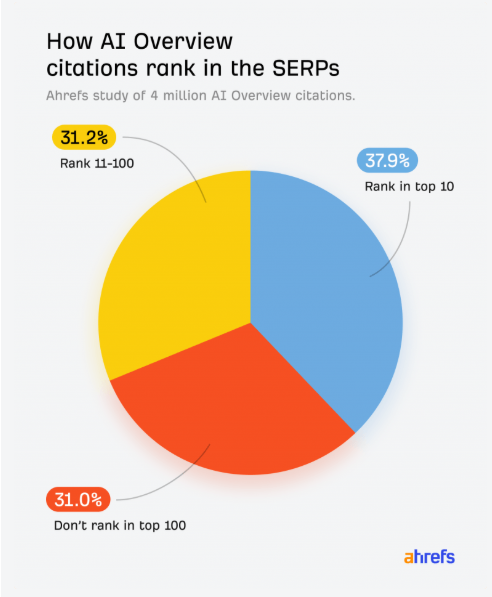
A top-ten ranking can improve your chances, but it is not a requirement. Ahrefs’ 2026 analysis of 4 million AI Overview citations found that 37.1% of cited URLs ranked in the top 10 for the same query.
To understand citation opportunities, study what Google is already surfacing. We review live SERPs, People Also Ask questions, competing pages, content formats, and existing AI Overviews to identify gaps and improve content briefs. These patterns inform editorial decisions, but they do not reveal Google’s internal selection process.
How can you improve your chances of ranking in AI Overviews?
To rank in AI Overviews, create content that directly answers your buyers’ questions with relevant information, clear explanations, and credible evidence. Start by understanding search intent, then improve or create pages that provide the most useful answer for that query.
1. Target relevant queries and match search intent
Target queries that reflect how your buyers research a problem, evaluate options, and make decisions. Use ICP pain points, use cases, buying roles, funnel stages, and customer language to build that list, then validate demand with search data.
Through our answer engine optimization services, we manually review SERPs and group target queries based on current AI Overview visibility:
- Overview present and cited: protect and improve.
- Overview present but uncited: identify what your page is missing.
- No overview observed: optimize for buyer intent and monitor.
For queries with an AI Overview, review the cited pages and note what each contributes. Use those patterns to spot answer gaps your page can fill.
Prioritize by buyer relevance, page fit, and effort. Improve pages that already match intent, create new content for distinct needs, and skip low-value queries.
2. Check technical eligibility, structured data, and page experience
Google’s current AI search guidance reinforces the same SEO foundations: your page should be crawlable, indexable, and eligible to appear in Search.
Check technical eligibility first:
- Indexing and canonical consistency
- Googlebot access and rendered main content
- Snippet eligibility
- Internal discoverability
- Search Console’s generative AI inclusion controls
Our publishing QA checks headings, metadata, internal links, image alt text, CTAs, and live previews before a page goes live. Deeper crawl, rendering, and performance issues sit with technical SEO.
Use standard structured data only when it matches visible content. Google does not require special “AEO schema” or AI-specific text files. Then review usability: mobile readability, page performance, intrusive elements, and accessible tables.
3. Demonstrate expertise with original evidence
AI Overviews need information worth citing. Make each important claim relevant, specific, verifiable, and backed by something the reader cannot get from a generic summary.
Strengthen your content with:
- Named author or SME input
- Original product or customer data
- Implementation lessons and examples
- Reliable external research
- Statistics with sample, period, methodology, and scope
In our content production workflow, AI-assisted drafts go through human rewriting, source checks, originality review, SEO review, and senior-editor approval. Tools such as Clearscope or Frase help assess coverage, but their scores are not Google ranking signals.
If a claim feels generic, add a source, example, explanation, or limitation before publishing.
4. Structure content around clear, direct answers
Answer the core question early, then add evidence, context, exceptions, and next steps. Match the format to the task:
- Definitions for concepts
- Steps for processes
- Tables for comparisons
- FAQs for follow-up questions
Our briefs map headings to search intent and reader journey before drafting. Editors then tighten structure, factual context, readability, and supporting visuals.
For Everstage, we reworked pages around answer-first sections and clearer content structure. After those changes, multiple pages started appearing in Google AI Overviews, giving the brand stronger visibility across relevant search journeys.
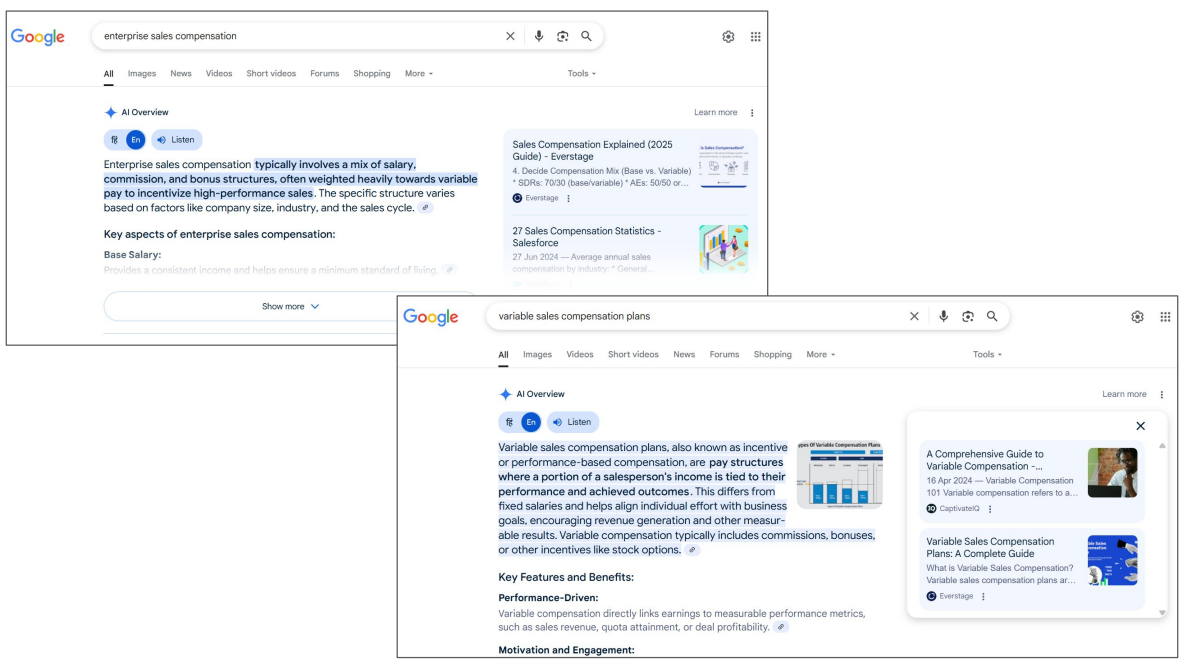
Keep answers concise, but do not force a fixed word count. Use visuals where they clarify the point, while keeping essential information in the text.
5. Build topical authority through connected content
Topical authority comes from covering related buyer questions with distinct, connected pages. A strong SaaS SEO strategy connects broad explanations with use cases, comparisons, and implementation content through contextual internal links.
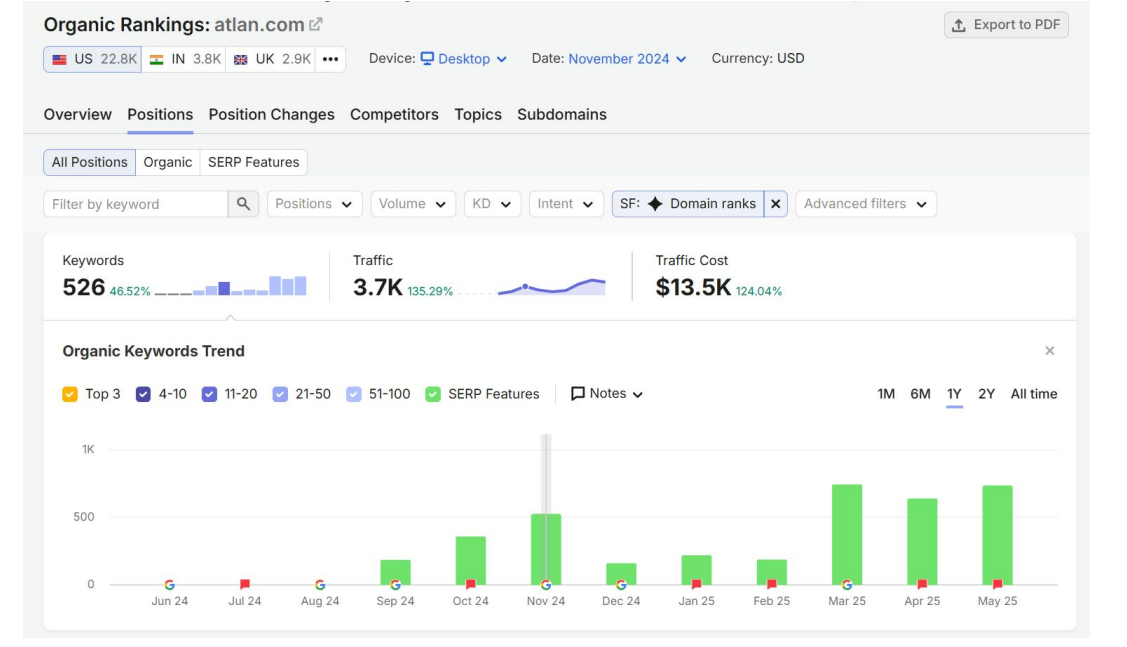
For Atlan, monthly organic traffic increased from 53,802 to 103,705, while top-three keyword rankings grew from 778 to 1,687. We supported this by connecting a core data-catalog page with related data-management and comparison content.
Use your content map to:
- Expand pages that already fit the intent
- Create resources for distinct questions
- Consolidate overlapping pages
- Retire weak or redundant content
Plan contextual links during outlining and review their relevance again before publishing.
6. Earn relevant backlinks and third-party brand mentions
Backlinks, brand mentions, and AI citations are separate outcomes, but credible third-party references can strengthen your authority around a topic. Prioritize sources your buyers already trust, and focus on contributions backed by original research, expert commentary, customer evidence, or genuinely useful resources.
As part of our contextual authority approach, we focus on earning relevant mentions and backlinks from sources that matter to the buyer. Evaluate each opportunity by audience fit, editorial quality, and contribution strength. Strong editorial backlinks come from useful contributions, and no single link or mention guarantees an AI Overview citation.
7. Keep content accurate and adapt to search changes
Refresh content when product details, evidence, buyer questions, search intent, or citation patterns change. Don’t react to a single missed citation. Look for repeated shifts, then review the cited sources, answer quality, and page performance together.
We benchmark pages against target queries, competing results, and conversion goals, while sales and client feedback informs revisions. Tracking emerging AEO trends also helps identify changes worth acting on.
During refreshes:
- Remove unsupported or repetitive content
- Fix intent and answer gaps
- Check technical issues
- Test updates before scaling them
How do you put AI Overview optimization into practice?
Start with a small set of high-priority pages and record their current rankings, AI Overview appearances, and citations. That baseline gives you something concrete to compare after changes.
Our AI-assisted SEO workflow uses AI where it speeds up research and drafting, while people own research judgment, source verification, editing, and approval.
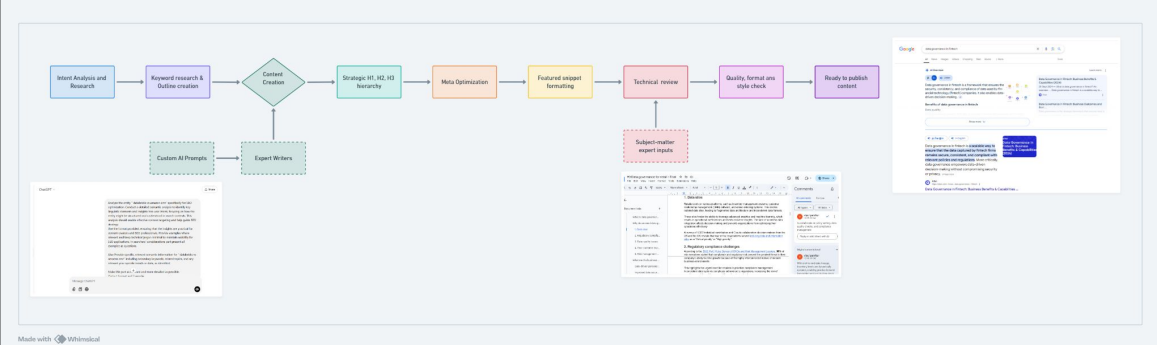
The workflow moves each page through a clear sequence:
Client feedback is incorporated before final publishing, and tools can vary by project. The broader AEO implementation framework follows the same principle: establish a baseline, make controlled improvements, and review what changed.
How do you measure AI Overview visibility and results?
Measure AI Overview performance in layers. A citation shows observed visibility; impressions show Google generative-search exposure; site activity shows what visitors did; pipeline shows whether that attention contributed to qualified demand.
Google’s generative AI reporting currently combines AI Overviews and AI Mode, so don’t label those impressions as AI Overview-only results. Keep ChatGPT and Perplexity referrals separate.
Consistent AEO tracking tools make it easier to monitor the same query set and compare citation patterns over time.
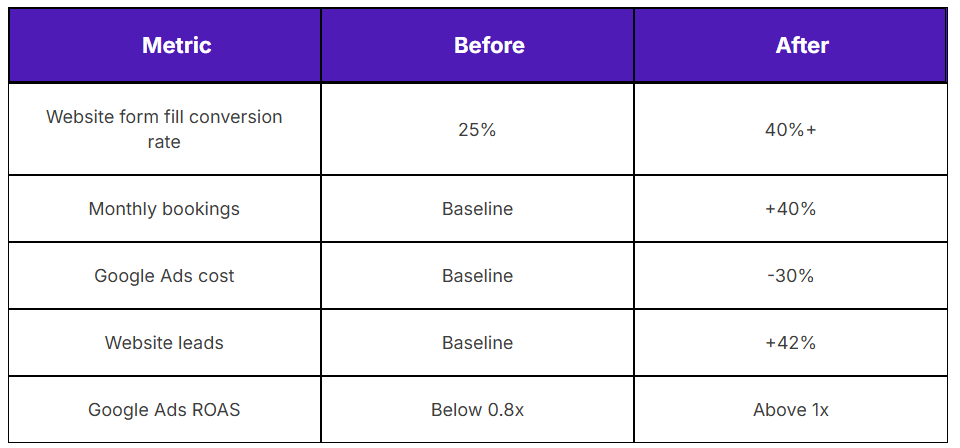
We also connect visibility with lead routing and CRM reporting. For LeadSquared, improvements to forms, enrichment, CTAs, and routing contributed to 40% more bookings from August 2022 to June 2024. That was a conversion outcome, not an AI Overview result.
Make AI Overview optimization part of your SEO workflow
If you want to improve how to rank in AI Overviews, start with a focused set of pages. Document current visibility, then identify the most important issue holding each page back and address it first.
RevvGrowth helps B2B SaaS teams turn those gaps into a practical optimization plan. We combine buyer research with editorial review, technical checks, publishing QA, and ongoing measurement. With our AEO service, you’ll get a clear view of which pages need attention first and what should change on each one.
Book a strategy call with RevvGrowth to find out what’s limiting your AI Overview visibility and where to focus first.
.svg)


.webp)
.avif)