


TL;DR
- Perplexity works differently from Google. There is no traditional ranking position, so visibility depends on whether your brand and content are mentioned or recommended in relevant answers
- To improve visibility, understand your buyers' questions, study the sources Perplexity already cites, and create credible, answer-focused content
- Strong evidence, clear entity signals, accessible pages, and relevant third-party sources can increase the chances of your content being retrieved and cited
- Measure visibility through prompts, citations, brand mentions, competitor share of voice, referral traffic, and pipeline, not a single ranking metric
Introduction
You want your brand to show up when buyers ask Perplexity AI about your category. But no matter what you publish, Perplexity keeps citing your competitors instead. Or it mentions your brand and links to a third-party review, not your website.
Figuring out how to rank on Perplexity AI starts with understanding that it does not work like traditional search. It does not crawl and rank pages. It retrieves sources in real time and decides which pages deserve a citation. Getting visible here requires understanding a different set of mechanics.
This guide shows you how Perplexity uses retrieval-augmented generation (RAG), which signals influence source selection, how to optimize your content for citations, and how to measure visibility.
How does Perplexity AI find and rank content?
Perplexity does not return a list of links like traditional search. It generates a direct answer and cites the sources it draws from.
For your brand, this means one thing: when a prospect searches for a query related to your category, your website should show up as a cited source in that answer.
For example, when someone searches "top AI marketing agency" on Perplexity, RevvGrowth appears among the cited sources. That is the kind of visibility your brand needs for the queries your buyers are asking.
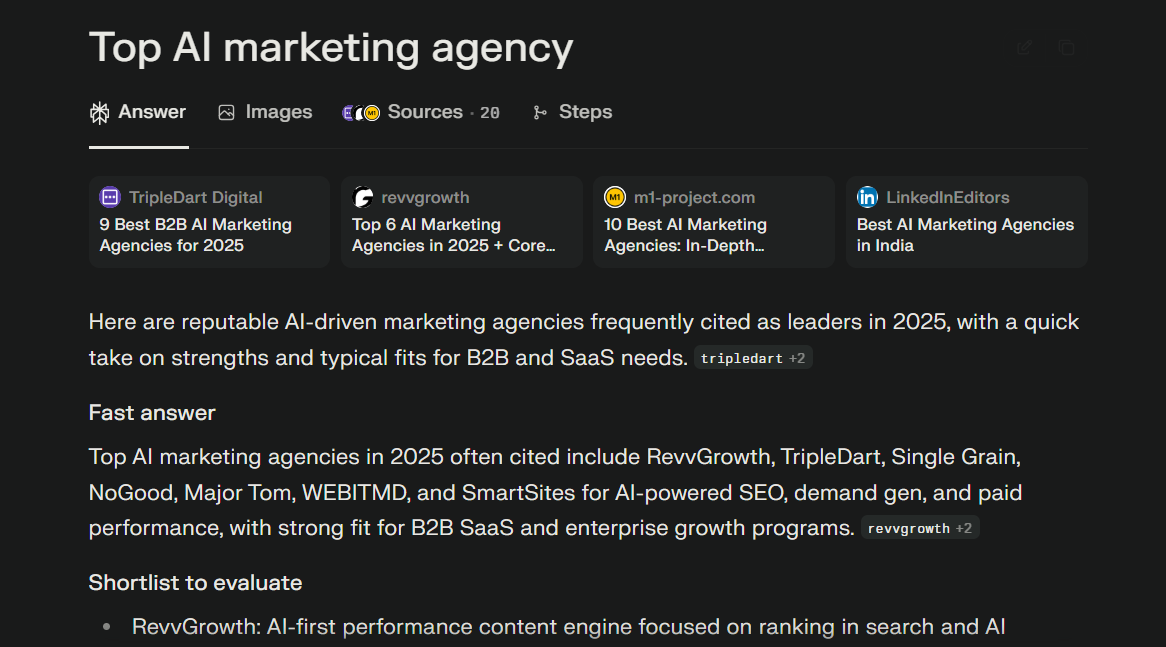
Snapshot of Revv Growth’s blog posts getting cited and mentioned in Perplexity AI
The sections below break down how Perplexity retrieves, evaluates, and selects sources for its answers.
How Perplexity uses Retrieval-Augmented Generation (RAG)?
Perplexity combines web retrieval with AI-generated responses to answer queries using current information from external sources. In simple terms, the process looks like this:
Your query → Query understanding → Web retrieval → Relevant sources → Answer generation → Citations
Here’s what happens at each stage:
Query understanding and routing
Perplexity first interprets your query to understand what information you need. Depending on the query and search mode, it can determine how much research the question requires and which model or search approach to use.
Retrieval
Perplexity then searches the web and retrieves information from sources relevant to your query. Its current product documentation describes this as real-time web search, with answers grounded in sources from the live web.
Grounded generation
Perplexity uses the retrieved information to synthesize an answer and connect its claims to source citations. The citations let users trace the response back to the underlying sources.
How Perplexity selects and cites sources?
When Perplexity builds an answer, it pulls from sources that help address the user's specific question. The exact ranking and citation system is proprietary, but several signals consistently emerge from Perplexity's documented behavior and observed patterns in AI search.
Here is a breakdown of the key factors and what they mean for your content:
How to rank on Perplexity AI: 8 practical strategies
Perplexity processed approximately 780 million queries in May 2025, with usage growing more than 20% month over month at the time. For brands, that creates a growing opportunity to appear when buyers research questions, products, and solutions.
The eight strategies below can help you build a more focused AEO strategy framework for improving visibility on Perplexity.
1. Audit your existing Perplexity visibility
Before you optimize for Perplexity, find out how your brand currently shows up.
Test a representative set of queries around your category, products, competitors, and key use cases. For each query, record:
- Whether your brand appears as a citation, mention, or not at all
- Which URL Perplexity cites, if any
- Which competitors or third-party sources appear
- The date and Perplexity mode you tested
- Whether the result changes when you repeat the query
Also separate brand visibility from owned-content visibility. Perplexity may mention your company because of a review, Reddit discussion or another third-party source without citing your website.
This tells you whether you need to improve your content, your broader online presence, or both.
2. Map the prompts your buyers actually use
Your buyers will use different prompts depending on where they are in the buying journey. Build your prompt set around different search intents:
- Problem: How do I improve sales compensation management?
- Category: What is sales compensation software?
- Comparison: Sales compensation software vs. spreadsheets
- Vendor: What are the best sales compensation platforms?
- Alternative: Alternatives to [competitor]
- Use case: How can I automate commission calculations?
Then map each prompt to the page you want Perplexity to cite. A category prompt may need an educational article, while a vendor or comparison prompt may need a product or comparison page.
At Revv Growth, we map the Perplexity prompts we track for our clients to ICP, buyer intent and journey, business objectives, and funnel stage. This helps us focus on the questions that matter at each stage and identify which pages should ideally earn those citations.
3. Study the sources Perplexity already cites
Next, study the sources Perplexity already uses for your target prompts.
Look at:
- What they answer: Which part of the query does the source address?
- Information depth: Does it define, compare, explain, or provide data?
- Source type: Is it a vendor, research report, publication, or community source?
- Content format: Does it use answer blocks, tables, original data, or examples?
- Citation patterns: Do the same pages or domains appear repeatedly?
This can help you identify what makes a page useful to Perplexity beyond simply matching the topic. If three competitors repeatedly appear for a category query, compare what each source contributes to the answer and where your content falls short.
For our clients’ AEO services, the analysis starts with the sources appearing in their target answers. We look for recurring pages, domains, content formats, and information gaps. With these insights, we decide whether existing content needs improvement or where a new page could create a stronger citation opportunity.
4. Optimize answer passages for retrieval and citation
After identifying the prompts and sources you want to compete with, make the relevant answers easy to find.
You can start important sections with a clear answer, then add the explanation, step-by-step process, examples, and nuances.
Adapt the structure to the query:
- Definition: Give the meaning first, then explain it
- Comparison: State the key difference in a table before expanding on it
- List: Surface the options and their distinguishing factors upfront
- Process: Show the steps before explaining each one
- Data-led question: Lead with the finding, number, or date before adding context
We used a similar approach for one of our clients, Everstage, while scaling its content library. The glossary grew from roughly 20 pages to 400+ answer-ready pages, including 40–60-word answer blocks designed for extraction.
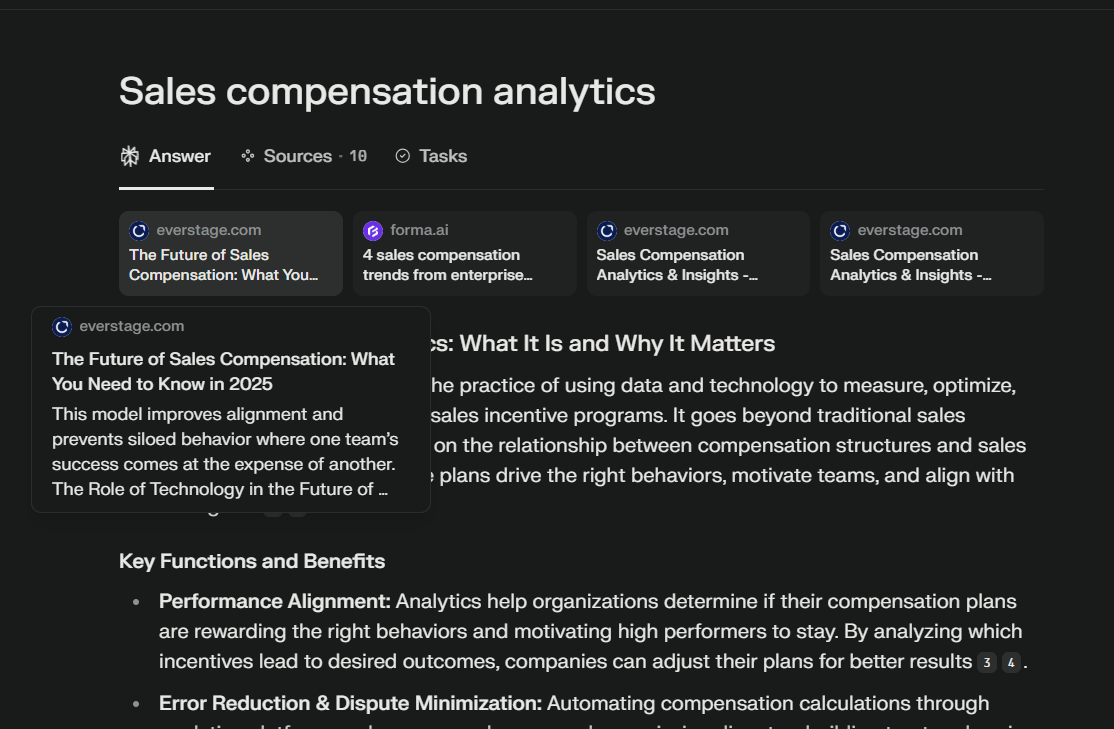
Snapshot of Everstage blog posts mentioned in Perplexity answers after working with Revv Growth
Within weeks of publishing, the content began receiving citations from Perplexity, and the result came from the broader AEO and content program.
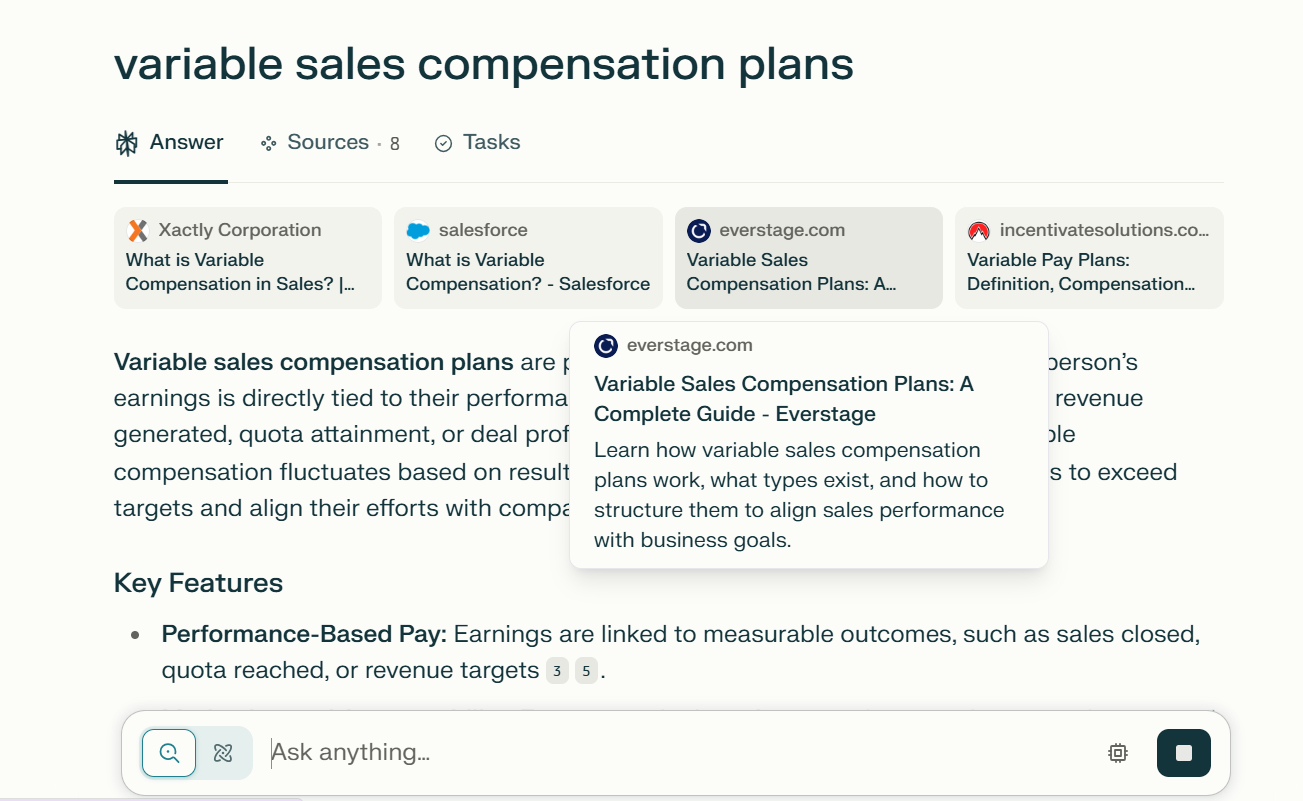
Snapshot of Everstage blog posts getting mentioned in Perplexity after working with Revv Growth
5. Strengthen your evidence and entity signals
Your own website still matters in AI visibility. Yext’s research analyzed 6.8 million AI citations across ChatGPT, Gemini, and Perplexity and found that 86% of citations came from sources brands could control or influence, including websites, listings, and reviews. Moreover, first-party websites alone accounted for 44% of citations.
For B2B SaaS brands, this puts greater emphasis on the information you publish and maintain on your own website. You must give Perplexity enough context to understand why the information is credible.
Support important details with:
- First-party data
- Original research
- Internal and external expert perspectives
- Industry evidence
- Case studies
- Credible external sources
We make these connections explicit when optimizing content for our clients. Our writers and editors incorporate product information, use cases, customer examples, and supporting evidence where they strengthen the page's answer to a specific query.
6. Check that Perplexity can access your content
Even strong content has limited visibility if Perplexity cannot reliably access or process the page.
Check for:
- Crawlability: Important pages should not be blocked from crawlers
- Indexability: Check for noindex, canonicalization issues, or other directives affecting discovery
- Rendering: Make sure the main content is available when the page loads
- Content accessibility: Keep important answers in accessible page content
- Canonicalization: Ensure the version you want indexed is clearly established
- Internal links: Connect related pages so important content is not isolated
- Page stability: Check for redirects, server errors, or intermittent access problems
If a page should answer a target prompt but does not appear, rule out access issues before rewriting the content.
7. Build external corroboration around your brand
Your website is not the only source Perplexity can use to understand your brand or category. Third-party sources can add context through reviews, community discussions, research, publications, and authoritative references.
Reddit is particularly relevant here. In Profound's analysis of 680 million citations across AI platforms from August 2024 to June 2025, Reddit represented 6.6% of Perplexity's citations in its dataset. Among Perplexity's top 10 cited domains, Reddit accounted for 46.7% of citation share.
Look for relevant discussions where your expertise genuinely fits and contribute useful information rather than forcing a brand mention.
For technical, scientific, or definitional topics, academic and institutional publications (.edu), government resources (.gov), industry research, and authoritative references can also provide useful context.
8. Track citations and business outcomes
Perplexity visibility can change quickly. In a six-week study by Digital Authority Partners, 66% of URLs cited in the first week were no longer cited by week four. The study tracked the same 30 queries across five AI platforms, including Perplexity.
That is why a one-time LLM content readiness audit is not enough. Track the same prompts consistently so you can see which pages gain, lose, or maintain visibility and connect citation data to actual business outcomes.
Perplexity optimization implementation table
Once you know which prompts and pages need attention, the next step is turning those findings into work your team can actually execute. Use the framework below to assign each activity and define what improvement should look like.
How to measure Perplexity visibility
Perplexity visibility can't be reduced to a single position number like traditional Google rankings. Because your brand can be cited or recommended across different prompts, you need to measure how often you appear and whether that visibility reaches your pipeline.
1. Track citation frequency
Measure how often your domain or specific pages are cited across a consistent set of target prompts.
For example, if your content is cited for 8 of 30 priority prompts this month, you have a baseline to compare against after optimization.
Keep your prompt set, testing conditions, and recording method consistent. Otherwise, changes in results may reflect different searches rather than changes in visibility.
2. Measure prompt-level visibility
Look at visibility prompt by prompt, rather than combining everything into one score.
A useful tracking sheet can distinguish between:
- Mentioned: Your brand appears in the answer
- Cited: Your website or another owned page is used as a source
- Included: Your brand appears among the options or sources presented
- Recommended: Perplexity actively suggests your product or solution
For Atlan, one of our clients, we worked on improving and tracking its AI visibility, which resulted in 6,500+ AI domain citations and increased monthly MQLs from 120 to 150.
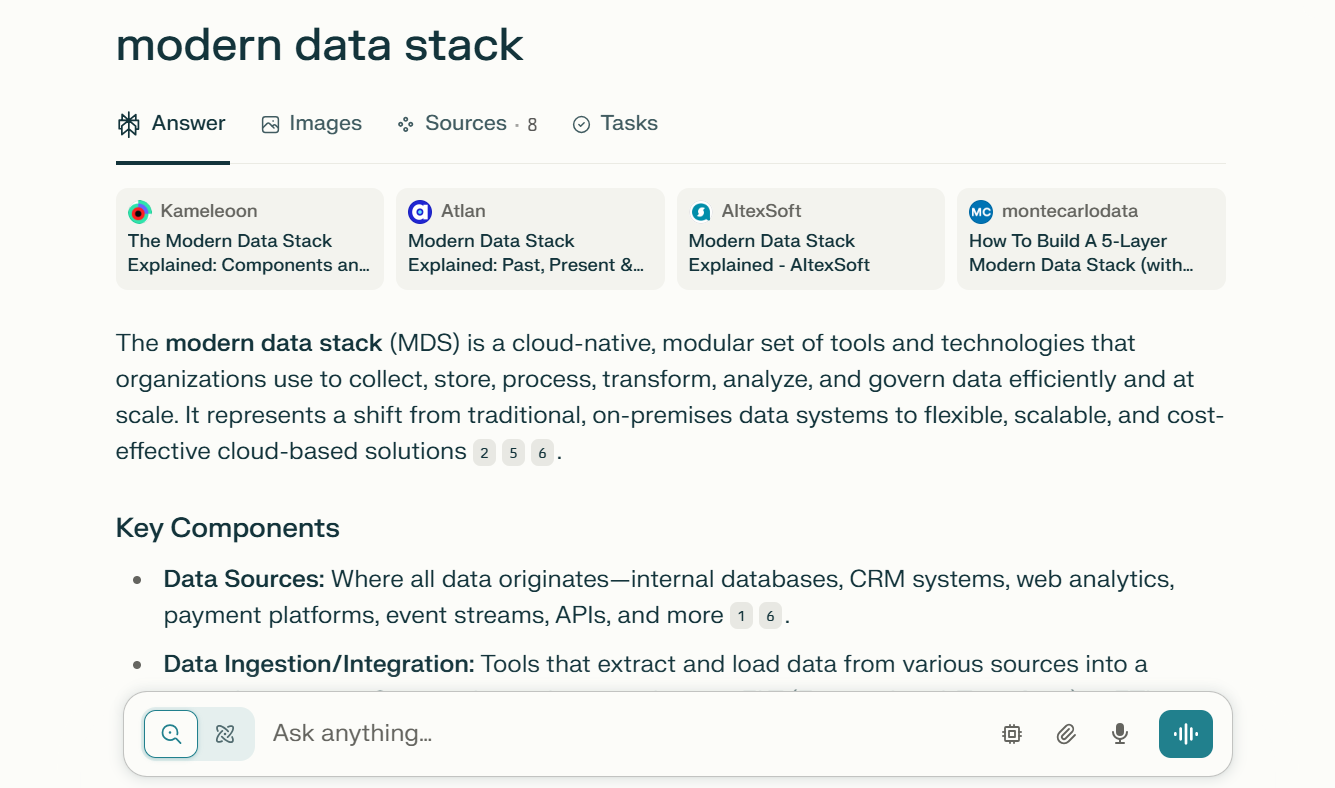
Snapshot of Atlan blogs cited in Perplexity answers for the relevant keyword
3. Monitor which sources Perplexity uses
Track the specific URLs Perplexity retrieves and group those URLs by content type, such as:
- Blog and educational content
- Product or service pages
- Original research and reports
- Comparison and alternatives pages
- Third-party publications and community sources
Look for recurring patterns. If certain page types consistently earn citations, you can identify which content assets contribute most to your AI visibility and where new or stronger sources are needed.
4. Track brand mentions separately
Your brand can appear in a Perplexity answer without your website being the cited source. For example, Perplexity might mention your company based on information from a review site or community discussion.
Track these mentions separately from website citations. This distinction becomes particularly useful for commercial and recommendation prompts, where brand awareness and source ownership are two different visibility outcomes.
5. Measure Perplexity referral sessions
Use your analytics platform to measure what happens after someone clicks through from Perplexity.
Track:
- Referral sessions originating from Perplexity
- Landing pages
- Engagement after the visit
- Conversion rate
Don't judge performance by traffic volume alone. A smaller number of highly relevant visitors can be more valuable than a larger spike with little engagement or conversion activity.
For another client, OvalEdge, LLM referral sessions increased 178% to 278 per month, while the program also generated 138 leads in a single month.
6. Connect AI visibility to conversions and pipeline
The final layer is connecting Perplexity visibility to business outcomes.
Where your attribution setup allows it, track whether Perplexity-referred visitors contribute to:
- Demo requests
- Free trial sign-ups
- MQLs
- SQLs
- Opportunities
- Influenced pipeline
This helps you move from reporting AI visibility as a standalone metric to understanding whether it contributes to revenue.
At Revv Growth, we use the GEO measurement strategy framework to connect AI visibility with the outcomes that matter to each client. We look beyond citations to understand how visibility, referral traffic, and conversions connect across the funnel.
7. Compare your share of voice with competitors
Run the same controlled prompt set for your brand and your key competitors, then calculate how frequently each appears.
For example:
- AI share of voice = Your brand's qualifying appearances ÷ Total qualifying brand appearances across the tracked prompts × 100
Over time, this gives you a clearer picture of whether you're gaining or losing visibility across the prompts that matter to your audience, rather than relying on an isolated citation or search result.
Turn Perplexity visibility into a repeatable growth channel
Perplexity visibility comes from consistently answering buyer questions with credible, accessible content that AI engines can retrieve and cite.
The bigger opportunity is to make AI visibility part of your broader organic growth strategy. When your brand repeatedly appears in the answers your buyers rely on, those citations can strengthen brand discovery beyond traditional search results and create another path to qualified website traffic.
If you want to understand what is helping or limiting your visibility in AI search, Revv Growth's AI visibility audit can show you which prompts and pages are driving mentions, where competitors are outperforming you, and which citation gaps to prioritize next.
.svg)


.webp)
.avif)