


Introduction
You have probably already noticed that buyers who used to find you through Google now mention they "saw your name in ChatGPT" or "got it from an AI Overview." Nearly 47% of US adults used AI for local search in the past month, signaling a major shift in how consumers discover brands and businesses.
That is where an AEO audit comes in, a structured check of whether AI engines can find your content, trust it enough to cite it, and surface it ahead of competitors. Without one, you are guessing why your brand is missing from the answers your buyers are reading.
This guide walks you through an AEO checklist, the RevvGrowth audit process, and the real wins we have delivered for our clients. If you want a professional AEO audit, RevvGrowth can do that for you. We don’t just audit, we show you exactly how to improve your chances of being picked by AI answers and drive measurable search performance.
The AEO checklist: 8 things every site must pass
Before you run any audit, you need a baseline of what good looks like. This is the basic AEO checklist we use at RevvGrowth on every client engagement. Each item below is non-negotiable for any B2B SaaS site that wants to show up in AI answers.
1. Content structure and answer formatting
AI doesn’t “read”, it extracts. Your job is to make extraction effortless.
What to check :
- Answer-first formatting
- Each H2 must be followed by a direct answer in 40–60 words
- Answer must stand alone (no dependency on previous paragraphs)
- Avoid fluff like “In today’s digital world…”
- Question-driven headings
- At least 30–50% of H2s are phrased as questions
- Match real query patterns (use “how,” “what,” “why,” “best way to”)
- Mirror how users ask in AI tools (natural language, not SEO keywords)
- Snippet optimization
- First paragraph under each H2 should:
- Define
- Answer
- Summarize
- Use definition-style sentences (“AEO audit is…”)
- First paragraph under each H2 should:
- Scannability
- Paragraphs: max 3–4 lines
- Every section includes:
- Bullets OR
- Numbered steps OR
- Table
- Avoid dense narrative blocks
- Formatting for extraction
- Use:
- Lists for steps
- Tables for comparisons
- Bold for key phrases
- Avoid:
- Nested paragraphs
- Long intros before value
- Use:
- Redundancy (intentional)
- Key answers repeated in:
- Intro
- Body
- FAQ section
- AI often pulls from multiple positions
- Key answers repeated in:
2. Schema and structured data
Schema isn’t optional anymore; it’s validation for AI systems.
What to check:
- Schema coverage
- Every page must have:
- Article OR BlogPosting
- Add:
- FAQPage (for Q&A sections)
- HowTo (for step-based content)
- BreadcrumbList
- Every page must have:
- FAQ schema quality
- Minimum 3–5 Q&A pairs per page
- Questions must:
- Match real queries
- Be conversational
- Answers must be:
- Concise (40–60 words)
- Non-promotional
- Entity linking
- Use the Organization schema with:
- SameAs links (LinkedIn, G2, etc.)
- Use Person schema:
- Author name
- Job title
- Profile URL
- Use the Organization schema with:
- Schema accuracy
- No mismatched types (e.g., blog marked as product)
- No empty fields
- No duplicate schemas
- Validation
- Pass:
- Google Rich Results Test
- Schema.org validator
- No warnings on required fields
- Pass:
- Advanced signals
- Add:
- datePublished
- dateModified
- author
- publisher
- Add:
3. E-E-A-T and authority signals
AI models rank based on trust + recognition, not just content quality.
What to check:
- Author credibility
- Every blog includes:
- Real author name
- Bio (2–3 lines)
- LinkedIn profile
- The author has:
- Relevant expertise
- Consistent publishing history
- Every blog includes:
- Content credibility
- Every page includes:
- At least 2–3 external citations
- Prefer:
- Research reports
- Industry data
- Case studies
- Every page includes:
- Freshness signals
- Visible:
- “Last updated” date
- “Reviewed by” (optional but strong)
- Updates reflect:
- New stats
- Current year
- Visible:
- Brand trust assets
- Must-have pages:
- About
- Team
- Contact
- Privacy policy
- Add:
- Case studies
- Testimonials
- Logos
- Must-have pages:
- Third-party validation
- Presence on:
- G2
- Capterra
- Trustpilot
- Consistent reviews and ratings
- Presence on:
4. Entity consistency across the web
AI builds your identity from external consensus, not your homepage.
What to check:
- Positioning consistency
- Same one-line description across:
- Website
- G2
- Crunchbase
- No variation in category (e.g., “CRM” vs “data platform”)
- Same one-line description across:
- Naming consistency
- Product names:
- Identical everywhere
- No internal naming differences
- Product names:
- Founder/entity signals
- Founders:
- Have LinkedIn profiles
- Mention the company consistently
- Company linked back in bios
- Founders:
- Structured presence
- Profiles exist on:
- G2
- Capterra
- Crunchbase
- Optional but powerful:
- Wikidata entry
- Profiles exist on:
- Mentions and citations
- Brand mentioned on:
- Blogs
- Directories
- PR sites
- Anchor text includes brand name
- Brand mentioned on:
5. Technical crawlability for AI bots
If AI bots can’t access it, it doesn’t exist.
What to check:
- Bot accessibility
- robots.txt allows:
- GPTBot
- ClaudeBot
- PerplexityBot
- Google-Extended
- Bingbot
- robots.txt allows:
- Rendering
- Key pages:
- Server-side rendered OR static
- Avoid:
- Client-side-only content
- Lazy-loaded critical text
- Key pages:
- Content visibility
- No:
- Hidden tabs for core content
- Expand-to-view answers
- Everything must be:
- Immediately visible in HTML
- No:
- Performance
- Page load:
- < 2 seconds (ideal)
- Time to first byte:
- < 0.5s
- Page load:
- AI-specific files
- llms.txt implemented
- Sitemap includes:
- All important pages
- Updated regularly
- Indexing
- No accidental:
- noindex tags
- blocked directories
- No accidental:
6. Freshness and update cadence
AI prefers recent + maintained content, not just accurate content.
What to check:
- Update signals
- Every page shows:
- Last updated date
- Updates reflect:
- New stats
- New examples
- Every page shows:
- Content decay monitoring
- Identify:
- Pages losing traffic
- Pages losing rankings
- Refresh:
- Quarterly for top pages
- Identify:
- Stat freshness
- Replace:
- Stats older than 2 years
- Add:
- Current year references (2026)
- Replace:
- Link hygiene
- Run:
- Broken link audit every 90 days
- Fix:
- 404s
- Redirect chains
- Run:
- Content expansion
- Add:
- FAQs
- New sections
- Keep content evolving
- Add:
7. Internal linking for topical authority
AI understands clusters, not pages.
What to check:
- Link depth
- Every page links to:
- 3–5 related blogs
- 1–2 commercial pages
- Every page links to:
- Anchor text
- Natural language:
- “how to run an AEO audit”
- Avoid:
- “click here”
- exact-match spam
- Natural language:
- Topic clusters
- Pillar page:
- Links to all cluster pages
- Cluster pages:
- Link back to pillar
- Pillar page:
- Orphan pages
- Zero orphan pages on priority topics
- Every page:
- Connected in at least 2 directions
- Hierarchy clarity
- URL structure reflects:
- Topic grouping
- Breadcrumbs implemented
- URL structure reflects:
8. Citation tracking and measurement
If you’re not measuring AEO, you’re guessing.
What to check:
- Manual testing
- Run queries in:
- ChatGPT
- Perplexity
- Google AI Overviews
- Track:
- Whether you’re cited
- Where (top vs buried)
- Run queries in:
- Query set
- Test:
- 20–30 high-intent queries
- Include:
- “best”
- “how to”
- “what is”
- Test:
- Tracking framework
- Monitor:
- Citation frequency
- Share of voice
- Brand mentions
- Monitor:
- Tooling
- Use:
- AEO tracking tools (like Profound, Peec.ai)
- Build:
- Internal dashboards
- Use:
- Analytics
- In GA4:
- Segment AI referral traffic
- Track:
- Conversions from AI sources
- In GA4:
- Iteration loop
- Identify:
- Pages not cited
- Improve:
- Structure
- Authority
- Clarity
- Identify:
Our 8 best AEO tracking tools guide breaks down many AEO tools.
The RevvGrowth AEO audit process
If running this audit yourself feels like a 60-hour project you do not have time for, here is how we do it for clients. RevvGrowth's AEO audit process is built specifically for B2B SaaS, and it is the same process that helped Everstage rank in Google AI Overviews and get cited across ChatGPT and Perplexity. We run the audit in four phases over 2 weeks.
Phase 1: AI visibility baseline and entity audit (Days 1 to 4)
Most teams skip this phase, which is why their AEO work feels disconnected from results. We start with the truth: where you actually appear in AI answers today.
What we do:
We test 50 to 100 buyer-intent queries across ChatGPT, Perplexity, Claude, and Google AI Overviews. We document every appearance, every competitor mention, and every misrepresentation of your brand. Then we audit how your company is described across G2, Capterra, LinkedIn, Crunchbase, Wikipedia, and your top third-party mentions.
What you get:
A baseline citation report showing your AI visibility and share of voice versus competitors, a third-party entity audit showing where your brand is described inaccurately or inconsistently, and a query map showing which buyer questions matter most for your pipeline.
Why it matters:
If your entity is fragmented across the web, no amount of on-page work will fix your AI visibility. We have seen SaaS clients with technically perfect sites get zero citations because Reddit and old G2 reviews described them inaccurately. Fix the entity first.
Phase 2: Content and schema deep dive (Days 5 to 8)
This is where we look at every page that should be earning citations and figure out why it is not.
What we do:
We audit your top 30 pages against the 8-point AEO checklist. We check schema implementation, content extractability, answer placement, FAQ coverage, and internal linking. We also test each page for whether AI engines can render and read it.
What you get:
A prioritized fix list with specific changes per page, schema gaps logged with the exact code to add, and a content rewrite priority list ranked by traffic and citation potential.
Why it matters:
Most B2B SaaS sites score between 18 and 26 out of 40 on the first audit. The two areas that drag scores down are entity consistency (Phase 1) and content extractability (this phase). Fix these two, and you have already done 70% of the work.
Phase 3: Competitive citation benchmarking (Days 9 to 11)
You are not the only brand trying to get cited. We map exactly where your competitors are winning and where the category is undefended.
What we do:
We run the same 50 to 100 query set against your top 3 to 5 competitors and document every citation pattern. We identify which competitors dominate which platforms, which queries no one owns yet, and which third-party sources keep getting cited in your category.
What you get:
A simple view of where you’re winning and missing out on citations, the best untapped queries to go after first, and the key third-party platforms where you should be present.
Why it matters:
According to G2's April 2026 report, 24% of buyers turn to peer reviews when an AI chatbot conflicts with a brand they trust. If your competitors own the review platforms and communities AI engines pull from, you cannot win citations through on-page work alone.
Phase 4: 90-day roadmap and handoff (Days 12 to 14)
The last phase turns everything into a plan you can actually execute.
What we do:
We build a 90-day implementation roadmap with prioritized fixes, owners, time estimates, and expected impact. We sequence the work into 30-day sprints (foundation, content, authority) so quick wins land first.
What you get:
A complete roadmap document, a tracking dashboard for citation lift, and a kickoff call to walk your team through everything.
Why it matters:
An audit is only useful if it leads to action. We hand over the roadmap, whether you execute in-house or have us run it. A prospect was not ranking in AEO, and they wanted us to audit their website. So our team built a Claude Agent and created a skill that evaluated 600+ URLs. What came back was a detailed breakdown showing exactly which pages had issues and why did it matter. Now they could see why their blogs were not ranking. After sending the report/proposal, they wanted to get on a call to discuss strategy and how to fix it.
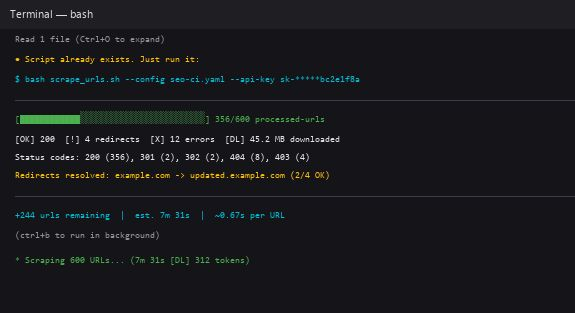
Screenshot: Claude Code automation for AEO audit
Similarly, our AEO audit framework helped deliver measurable improvements in our client’s performance.
The Everstage Case Study: How our AEO audit led to AI Overview citations
Everstage is a global sales compensation platform serving RevOps, SalesOps, and Finance leaders. They came to RevvGrowth wanting to scale content output without losing brand voice or strategic consistency.
The challenge:
Everstage had strong product traction but limited content visibility. Their blogs were not ranking for high-intent queries, were not getting cited in AI Overviews, and were not surfacing in ChatGPT or Perplexity. They needed a content engine that could produce volume without sacrificing quality.
What we did:
We ran the same 4-phase AEO audit process. The Phase 1 baseline showed almost zero AI citation presence. Phase 2 surfaced extractability issues across most blogs. Phase 3 showed competitors dominating sales compensation queries on Perplexity and ChatGPT.
We then built an AI-driven content workflow tailored to Everstage.
We designed AI prompts for every stage of content production: outlining, sourcing stats, drafting, and FAQs. Our editorial team layered in tone, original research, and survey data to keep the brand voice intact. We added schema, optimized for AI extractability, and structured every blog with answer-first formatting.
The results:
We shipped over 40 long-form blogs in 3 months. Several now rank for highly competitive queries like “sales compensation statistics” and “sales compensation plans”, terms that typically have high keyword difficulty and strong monthly search demand, dominated by established players.
Despite that, Everstage now appears in Google AI Overviews, gets cited by ChatGPT, and surfaces on Perplexity for these same queries. They went from zero presence to consistent citations in a competitive category, while scaling content output 4x without compromising quality.
Screenshot — Everstage in Google AI Overview (1 of 2)
Query: 'enterprise sales compensation' — Everstage featured as the primary cited source.
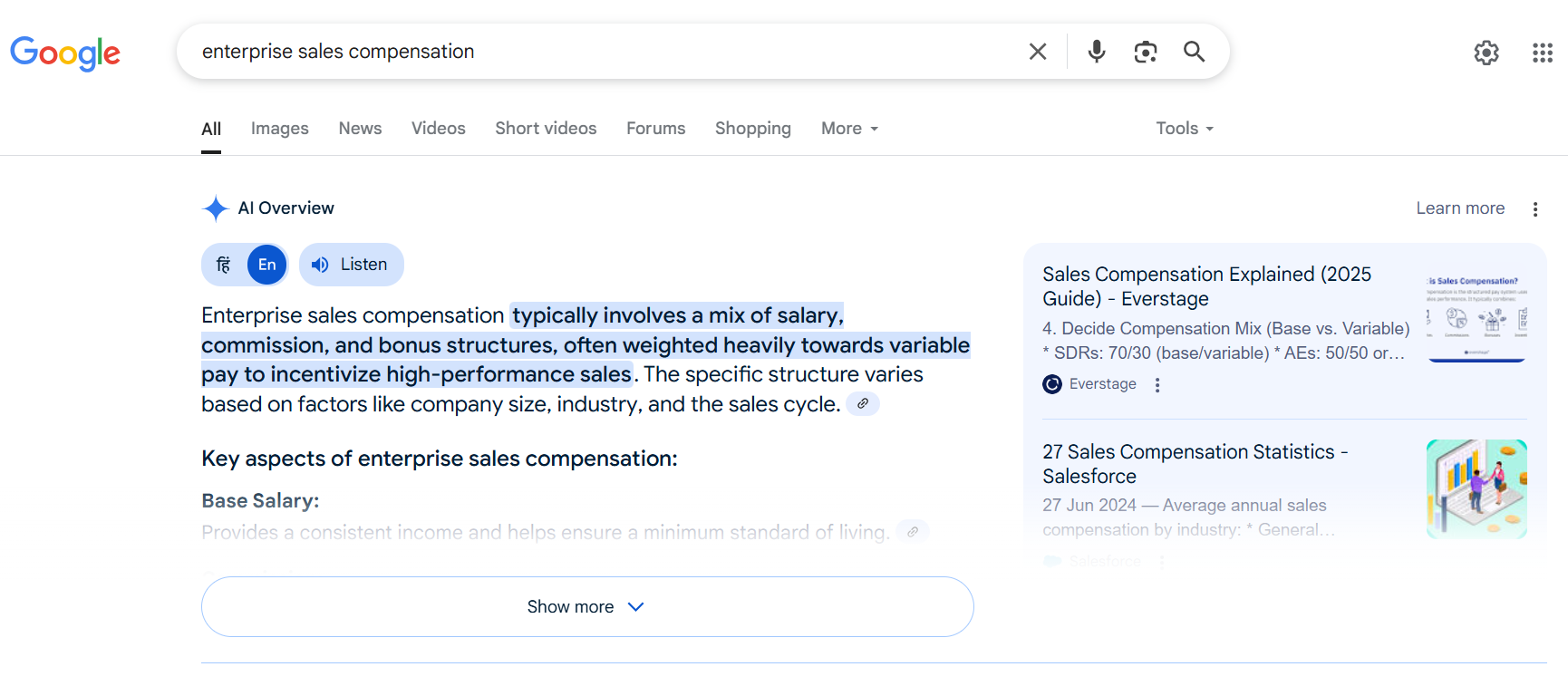
Google AI Overview: 'enterprise sales compensation' — Everstage cited
Screenshot — Everstage in Google AI Overview (2 of 2)
Query: 'sales compensation compliance' — Everstage featured in the Google AI Overview.

Google AI Overview: 'sales compensation compliance' — Everstage cited
Screenshot — Everstage in ChatGPT
Query: 'sales compensation consultants' — Everstage cited in ChatGPT 4o citations panel.

ChatGPT 4o: 'sales compensation consultants' — Everstage cited
Screenshot — Everstage in Perplexity AI
Query: 'variable sales compensation plans' — Everstage featured as a top cited source in Perplexity.

Perplexity AI: 'variable sales compensation plans' — Everstage as top cited source
Screenshot — Everstage Google Featured Snippets
Queries: 'sales compensation statistics' and 'the future of sales compensation' — Everstage owns both featured snippet positions.
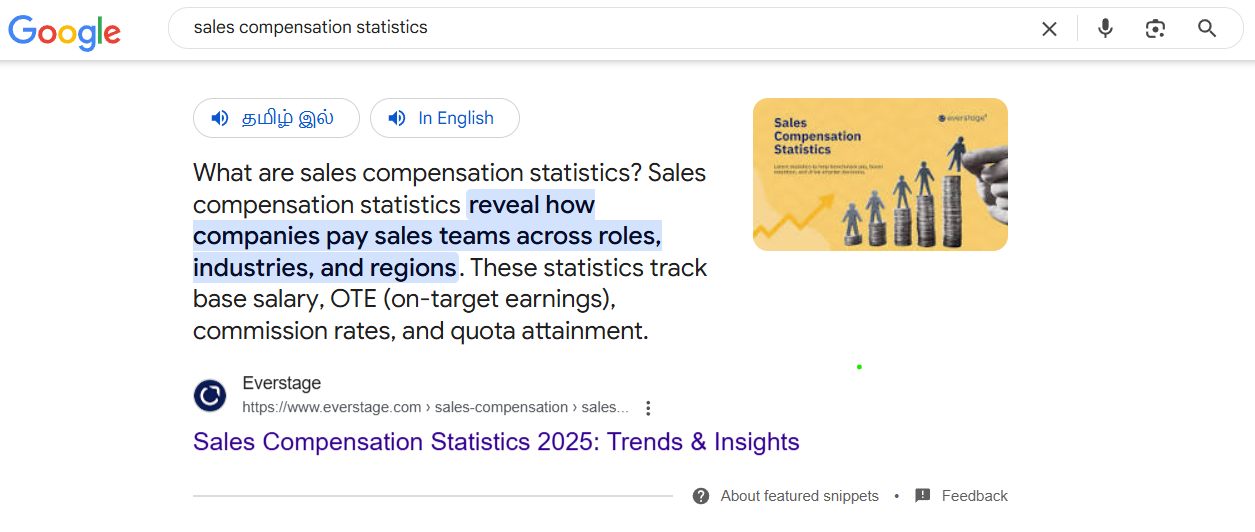
Google Featured Snippet: 'sales compensation statistics' — Everstage

Google Featured Snippet: 'the future of sales compensation' — Everstage
AEO is not a one-time fix. It is a system. The audit gave Everstage the gap map. The content workflow turned the gaps into citations. The bi-weekly performance reviews kept it compounding.
For more on how we built this content engine, see our AI marketing guide and our AI SEO strategy guide.
DIY audit vs RevvGrowth audit: what's the difference
Both can work. The right choice depends on team capacity, technical depth, and how fast you need results.
| Factor | DIY Audit | RevvGrowth Audit |
|---|---|---|
| Time investment | 40–60 hours over ~2 weeks | 0 hours from your team |
| Speed to insights | Slower, depends on internal bandwidth | Fixed turnaround (typically ~2 weeks) |
| Depth of analysis | Limited to in-house expertise | Backed by 50+ B2B SaaS audits and pattern recognition |
| Tools needed | $300–$800/month in subscriptions | Included |
| Competitive benchmarking | Manual, often skipped | Built into the audit |
| AEO / AI Overview readiness | Basic or inconsistent | Structured specifically for AI search + AEO |
| Data accuracy & validation | Depends on internal processes | Standardized audit frameworks and QA |
| Prioritization clarity | Can be unclear or scattered | Clear, ranked action plan |
| Implementation roadmap | Usually missing or high-level | Step-by-step recommendations |
| Implementation support | None | Optional 90-day execution support |
| Cross-functional alignment | Requires internal coordination | Delivered in a format ready for marketing, SEO, and content teams |
| Opportunity identification | May miss emerging trends | Includes untapped query and citation gap discovery |
| Cost structure | Lower upfront, higher hidden cost (time + tools) | Fixed investment with bundled expertise |
| Best for | Teams with senior SEO + AI search expertise in-house | SaaS teams that want clear answers and faster execution |
DIY makes sense if you have senior SEO talent who already understands AI search. If your team is splitting AEO across an SEO manager, a content lead, and a developer who all have other priorities, outsourcing the audit is faster and cheaper.(AEO Services)
Talk to RevvGrowth to scope what your audit would look like.
Key takeaways
- An AEO audit shows whether your content is visible, trusted, and actually getting cited across AI platforms like ChatGPT, Perplexity, and Google AI Overviews.
- Strong AI visibility depends on getting a few fundamentals right: how your content is structured, how it’s marked up, and how consistently your brand appears across the web.
- Most SaaS teams struggle with unclear entity signals and content that isn’t easy for AI to extract, which directly impacts citation chances.
- You can’t win citations through your website alone: review platforms, directories, and third-party mentions heavily influence how AI systems evaluate your brand.
- A structured audit approach helps turn scattered insights into a focused, prioritized action plan your team can execute.
- As seen in the Everstage case study, the right mix of audit + content improvements can move you from no visibility to consistent AI citations.
- AEO is ongoing work. Regular updates, tracking, and iteration are key to staying visible as AI search evolves.
Ready to find your AEO gaps?
If you want to see exactly where your site stands across ChatGPT, Perplexity, and Google AI Overviews, with a prioritized fix list and competitive benchmarking included, book a call with us.
We will run the audit, deliver the roadmap, and show you the queries where you should already be getting cited.
FAQs
What does a basic AEO checklist include?
A basic AEO checklist covers 8 areas: content structure, schema, E-E-A-T signals, entity consistency, technical crawlability for AI bots, content freshness, internal linking, and citation tracking. These eight together form the foundation of whether AI engines can find, understand, and cite your content.
How do I audit my website for AEO?
Start by testing 20 to 30 buyer-intent queries in ChatGPT, Perplexity, and Google AI Overviews to baseline your visibility. Then check robots.txt for AI bot access, validate schema on top 20 pages, review content extractability, audit entity consistency across G2, Capterra, and LinkedIn, and document every gap. Score each area on a 1 to 5 scale and prioritize by impact.
What is AEO readiness?
AEO readiness is how prepared your site is to be cited by AI answer engines like ChatGPT, Perplexity, and Google AI Overviews. It covers content structure, schema, authority signals, entity consistency, technical crawlability, freshness, internal linking, and tracking. Most B2B SaaS sites score between 18 and 26 out of 40 on the first audit.
What is AEO optimization?
AEO optimization is the process of improving your site so AI engines can extract, trust, and cite your content. It includes restructuring content with answer-first formatting, adding schema, fixing entity drift across third-party platforms, improving E-E-A-T signals, and setting up citation tracking. Unlike SEO, which optimizes for clicks, AEO optimizes for citations.
How long does an AEO audit take?
A manual AEO audit on a mid-sized B2B SaaS site takes 40 to 60 hours over 2 weeks if done in-house. RevvGrowth's done-for-you audit takes 10 to 14 days end-to-end and includes competitive benchmarking, an entity gap list, a content fix list, and a 90-day implementation roadmap.
How often should I run an AEO audit?
Run a full AEO audit every quarter to keep your site aligned with how AI engines evaluate and cite content. Do a lighter monthly check on your top pages to track citation changes and visibility. Focus on where you're gaining or losing presence across key queries.
.svg)


.webp)
.avif)