


Introduction
Search didn't slowly evolve. It broke.
Pew Research Center tracked 68,000 real Google searches and found that when an AI summary appeared, users clicked a traditional link only 8% of the time, compared to 15% when no summary was present. Half the clicks, gone. Not because your content got worse, but because the page changed around it.
AEO and GEO both exist to answer this problem. AEO gets you into Google's answer layer, such as People Also Ask, and AI Overviews. GEO gets you cited by AI platforms like ChatGPT and Perplexity. They're not the same thing, but most teams treat them like they are.
This blog breaks down where they actually differ, what they share, and how to build a strategy around both.
Let's start with the differences.
How Are AEO and GEO Actually Different?
Both are about visibility in AI-driven search. But they work on different platforms, respond to different signals, and need different strategies. Treating them as the same thing is why most content programs underperform on both.
Here's the quick version:
Now, the five differences are worth understanding in depth.
1. AEO Stays on Google. GEO Goes Beyond It.
AEO is a Google problem. Everything it targets, such as PAA boxes, voice search, and AI Overviews, lives inside Google's ecosystem. If you rank well and structure your content correctly, Google can extract your answer and surface it directly in the SERPs.
GEO is a different game. ChatGPT, Perplexity, Gemini, and Copilot all pull from the web independently. Ranking #1 on Google doesn't automatically get you cited in ChatGPT. These systems retrieve and evaluate content differently.
For instance, one of our blogs appeared in Google's AI Overview for the keyword "AEO Agencies USA", which showcases our AEO strategies working.
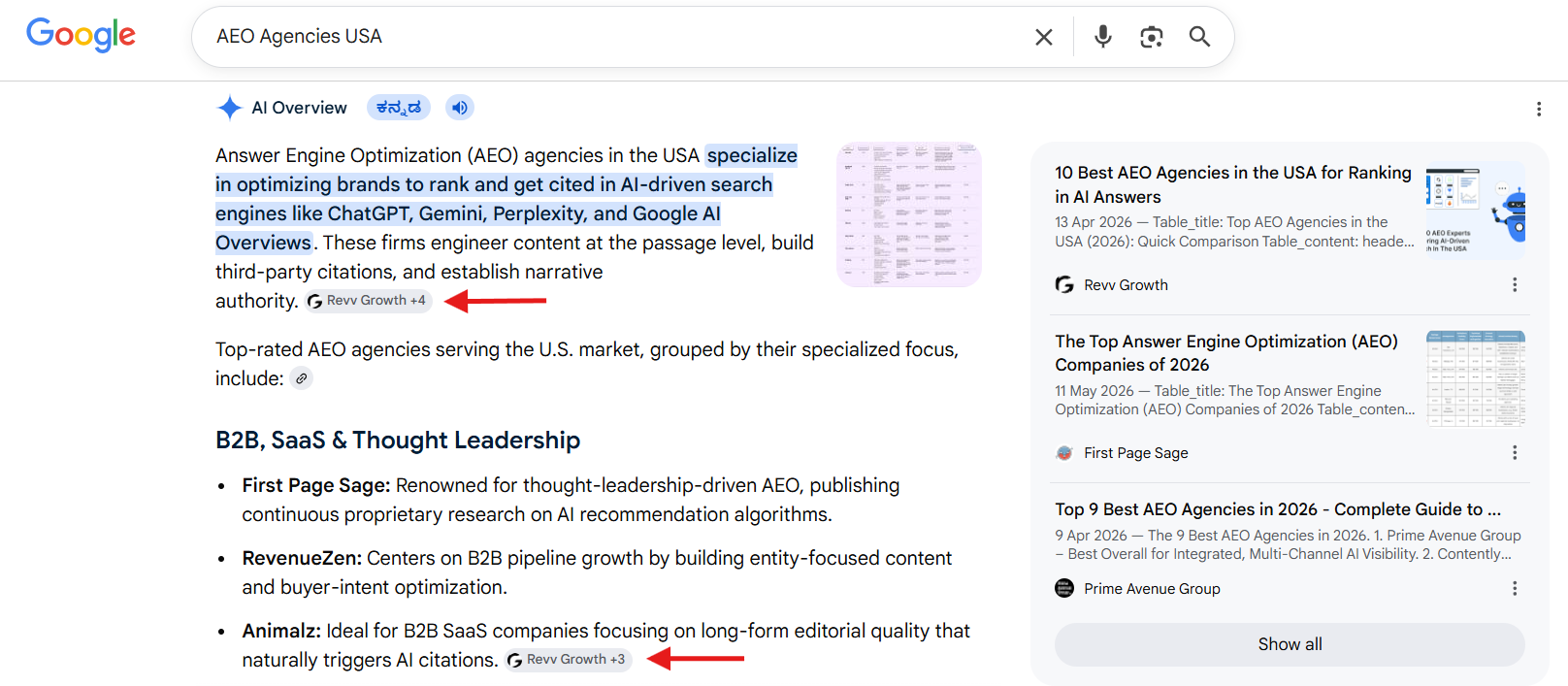
Screenshot: AEO Agencies USA keyword appearing in AI Overviews
RevvGrowth also appeared in ChatGPT responses for prompts like "top ABM agencies," where the AI directly referenced the brand in its recommendations, which is GEO working. Same brand, two different surfaces, two different strategies behind each win.
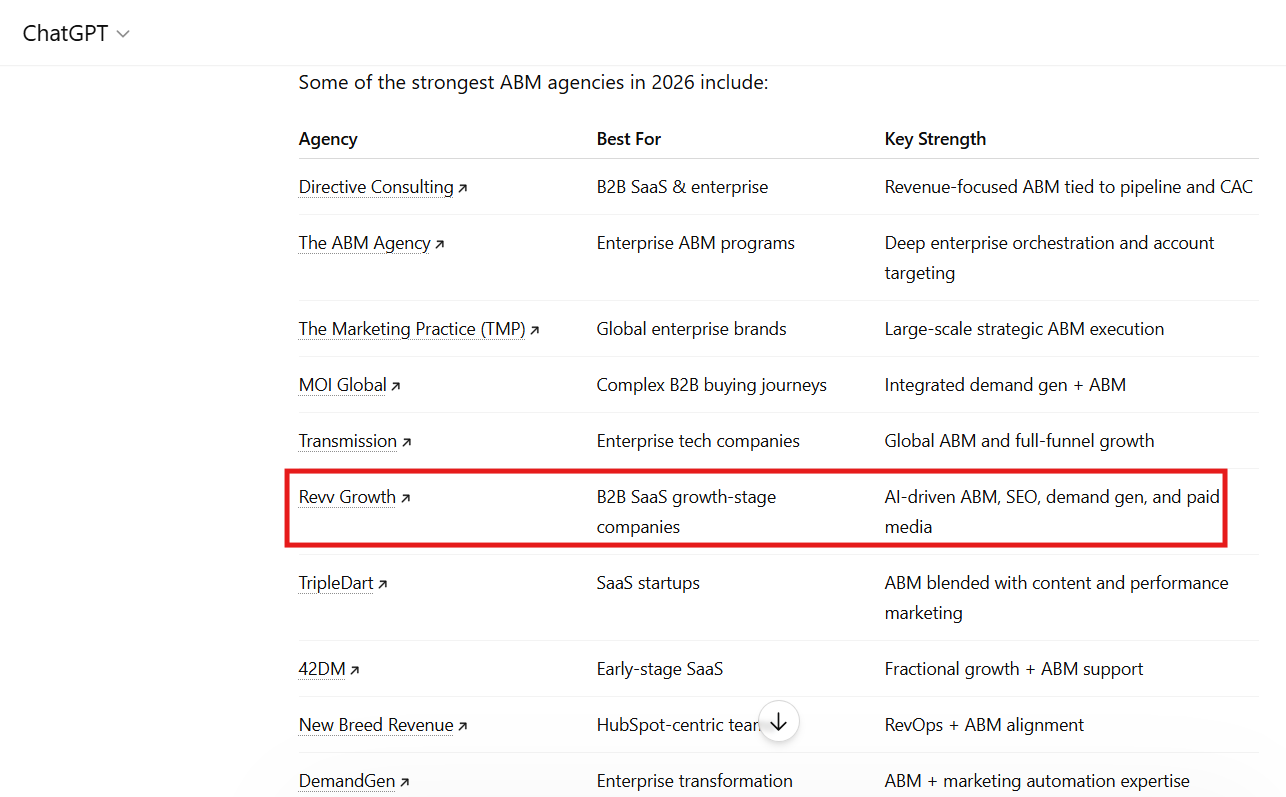
Screenshot: ABM agencies' keyword on ChatGPT
If you're only thinking about Google, you're only covering half the surface your buyers are using.
2. Google Reads Your Format. AI Judges Your Authority.
For AEO, structure is everything. Concise answer blocks, question-style headings, FAQ schema, and clean formatting are the signals Google looks for when deciding what to extract. Get the format right by following best practices for AEO, and you have a real shot at owning AI Overview.
GEO works differently. AI platforms don't just scan your page structure. They evaluate whether your brand is trustworthy enough to cite based on how widely you're referenced across the web, how consistently you demonstrate expertise, and whether third-party sources back up what you're saying.
3. AEO Can Be Measured. GEO Is Harder to Track
AEO is measurable, but not as directly as traditional SEO. Search Console can help surface changes in impressions, clicks, and CTR that may indicate increased visibility, but it does not confirm AI Overview inclusion.
Most teams combine manual checks with third-party visibility tools such as SEMrush to monitor whether they appear in AI-generated search experiences and track changes over time. For teams evaluating dedicated solutions, there are also emerging AEO tracking tools designed specifically to measure AI visibility, monitor citations, and track presence across AI-generated search experiences over time.
At RevvGrowth, we track AEO performance using SEMrush to monitor AI Overview visibility across target keywords. We look at signals such as AI Overview appearances, citation frequency, mentions, and which pages are being surfaced most often.
These insights help identify which content formats and optimisation patterns are contributing to visibility, informing broader strategies on how to rank in AI Overviews and improve presence across AI-generated search experiences.
→ See how RevvGrowth helps brands improve visibility in AI Overviews and answer-driven search
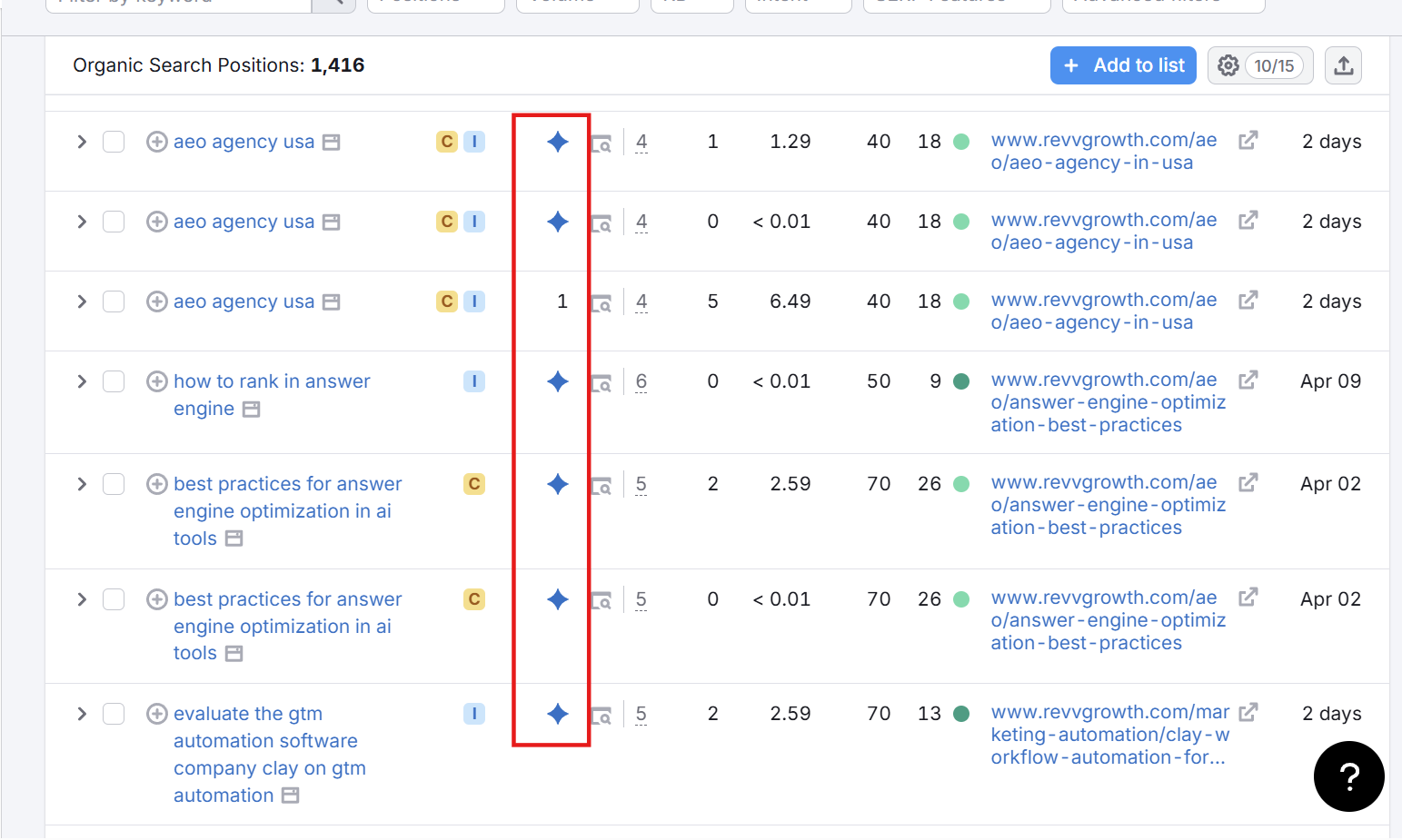
Screenshot: Semrush data showcasing certain RevvGrowth blogs being cited by AI overviews on Google.
(The diamond icon in the report above indicates keywords where our content appeared in AI Overviews, helping us measure visibility beyond traditional rankings.)
GEO measurement is still evolving. To complement traffic measurement using manual audit, you can also use GEO tools such as Semrush, Otterly, and Profound to monitor brand mentions, citation patterns, and presence across LLM-generated experiences.
At RevvGrowth, our process looks like this:
- Track AI referral traffic in GA4: Go to Reports → Acquisition → Traffic acquisition and switch the primary dimension to Session source/medium.
- Filter for AI platforms: Search for sources such as ChatGPT, Gemini, Perplexity, Copilot, and Claude to isolate AI-driven sessions.
- Measure business impact: Analyse users, sessions, engagement, and conversions to understand whether AI visibility translates into outcomes.
- Track visibility separately: Use tools such as Profound and Otterly to monitor mentions, citations, and visibility across LLM-generated experiences.
- Validate manually: Periodically test priority buyer prompts to understand how and where brands are being surfaced.
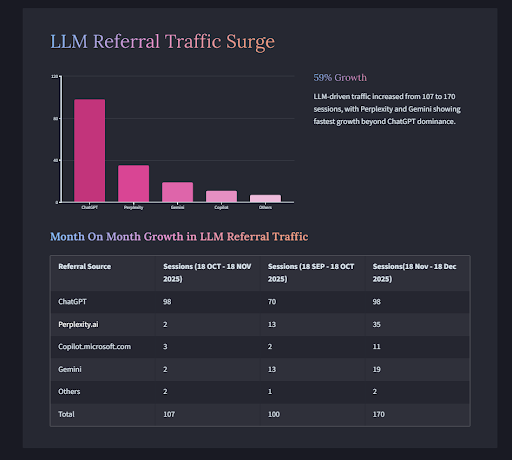
Screenshot: The monthly report we present to our clients using GA4
Together, these methods help us move beyond traditional visibility and measure GEO through both presence and performance.
Together, these methods provide a more complete view of both AI visibility and business impact.
4. AEO Can Deliver Faster Feedback. GEO Builds Over Time.
AEO often has a shorter feedback loop because changes such as improving answer blocks, adding schema, or restructuring content can influence visibility at the page level and be observed through search performance signals over time.
GEO is a longer game. As buyers increasingly use AI and answer engines for research, visibility depends less on individual page changes and more on building sustained authority through consistent publishing, topical depth, and repeated brand exposure across trusted sources. Progress is typically reflected through growing AI referrals, mentions, citations, and overall visibility over time rather than immediate gains.
5. AEO Needs Your Website. GEO Needs the Whole Web.
AEO is mostly about your own pages. If your content is well-structured and your site is technically sound, you have everything you need to compete for AI Overviews.
GEO requires a presence beyond your website. AI platforms pull from Reddit, YouTube, LinkedIn, G2, Capterra, and industry publications. G2's survey of 1,076 B2B software buyers found that 69% of buyers chose a different vendor than they originally planned based on AI chatbot guidance, and a third purchased from a vendor they had never heard of before. Those vendors weren't just ranking on Google. They were showing up in the places AI platforms trust.
Understanding where AEO and GEO split is the first step. But before you decide which one to focus on, it helps to know where they actually share common ground because a lot of the work overlaps.
Is There Anything Common Between AEO and GEO?
More than most people think. And that's actually good news; it means you're not building two separate content programs from scratch.
1. SEO Is Still the Foundation
Neither AEO nor GEO works well on a weak SEO base. If your site has crawl issues, thin content, weak internal linking, blocked resources, or pages that fail to satisfy intent, AI systems are less likely to discover, trust, or surface your content.
2. User Intent and Content Usefulness
Both optimise for satisfying the user, not rewarding keyword density. Content that directly solves problems, answers questions, and helps users complete tasks performs better across both environments.
3. Answer-First Content Structure
Both reward content that answers the question upfront before expanding. For AEO, this improves extraction into AI Overviews and answer surfaces. For GEO, it creates passages that LLMs can understand and reuse.
4. Entity Clarity and Brand Understanding
Both perform better when platforms can clearly understand who your brand is, what you do, and what topics you should be associated with. Clear positioning, service pages, author information, and consistent messaging matter.
5. Topical Authority
One article rarely creates durable visibility. Both reward brands that cover a subject comprehensively through interconnected content rather than isolated keyword pages.
6. Semantic Depth Over Exact Keywords
Neither depends purely on exact-match keywords anymore. Covering related concepts, comparisons, supporting questions, and adjacent buyer intent generally performs better.
7. Trust and Credibility Signals
Original insights, expert input, author transparency, first-party data, and third-party validation strengthen performance across both AEO and GEO.
8. Content Extractability
Content that is easy to parse tends to perform better across both systems. Clear headings, concise paragraphs, structured formatting, tables, and FAQs improve retrieval and understanding.
9. Content Freshness
Both Google and AI platforms favour content that remains current. Updating statistics, examples, and references helps maintain visibility.
10. Distribution and External Signals
Publishing alone is rarely enough. Mentions, links, citations, and external visibility reinforce authority across both search and AI ecosystems.
Takeaway: AEO and GEO are not replacements for SEO. They are additional discovery layers built on top of strong SEO fundamentals. If your content is already discoverable, helpful, and technically sound, you are building the foundation for both.
Now that you know where AEO and GEO overlap, the next question is practical: which one should you actually focus on first? The answer isn't the same for every company. It depends on where your buyers are searching right now.
AEO vs GEO: Which One Should I Choose?
This decision depends on where your buyers are actually searching right now.
GEO gets attention because it feels like the next frontier, but for most B2B brands, buyers still spend much of their research journey on Google. Overlooking AEO means giving up visibility in a channel that continues to drive demand.
Here's a simple way to think about it.
- Start with AEO if your Google visibility is declining
If rankings remain stable but clicks are falling, investigate whether AI Overviews and other SERP features are reducing click-through rates. In these cases, improving visibility within the answer layer can matter as much as improving traditional rankings.
Start by auditing your highest-impression informational queries in Search Console. Find pages ranking in positions 1 to 5 that don't own AI Overviews. Restructure those sections with answer-first formatting, add FAQ schema, and target the PAA questions around your core topics.
- Start with GEO if your buyers have moved to AI platforms
If your ICP is in SaaS, fintech, or B2B tech, there's a real chance a significant portion of your buyers are opening ChatGPT or Perplexity before they run a Google search. If your brand isn't showing up in those responses, no amount of AEO work will fix that gap.
What we've seen in practice
At RevvGrowth, we usually do not recommend choosing one in isolation. What we do is strengthen SEO and AEO first: fixing content structure, schema, and answer formatting, then build GEO on top of that foundation.
That's the approach we took with OvalEdge, a data governance SaaS competing against much larger enterprise players.
Instead of targeting only broad keywords, we focused on AI-friendly content formatting, long-tail search intent, technical SEO improvements, and structured topical coverage.
.png)
Screenshot: Optimized content created by RevvGrowth helped OvalEdge appear in AI prompts and earn citations across high-value keywords – An SEO Win
For AEO,
- We audited every high-impression page in Search Console and identified where OvalEdge was ranking in positions 1 to 5 but not owning the answer layer.
- We then restructured those pages, rewriting opening paragraphs as direct 50-word answers, adding FAQ schema, and reformatting H2s as questions that matched how buyers were actually searching.
- Pages targeting queries like ‘BCBS 239 compliance tools’ started showing up in Google's answer layer within weeks.
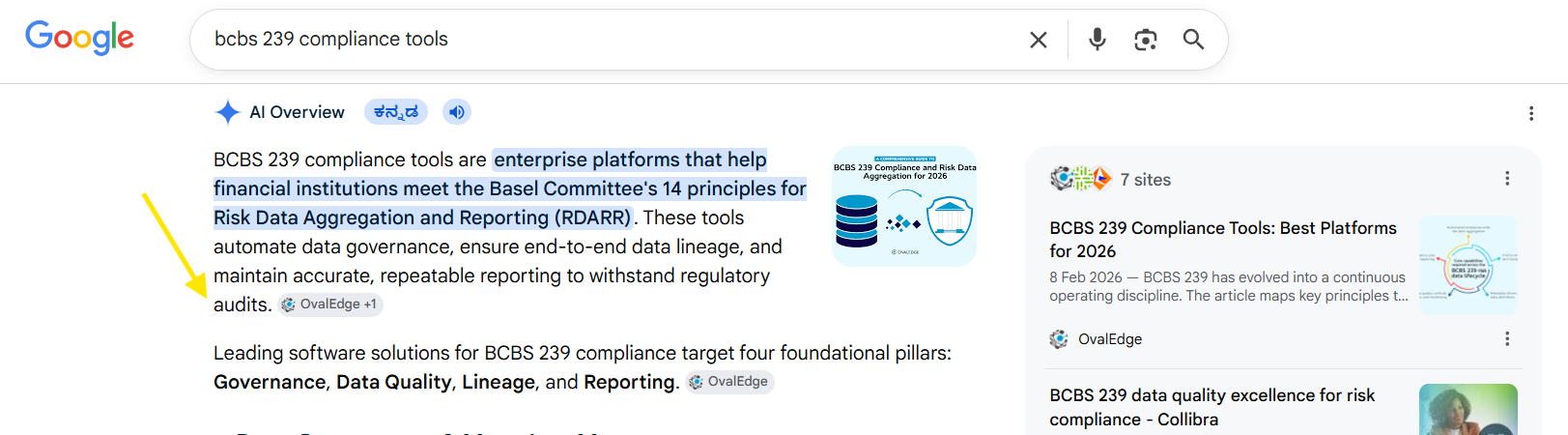
Screenshot: OvalEdge featuring in AI Overviews – An AEO Win
For GEO,
- We built interconnected content clusters around OvalEdge's core topics: data catalog, data lineage, data quality, metadata management, so that Google and AI platforms would start associating OvalEdge with those themes consistently.
- Every piece was structured with concise answer blocks and citable data points that AI platforms could extract and reference.
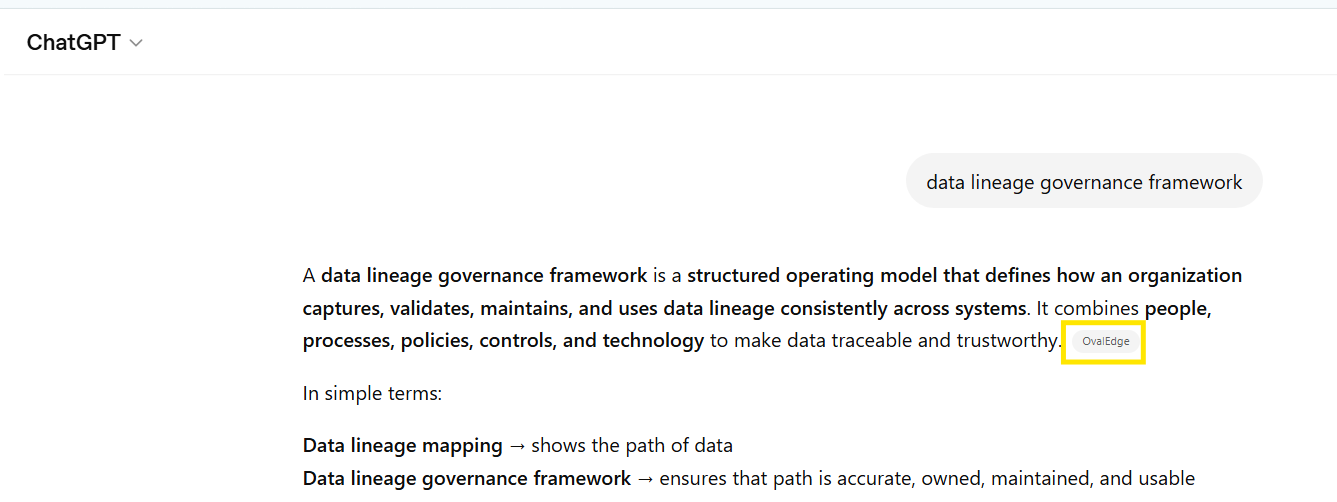
Screenshot: OvalEdge featuring in ChatGPT – A GEO Win
That's what happens when AEO and GEO are built in the right sequence, not as two separate programs but as one content strategy that serves both surfaces.
Not Sure Whether to Prioritise AEO, GEO, or Both?
See how we help brands win AI search visibility
Choosing where to start is one thing. But in practice, the strongest content programs don't treat AEO and GEO as two separate workstreams; they run them together. Here's how that actually works.
How SEO, AEO, and GEO Work Together
SEO, AEO, and GEO work in unison, each building on the other. SEO creates the foundation, AEO strengthens visibility within search experiences, and GEO expands that visibility across AI platforms. The infographic below shows how these three layers come together as one visibility system.
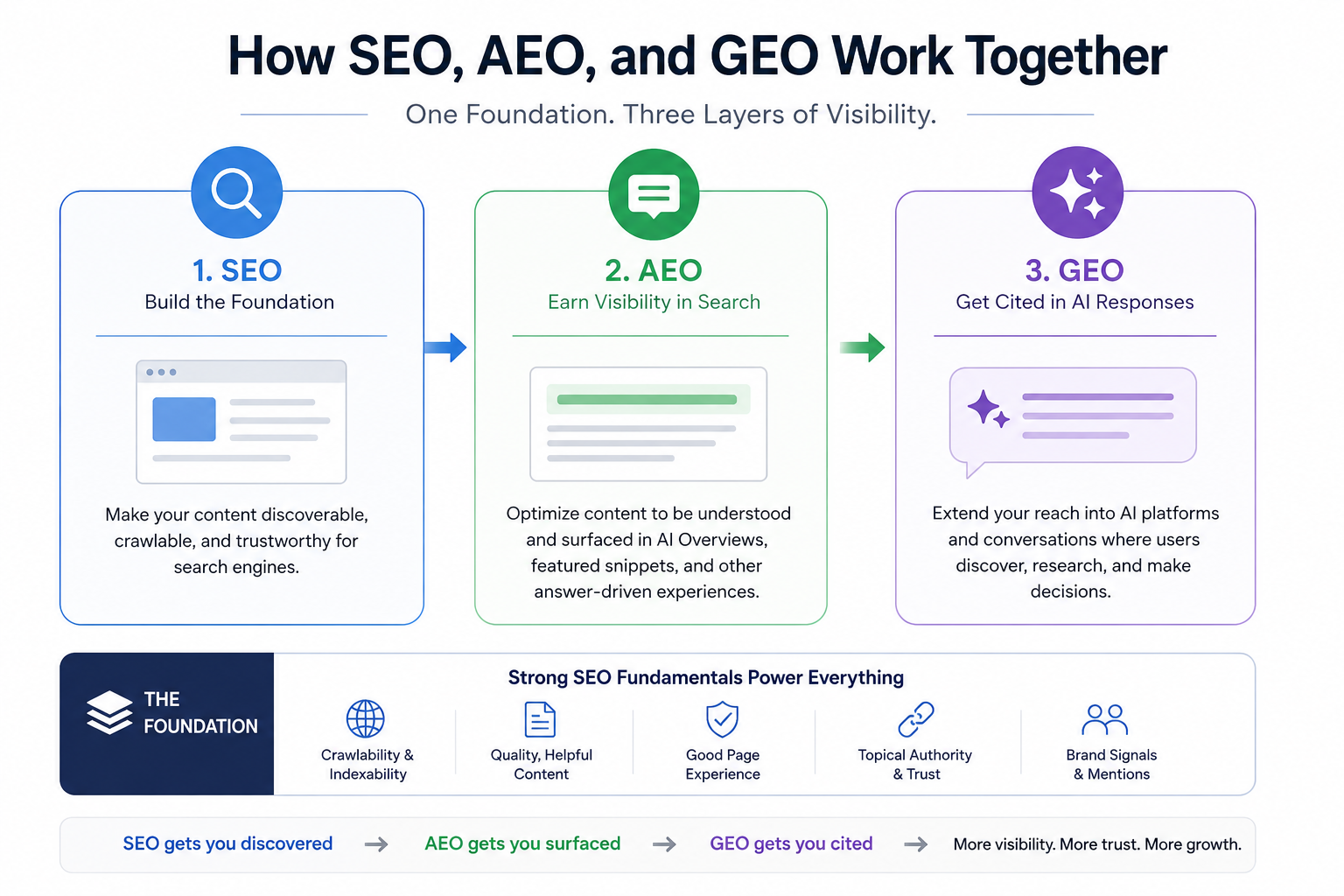
What this looks like in execution
At RevvGrowth, we do not treat SEO, AEO, and GEO as separate programmes. We build them as one visibility system because the same improvements often strengthen all three at once.
When we work with B2B SaaS companies, three things happen simultaneously:
1. Build Content That Can Be Discovered
Everything starts with SEO fundamentals: technical accessibility, internal linking, topic coverage, crawlability, and content quality. If search engines cannot reliably discover and understand your content, neither AEO nor GEO compounds effectively.
2. Make Content Easy to Extract and Trust
Once the foundation is in place, we optimise content to surface across answer-driven experiences. That means concise answers near the top of sections, semantic structure, FAQs, clear headings, original insights, expert input, and evidence-backed claims. These improvements help search engines extract answers and give AI systems stronger signals for citation.
3. Build Visibility Beyond Your Website
AI platforms do not only rely on your website. Mentions, backlinks, review sites, communities, partnerships, and industry publications all strengthen how your brand is understood and referenced across the web.
How This Played Out for Atlan
Atlan is a data collaboration platform competing in one of the most crowded SaaS categories, such as data catalog and data governance. They wanted to grow organic traffic, rank for high-intent keywords, and start showing up in AI Overviews and platforms like ChatGPT and Perplexity. A lot of their blogs were already in the top 10 but weren't getting featured. And they had zero visibility in AI-generated responses.
At RevvGrowth, rather than treating SEO, AEO, and GEO separately, we ran them as one programme:
- SEO: Expanded topical coverage, strengthened internal linking, and improved content depth across high-intent themes.
- AEO: Reverse-engineered how Google selects content and restructured existing content to match. Atlan started winning AI Overviews for keywords like "data lineage benefits" without new backlinks or new content.
For instance, Atlan appears in Google's AI Overview for a high-intent data catalog query, AEO working exactly as it should.
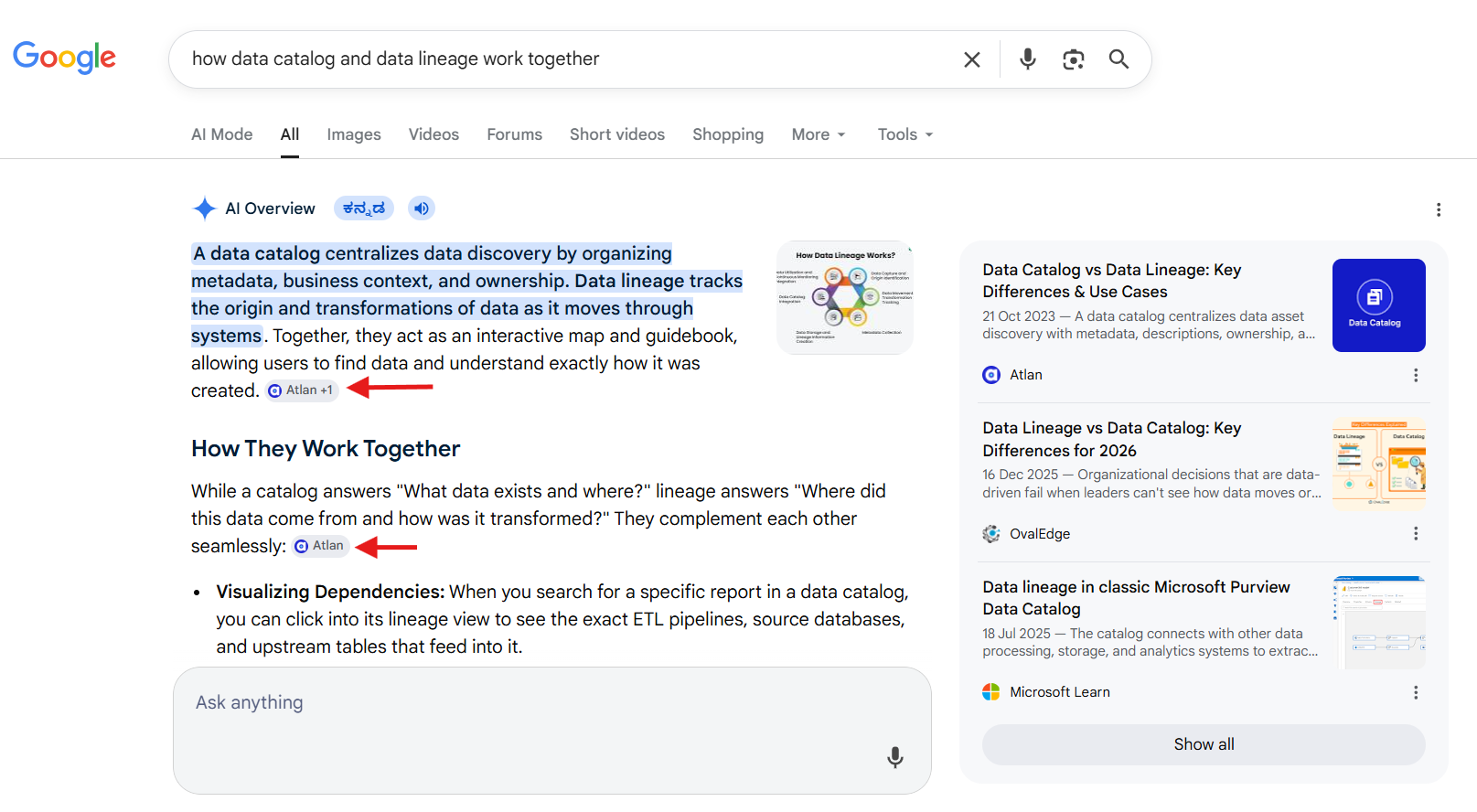
Screenshot: Atlan appearing in the AI Overview for the data catalog keyword
- GEO: Built topic clusters around core themes such as data catalog, data lineage, metadata management, with concise answer blocks and semantic structure that AI platforms could extract and cite.
For instance, Atlan cited in a ChatGPT response for a data dictionary query, the GEO result of building topical authority across the right content clusters.
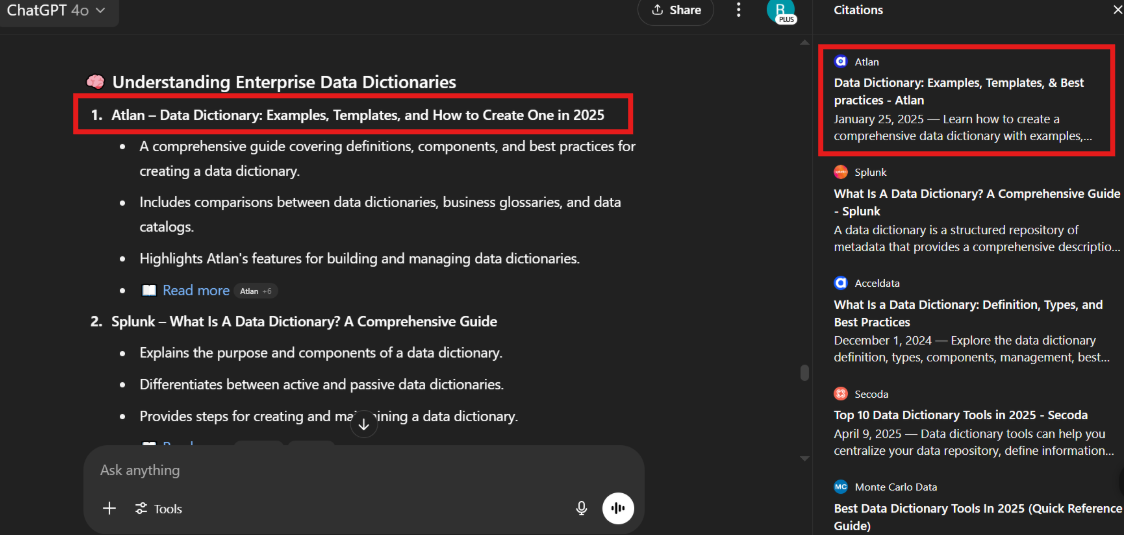
Screenshot: Atlan appearing in ChatGPT for the keyword ‘data dictionary.’
The result: Atlan grew from 17,000 to 128,000 organic visitors in 11 months. Content is showing up in AI-generated responses for the same queries their buyers were researching.
That's the compounding effect of running AEO and GEO together. AEO gets you visible fast. GEO builds the authority that makes that visibility stick.
Key Takeaways
The winners in AI search will not choose between SEO, AEO, and GEO. They will combine all three into one scalable visibility strategy.
- SEO, AEO, and GEO are not competing strategies; they build on each other. SEO creates the foundation, AEO improves visibility inside search answers, and GEO extends visibility into AI-generated discovery.
- AEO and GEO solve different visibility problems. AEO helps content surface in Google experiences such as AI Overviews. GEO helps brands appear in AI platforms like ChatGPT, Perplexity, Gemini, and Copilot.
- Strong rankings no longer guarantee attention. Visibility increasingly depends on whether your content is surfaced, extracted, and referenced, not just whether it ranks.
- You do not need separate content programmes. The same fundamentals: strong SEO, answer-first structure, topical authority, trust signals, and distribution, support both AEO and GEO.
- Measurement looks different across each layer. AEO visibility can be monitored through tools like SEMrush and search performance signals, while GEO requires tracking AI referrals, mentions, citations, and LLM visibility.
- Choose your starting point based on buyer behaviour. If Google still drives discovery, prioritise AEO. If buyers actively research through AI platforms, expand into GEO.
- The brands winning AI search are not chasing hacks. They are consistently building discoverable, trustworthy, and distributed content systems that compound over time.
.svg)


.webp)
.avif)