


Introduction
Most SaaS teams publish consistently, watch their traffic climb, and still can't explain why pipeline hasn't moved. The reason is almost never effort. It's that "SEO content strategy" has quietly become shorthand for a keyword list and a publishing calendar, not an actual system.
A real content strategy has seven interlocking parts: an audit that tells you what's actually broken, a keyword process that scores opportunities instead of chasing volume, an architecture that compounds authority instead of publishing isolated posts, a funnel-mapped production process, an editorial system that pairs AI speed with human judgment, an optimization layer built for both Google and AI engines, and a distribution plan that gets each piece in front of buyers more than once.
This guide walks through RevvGrowth's actual 7-phase process for building that system, the same one we run for every SaaS client, with the tools, decision frameworks, and real results behind it.
None of this is theoretical. Every phase below is the process we run internally, not a generalized best-practices list assembled from other people's blog posts, and every number attached to it is a verified client result, not a projection.
Why Most SaaS SEO Content Strategies Fail Before They Start
The gap almost always shows up the same way: traffic is up, rankings are climbing, the monthly report has green arrows everywhere, and nobody in the pipeline review can explain how many demos came from organic. That's not a writing problem. It's a systems problem,and it's rarely visible until someone asks the pipeline question directly.
Most "strategies" skip straight to publishing. There's no audit to identify what's already broken onthe site or in the existing content library, no scoring model to separate high-value keywords from vanity ones, no architecture connecting individual posts into topical authority, and no funnel mapping telling each piece what job it's supposed to do once a reader lands on it.
Content gets produced. Activity increases. Momentum doesn't, because there was never a system underneath the calendar, just a sequence of individually reasonable decisions that don't add up to a strategy.
The teams that get this right treat content the way they'd treat any other revenue system: audited before it's built on, sequenced deliberately, and measured against pipeline rather than vanity traffic. Here's the 7-phase process that replaces the calendar with that system.
8 Steps in building a SaaS-specific SEO content strategy
A SaaS SEO content strategy has eight parts: a website audit, a content audit, keyword research, competitor analysis, strategy planning, on-page optimization, technical SEO, and continuous optimization. Here's how we run each one.
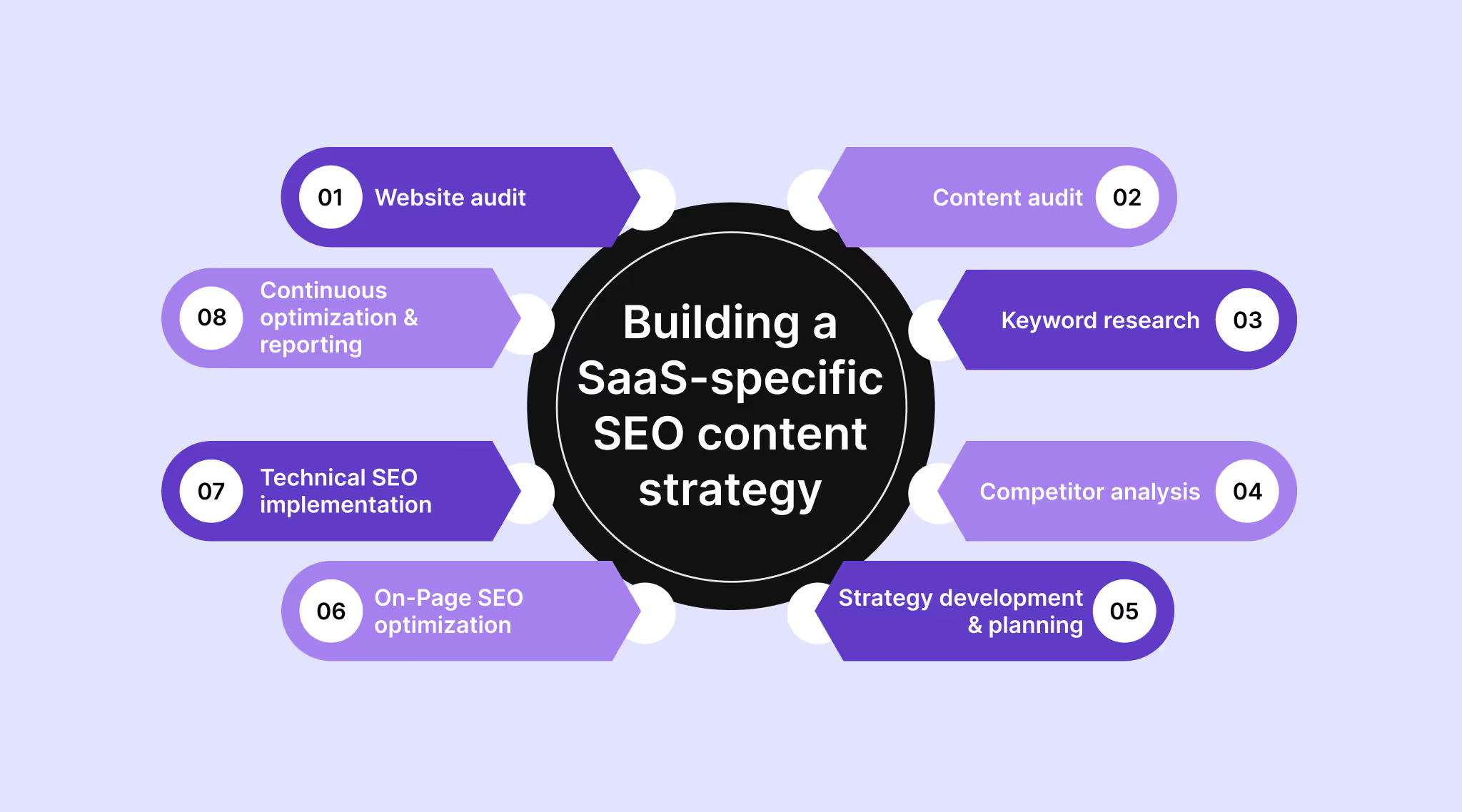
- Website audit
- Content audit
- Keyword research
- Competitor analysis
- Strategy development & planning
- On-page SEO optimization
- Technical SEO implementation
- Continuous optimization & reporting
1. Website audit
Before a single keyword is researched, we verify the site can actually rank and that we know what's already working. This phase runs 2–3 weeks during onboarding, and nothing gets briefed until it's complete, because great content on a technically broken siteis a high-converting landing page with a broken form.
We pull traffic sources, volumes, and trends from Google Analytics and Search Console, review site architecture and URL structure, and check Core Web Vitals and page speed against Google's ranking thresholds. Using Screaming Frog and Semrush, we run a full crawlability and indexability audit, flagging broken links, redirect chains, duplicate content, and any pages Google is spending crawl budget on that don't deserve it. Mobile-friendliness and HTTPS security get verified in the same pass.
2. Content audit
Every existing asset, blogs,landing pages, case studies, ebooks, resource pages, gets a full inventory anda performance score across traffic, rankings, backlinks, and engagement. Weflag content gaps (topics your ICP searches for that aren't covered yet) andthin or cannibalizing pages where two URLs are quietly competing for the samequery, then sort every URL into one of four buckets:
● Update — the page ranks but underperforms; refresh the data, strengthen the CTA, rebuild internal links.
● Consolidate — two or more pages targeting the same keyword; merge into one authoritative piece and redirect the weaker URLs.
● Redirect — zero traffic, no backlinks, no realistic path to relevance; redirect to the closest live equivalent.
● Create New — the ICP is actively searching, no page exists, and the keyword scores high in our prioritization model.
That prioritization matrix iswhat turns an audit into a work plan instead of a report nobody acts on. In most content libraries we audit, 30–40% of URLs land in Consolidate or Redirect, which means a significant share of past content investment has been generating zero pipeline value, and in some cases actively suppressing pages that could rank higher on their own.
3. Keyword research
Keyword research isn't aone-time onboarding exercise, it's a continuous intelligence function. We runit in four stages.
● Stage 1 — Initial Discovery: seed keywords from ICP language, product features, and pain points, expanded through Ahrefs and Semrush, mined from existing Search Console data, and pulled from Answer The Public and Also Asked for question-based queries.
● Stage 2 — Categorization & Clustering: grouped by intent (informational, navigational, commercial, transactional), built into topical clusters, and separated into head terms versus high-value long-tailopportunities. AI-trigger keywords, the ones generating AI Overviews, get flagged as primary AIO optimization targets.
● Stage 3 — Prioritization Matrix: every keyword scoredacross four dimensions.
● Stage 4 — Content-Keyword Mapping: priority keyworda assigned to a specific content type, pillar, sub-pillar, landing page, or case study, and slotted into the calendar by priority score and competitive window.
Ahrefs' research shows 96.55% of content gets zero organic traffic from Google, almost always because it was never scored against the right criteria in the first place.
Alongside this, we run competitive content intelligence on 3–5 direct competitors: mapping their keyword universe, identifying gaps where they rank and you don't, comparing backlink profiles, and tracking which competitors own featured snippets, AI Overviews, and People Also Ask boxes on your priority terms. Our full scoring model and worked examples live in a dedicated guide if you want the deeper mechanics.
For every priority keyword, wealso run a SERP-level deep dive: identifying the featured snippet format(paragraph, numbered list, or table) so the article structure can be built tomatch it from the outline stage, checking whether the query triggers an AI Overview and what source types get cited and why, and flagging competitor weaknesses, thin answers, outdated statistics, missing schema, that a better-structured page can beat outright rather than simply outranking on backlinks alone.
Read more --> 7 Advanced Keyword Research Strategies to Boost Your SEO Game
4. Competitor analysis
Map 3–5 direct competitors using Semrush and Ahrefs, identifying keyword gaps (terms they rank for that you don't), comparing backlink profiles, and tracking who owns featured snippets, AI Overviews, and People Also Ask boxes on your priority terms. The SERP feature ownership piece matters as much as the keyword gaps now, since a competitor's snippet dominance signals exactly where a better-structured page can win outright.
5. Strategy development & planning
Turn the audit and research into a rolling 90-day roadmap, not a static plan: every article with its target keyword, funnel stage, writer/editor assignment, and a success benchmark, sequenced so pillar content publishes before its sub-pillars and nothing gets briefed without a dependency check against what's already live.
Scoring tells you which keywords matter. Architecture tells you what to build and in what order. We structure every content program on a three-tier model.
Every sub-pillar links back to its parent pillar with descriptive, keyword-rich anchor text, and every pillar links forward to all its sub-pillars. New content gets cross-linked to related articles immediately at publication, and the full architecture is audited monthly for gaps.
We deliver this as a rolling 90-day roadmap: every planned article with its target keyword, search intent, funnel stage, writer and editorassignments, and a success benchmark, target ranking position and traffic threshold, so the calendar is a plan with dependencies built in (pillars publish before their sub-pillars, clusters stay cohesive) rather than a list of topics someone thought sounded good.
6. On-Page SEO optimization
Refine meta titles (primary keyword in the first 60 characters), meta descriptions (150–160 characters), and header hierarchy, then place 3–5 contextual internal links per article. Featured snippet structure matters here too: write the direct answer within the first 100 words of the relevant H2, matching the exact query as the heading above it. This exact methodology delivered a 4–5x traffic uplift on targeted terms in our work with Atlan. Read the detailed case study here.
This is where most SaaS contentprograms stop short, treating AI visibility as an afterthought instead ofbuilding it into the same optimization pass as traditional SEO. We don'tseparate the two.
Traditional on-page work covers the basics: primary keyword within the first 60 characters of the meta title, a 150–160 character meta description, a keyword-rich H1 matched to search intent,and Core Web Vitals compliance on every published page.
Featured snippet optimization sits alongside it: identifying the snippet format (paragraph,list, or table), writing the direct answer within the first 100 words of the relevant H2, and matching the exact query as the heading above it. This exact methodology delivered a 4–5x traffic uplift on targeted terms for the Atlan engagement.
For AI Overviews and GEO, everyH2 section is written as a self-contained, citable answer, statistics are sourced and specific rather than vague, and Article, FAQ, and HowTo schema are implemented to increase citation probability. Author attribution, publication dates, and a quarterly refresh cycle round out the E-E-A-T signals AI models weight most heavily. If you want the full mechanics of scoring existing content against AI citation criteria, we've broken down the complete audit process separately.
7. Technical SEO implementation
Optimize page speed, confirm mobile-friendliness and HTTPS, and submit XML sitemaps while fixing crawl errors. Google's page experience signals remain a real ranking factor, and Core Web Vitals compliance (LCP, INP, CLS) determines how often Google, and increasingly AI crawlers, revisit your pages at all.
8. Continuous optimization & reporting
SEO content isn't a publish-and-forget asset. Review cornerstone pages quarterly, statistics checked for currency, case study outcomes updated, last-modified dates refreshed, and track performance against pipeline metrics, not just sessions and rankings, in a monthly report. Content left untouched for 6+ months starts losing both search ranking and AI citation frequency, even when the underlying information is still accurate.
Common pitfalls in SaaS SEO content strategy (and how to avoid them)
Even with the best intentions, it's easy to fall into some common traps when building your SaaS SEO content strategy. Here are a few to watch out for
- Overstuffing keywords: It might be tempting to cram your content with keywords, but this can backfire. Google’s algorithms are smart enough to spot this and could penalize your site.
- Ignoring User Experience (UX): A website that’s hard to navigate will frustrate users and increase bounce rates, which hurts your SEO. SEMrush states that websites with high bounce rates (over 70%) typically rank lower in search results.
- Neglecting analytics: Not monitoring your performance means you’re flying blind. Use analytics to track what’s working and what isn’t, and tweak your strategy accordingly.
- Skipping technical SEO: Technical issues like slow load times or broken links can kill your SEO efforts. Regularly audit your site to catch these problems early.
Teams optimizing for the first number and wondering why demos never show up are almost always looking at the wrong metric on the keyword research spreadsheet.
The role of content refreshing in long-term SEO success
SEO isn’t a one-and-done deal; it’s an ongoing process. Content refreshing plays a crucial role in maintaining and even boosting your SEO rankings over time. Here’s why:
1. Keeps content relevant
Google favors up-to-date content. Refreshing old posts with new information, updated statistics, or additional insights can keep them relevant.
2. Improves search rankings
Updating content can signal to Google that it’s still valuable, potentially improving your rankings.
3. Enhances user experience
Visitors are more likely to trust and engage with content that feels current and relevant, which can lead to lower bounce rates and higher conversions.
How Revv Growth can help you develop a high-impact SaaS SEO content strategy
To see how an effective SEO strategy works in practice, look at Atlan’s success story. Atlan, a platform for data teams, faced challenges with low organic search visibility despite offering a valuable service:
- Atlan’s situation: The company struggled with poor search rankings and suboptimal content. Their product was strong, but their online presence didn’t reflect that.
- Our approach: We crafted a detailed SEO strategy for Atlan. This involved:
- Targeted Keyword Research: Identifying key terms to attract their ideal audience.
- Content overhaul: Enhancing their existing content to meet SEO standards and audience needs.
- Optimization for SERPs: Aiming for top rankings and optimizing for featured snippets.
- The result: Atlan experienced a 500% increase in organic traffic. This remarkable growth not only improved their visibility but also solidified their market position.
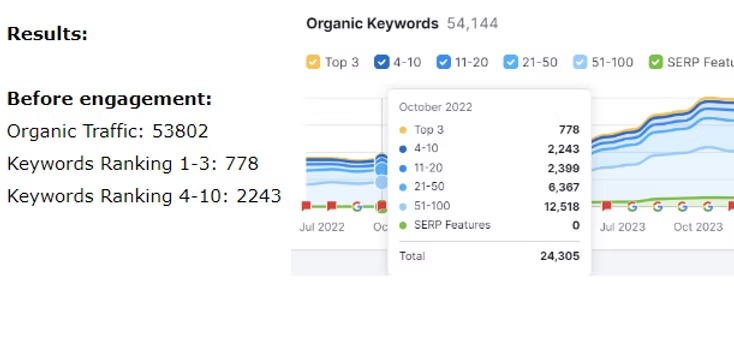
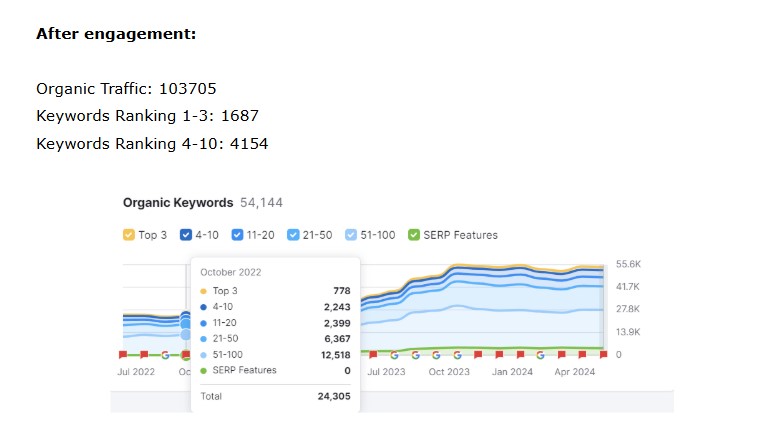
This success is reflective of broader trends: A 2024 Ahrefs report highlights that businesses investing in SEO often see an average return of 5.7 times their initial investment, demonstrating SEO’s cost-effectiveness and value for SaaS companies.
Key Takeaways
● A real SaaS SEO content strategy has 7 phases: audit,keyword research, pillar/sub-pillar architecture, full-funnel production,AI-assisted writing, on-page/AIO/GEO optimization, and distribution, not just akeyword list and a calendar.
● The audit phase sorts every existing page into Update,Consolidate, Redirect, or Create New, before any new content gets briefed.
● Keywords are scored across business value, searchvolume, difficulty, and SERP opportunity, not chased by volume alone.
● The 3-tier pillar/sub-pillar architecture is whatcompounds topical authority instead of producing isolated posts.
● AEO and GEO are built into the same optimization passas traditional SEO, not treated as a separate, later step.
● For Atlan, this process delivered a 5x increase inorganic traffic and 130+ blogs published monthly, with zero paid media spend.
.svg)


.webp)
.avif)