


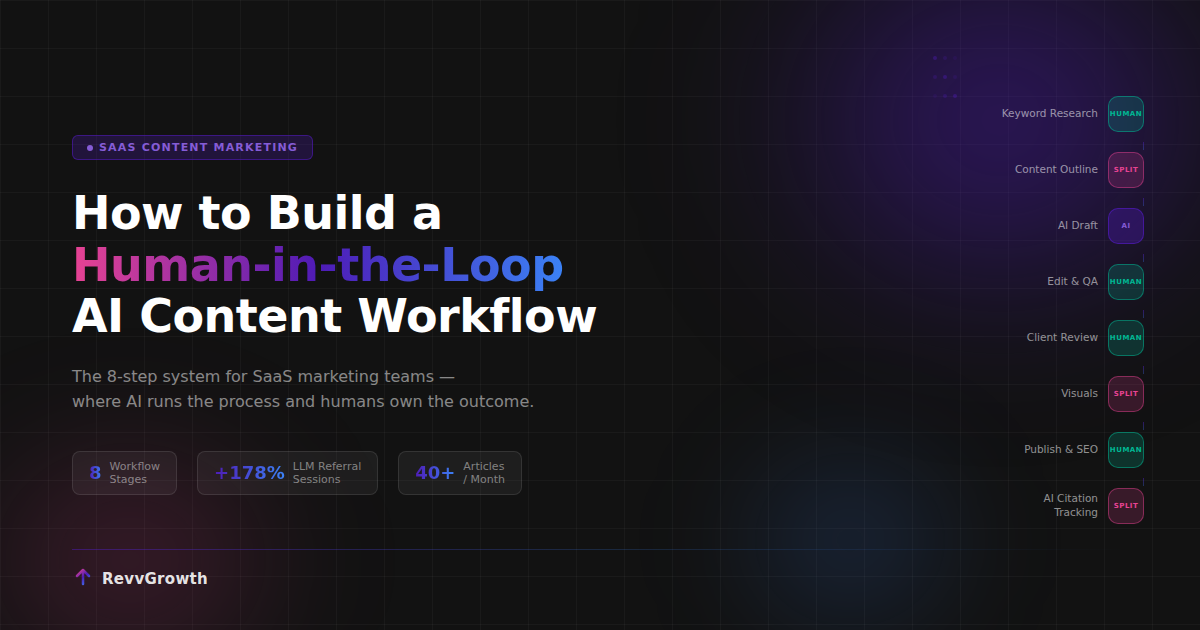
A human-in-the-loop AI content workflow is a structured production system where AI handles research synthesis, outline generation, and first-draft creation, while human editors own strategy, fact verification, brand voice, and the final publish decision. AI accelerates throughput. Humans guarantee the output is accurate, differentiated, and built for the buyer reading it. You need both, in the right sequence.
Firing your content team and handing everything to AI is one of the most expensive mistakes a SaaS founder can make right now. It just doesn't look expensive for the first few months.
The savings are visible immediately. The damage shows up quietly, in rankings that stop climbing, in traffic that plateaus, in AI Overview citations that go to your competitors instead of you.
By the time the board asks why organic has flatlined, the AI has published dozens of articles with hallucinated statistics, generic angles, and in some cases, copy that recommends a competitor as the category leader. No one caught it because no one was looking.
This is not a hypothetical. I've seen it happen across multiple SaaS companies in the last twelve months, all of them chasing the same LinkedIn-famous idea that a $12-a-month AI system can replace a content team.
It cannot. Not because AI is bad at writing. It isn't. It's fast, structured, and tireless. But it has no judgment. It cannot decide what's worth writing about, verify whether a claim is true, or recognise that the draft it just produced sounds nothing like your brand. Those decisions require a human, and they require a human at specific, defined points in the workflow, not as a final polish pass on content that's already broken.
The SaaS companies producing content that ranks on Google, earns citations in ChatGPT and Perplexity, and actually generates pipeline have figured this out. They're not debating AI versus humans. They've built an AI content workflow where the answer is both, in the right order, at the right stages, for the right reasons.
This is that workflow. The exact 8-step system we have run at RevvGrowth across programs for Atlan, Everstage, and OvalEdge, with the AI/human split at every stage and the results that split produces.
What Is a Human-in-the-Loop AI Content Workflow?
A human-in-the-loop AI content workflow is a repeatable production system that assigns specific tasks to AI and specific tasks to humans, based on where each adds irreplaceable value.
AI adds value at tasks requiring speed and pattern recognition: generating outlines from SERP data, producing first drafts from approved templates, and running keyword coverage checks. Humans add value at tasks requiring judgment: defining the angle, verifying every claim, editing for brand voice, and deciding what gets published.
The AI content workflow is not "AI first, human last." It is a series of documented handoffs with defined quality gates before anything moves to the next stage.
The reason this calibration matters is not philosophical. It's practical. CMI's 2025 B2B Content Marketing Benchmarks found that only 4% of B2B marketers report high trust in AI outputs, and yet 81% of teams are using generative AI tools.
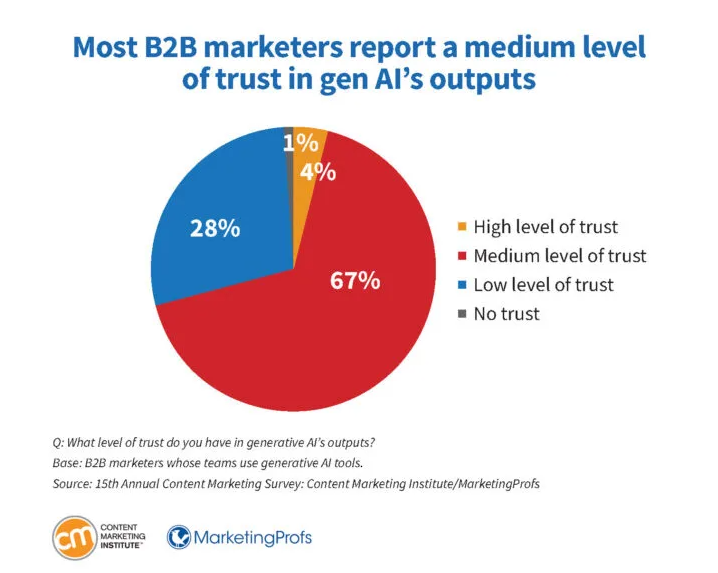
That gap exists because most teams adopted the tools without building the system around them. They have AI. They don't have a workflow. The companies that have built the workflow and stuck to the discipline of it are the ones generating results that look almost unreasonable from the outside. Not because they found a better AI model. Because they built a better process.
Why Do Most AI Content Workflows Fail SaaS Teams?
The failure part is predictable. A content manager discovers that an LLM can write a 1,500-word blog in 90 seconds. They build a lightweight process: prompt the AI, skim the output, publish. Within a few months, the site has more content, but rankings plateau, bounce rates climb, and every article sounds identical.
Here is what went wrong in almost every case we've seen:
- No strategy at the front. AI cannot decide what to write. If the prompt is not grounded in ICP pain points, keyword intent data, and a real differentiation angle, the output is generic by design. Generic content does not rank.
- No QA at the back. AI hallucinates. It cites statistics that don't exist, misattributes quotes, and presents outdated data confidently. Without a trained editor running fact verification, errors accumulate, and in B2B SaaS, a wrong statistic does real reputational damage. Current hallucination rates across leading models range from 0.7% for Gemini-2.0-Flash to 4.4% for Claude Sonnet to over 10% for more complex reasoning tasks, according to Rank Prompt's 2025 benchmark analysis.
- No structure for AI extraction. Content that earns AI Overview citations is structurally formatted so AI engines can extract it: direct answer blocks, question-format H2s, named frameworks, and comparison tables. Most AI-first content workflows skip all of this.
- The wrong split. Teams that hand 100% of the process to AI remove the elements that make content authoritative. Teams that insist on 100% human production cannot scale. The right split is calibrated per stage.
The teams that have cracked this aren't the ones using the most sophisticated AI tools. They're the ones who figured out exactly where human judgment is load-bearing in the production process and built hard gates at those points. Every stage in the workflow we'll walk through next has been designed around that principle.
The 8-Step AI + Human Content Workflow We Use for SaaS Clients
Here is what the full workflow looks like, with the AI/human (AI vs. human content) split at each stage and exactly why it's set that way.
Step 1: Keyword Research and ICP Pain Point Mapping
Before opening Ahrefs or SEMrush, the Strategy Lead maps the ICP's pain points by funnel stage. What is a VP of Marketing searching for when they are problem-aware but not yet solution-aware? What language does a Head of Content use when comparing tools in Perplexity?
We run keyword selection through three filters:
- Search volume and competition via Ahrefs or SEMrush
- AI Overview potential — long-tail queries with question format tend to surface in AI Overviews far more reliably than broad head terms
- Competitor content gaps — we audit the top 5 ranking pages per keyword for format, heading structure, FAQ patterns, and featured snippet formatting. The gaps become our differentiation angle.
We also pull from Reddit threads, Slack community discussions, and LinkedIn comments to understand how buyers actually phrase their problems, not just how they search for solutions. This is the layer most AI-first workflows skip entirely.
The output: A prioritised keyword list with funnel stage, intent classification, AI Overview potential rating, and a specific differentiation angle for each topic.
Step 2: Content Outline Creation (60% AI-Assisted, 40% Manual)
The outline is the most structurally important document in the entire production process. A weak outline produces a well-written article that fails to rank, because the architecture was wrong from the start.
The Content Strategist runs a manual SERP analysis first. Then AI generates a first-draft outline using a pre-approved structure template. Two rules are non-negotiable:
- Every H2 must be written as a direct question in natural language
- The first sentence under every H2 must directly answer that question
This is an AEO requirement, not a stylistic preference. AI engines extract question-answer pairs. "Benefits of Content Marketing" as a heading with a vague opening sentence gets extracted zero times. "What are the benefits of content marketing for SaaS companies?" with a direct first sentence gets pulled into AI Overviews consistently.
At the outline stage, the Content Strategist also identifies data placeholders, sourced from post-2023 research from McKinsey, Gartner, and Forrester, and sets the internal and external linking plan. Links planned at the outline stage integrate naturally. Links added retroactively feel forced.
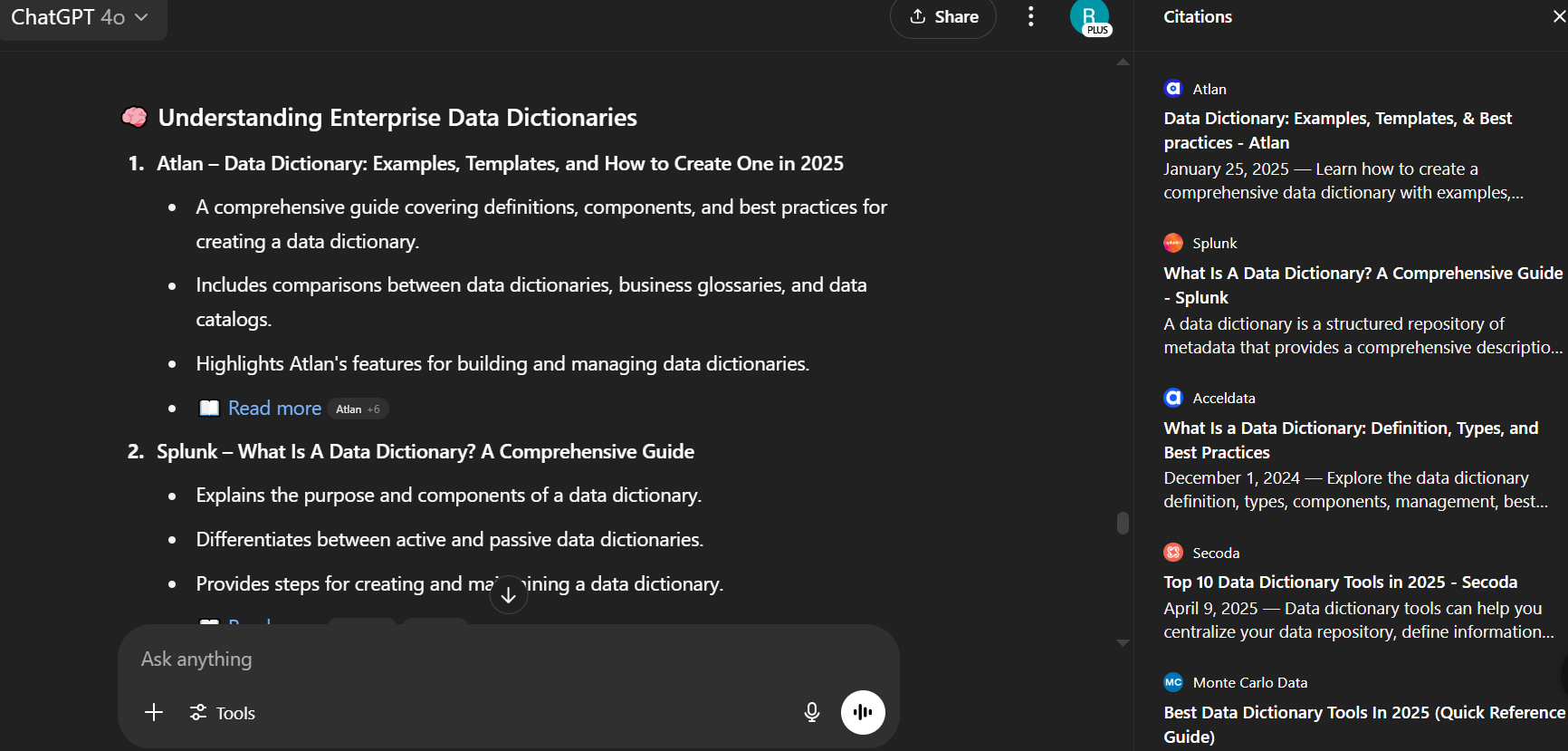
When we built the content architecture for Atlan, a data collaboration platform competing for some of the most contested keywords in the data operations space, every pillar page started with this outline-first process. The H2 hierarchy was designed for AI extraction before a single word was written.
The result: 130+ SEO-optimised blogs published per month, multiple Google Featured Snippets, and Atlan cited as the primary source in Google AI Overviews and also started coming in LLMs.

Step 3: Content Creation (55% AI-Assisted, 45% Human Editorial)
Once the outline is approved, AI generates the first draft following the approved structure, brand tone guide, and client-specific style requirements. The first draft is raw material, not a finished product.
The human editor rewrites for three priorities:
- Accuracy first. Every claim is checked against the pre-assigned source before it is included in the article. No exceptions.
- Strategic depth second. AI produces competent surface-level text. The editor adds the practitioner insight, the real-world example from manual research, and the specific client context that signals genuine expertise to both human readers and AI engines.
- Citation bait third. These are the structural elements that AI engines preferentially extract when building answers:
After the human rewrite, the draft runs through Clearscope or Frase for keyword coverage and semantic richness. We're checking topical depth, not keyword frequency.
For Everstage, a sales compensation and commission tracking platform, the entire content program ran on this 55/45 split. We built a prompt-led workflow mapped by funnel stage and search intent, with mandatory human QA at every drafting stage.
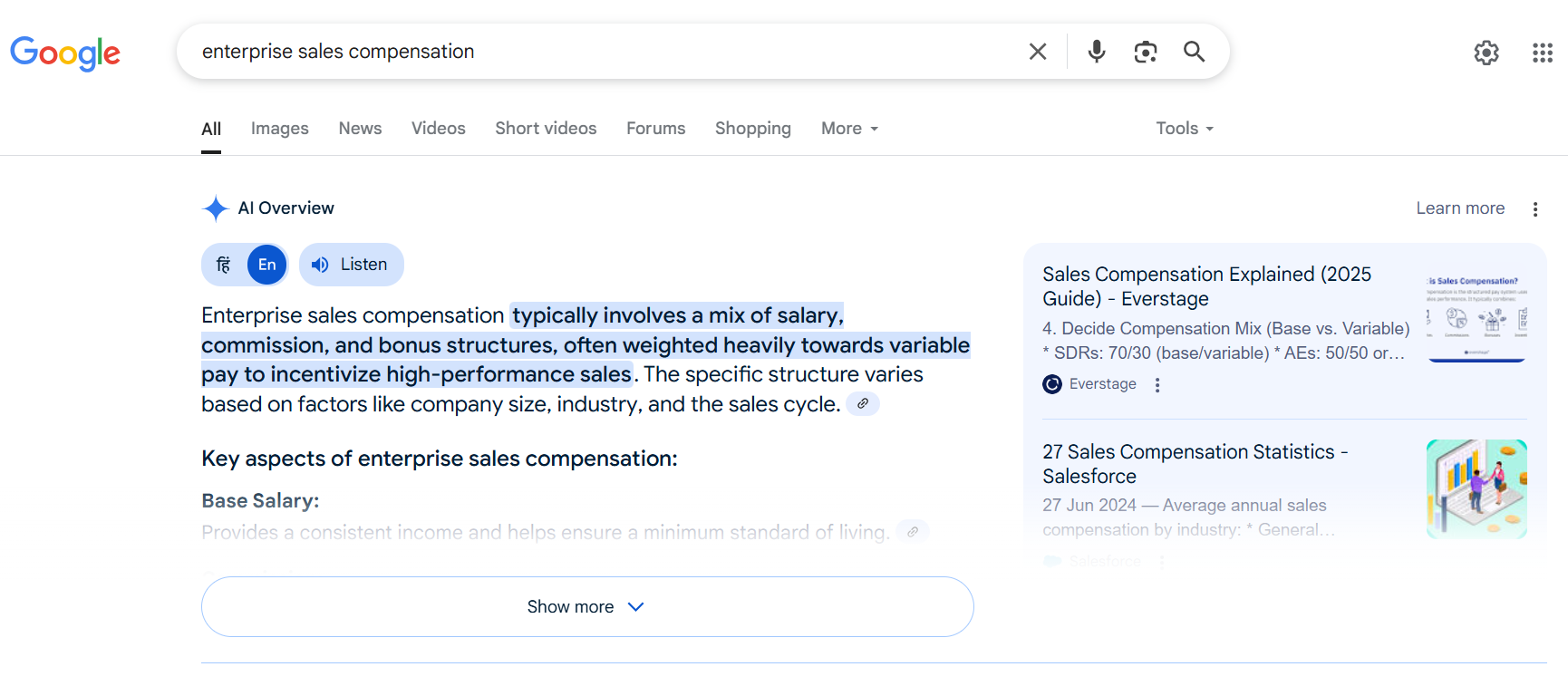
In one month: 40+ long-form blogs published, Page 1 Google rankings on target queries, and Everstage cited across 3+ AI platforms, including Google AI Overview for "enterprise sales compensation" and Perplexity for "variable sales compensation plans".

See the full results across our SaaS content programs → RevvGrowth case studies
Step 4: Editing and QA (100% Manual, No AI in This Phase)
This is the gate between a draft that looks publishable and an article that is actually ready to go live. No AI tool replaces the judgment of a trained senior editor at this stage.
The Senior Editor runs five checks in sequence:
- Copy editing: Grammar, sentence structure, tone consistency, readability. Paragraphs are kept to 2–4 sentences. Passive voice is removed. Filler phrases are cut.
- SEO editing: Clearscope is run again to confirm keyword coverage and semantic depth survive the rewrite.
- AEO compliance check: The Short Answer Block is reviewed; it must be 50–80 words, standalone, and quotable. All H2s are confirmed in question format.
- Fact verification: Every statistic is traced to its primary source. Only post-2021 data is accepted. Any statistic that cannot be verified is removed or replaced.
- Brand voice check: Does this sound like the client's brand, or does it sound like a formatted AI output? These are distinguishable to a trained reader and to the AI engines assessing content quality. This check is the one no tool can replicate.
Senior editor sign-off is required before the article moves forward. No exceptions.
Step 5: Client Review and Revisions
The client has domain knowledge that the content team doesn't. Their review catches factual inaccuracies, positioning mismatches, and internal terminology errors that no external team could catch alone.
Client feedback is categorised on receipt: factual corrections, tone adjustments, SEO modifications, and strategic additions. Revisions are implemented within 24 hours, while preserving the Clearscope optimisation, heading structure, and factual accuracy established in QA.
Step 6: Visuals and Design (60% AI-Assisted, 40% Manual)
Visuals are not decorative in an AEO context. AI engines extract structured visual formats, tables, labelled diagrams, and process flows when generating answers. Every visual we create is designed with that extraction potential in mind. We use AI tools like ChatGPT, Claude Design, and Canva AI.
Every article that contains statistics gets a chart. Every framework gets a flow diagram. Every comparison gets a table. Each visual gets an SEO-optimised alt text description and a keyword-rich file name before upload.
Step 7: Publishing and CMS Formatting (100% Manual)
On-page SEO decisions at the publishing stage directly affect how Google indexes and ranks the article. This is not a step to automate.
The Publishing Team executes a consistent checklist on every article:
- Correct H1 to H3 hierarchy applied in the CMS (not just in the document)
- 3–5 internal links to pillar pages or high-value service pages with descriptive anchor text
- 3 outbound links to authoritative external sources (Gartner, McKinsey, Forrester, G2)
- Meta title at or under 60 characters, keyword-forward
- Meta description at or under 155 characters, outcome-focused
- URL slug cleaned and keyword-aligned
- Featured image with descriptive alt text
- Final QA on live preview: readability, CTA function, mobile rendering
- Published with UTM-tagged URL for attribution tracking
Step 8: Performance Tracking and AI Citation Monitoring
Every article is benchmarked from day one. We track keyword rankings, AI Overview citation status, and conversion performance. When a citation is won, we document it. When one is lost, the recovery protocol runs immediately.
- Google performance: Keyword rankings via Ahrefs and Google Search Console weekly. Organic CTR, impressions, and average position tracked per article against original targets.
- AI citation monitoring: Every target keyword is manually checked in incognito weekly to confirm AI Overview status. We run structured prompt checks across ChatGPT, Perplexity, Gemini, and DeepSeek. Every confirmed citation is logged.
This is where the OvalEdge results became concrete. OvalEdge, a data governance platform, entered the program with 2,130 clicks per month, an average position of 16.2, and zero measurable LLM referral traffic.
After running the full 8-step workflow across a pillar-cluster architecture, results reflect the latest available data from Google Search Console and GA4 (March 2026 reporting cycle).
Those numbers didn't come from a better AI model. They came from running the same 8 steps consistently, with the right human at the right stage.Want results like OvalEdge for your SaaS company? Let's build the workflow together.
Building This Workflow Internally vs. Working with an Agency
This workflow is executable internally. But the realistic requirements are worth thinking through before you decide.
What the internal build requires:
- A Strategy Lead who can run keyword research, SERP analysis, and AI Overview intent mapping
- A Content Strategist who understands AEO structure and can refine AI-generated outlines
- A Senior Editor with SEO knowledge and fact-checking discipline, this is a rare combination
- A Design resource for structured visuals
- A Publishing resource who knows on-page SEO at the CMS level
- An Analytics resource tracking both Google and AI citation surfaces weekly
Where agencies add leverage:
- The prompt library and brand tone guide frameworks are already built
- QA checklists, Clearscope benchmarks, and AEO compliance frameworks are predefined
- The AI citation tracking infrastructure is already operational
- The workflow can stand up in days, not months
The honest decision framework: If your team has two or fewer people handling content and you're trying to publish more than 10 articles per month at AEO quality, the internal build will consume the team before it produces results. For teams with a dedicated content ops function and the primary need being process documentation and training, the internal build is worth the investment.
The Bottom Line
Most SaaS teams that go all-in on AI content hit the same ceiling: more articles, no rankings, no citations, no pipeline.
The fix is not to slow down AI production. It is to build human oversight into the right stages, strategy at the front, editorial judgment at the QA gate, and structured tracking at the back.
The 8-step workflow above is the system we run across every content engagement. It produced 278 monthly LLM referral sessions for OvalEdge, 40+ published articles in a month for Everstage, and 130+ monthly optimized articles at scale for Atlan. None of those results came from pure AI output or pure human production. They came from a disciplined handoff between the two.
Start with the workflow structure before you start with the tools. The tools are only as good as the process that governs them.
.svg)


.webp)
.avif)