


Introduction
You may already have a shortlist of content marketing agencies, or you may still be deciding whether to hire one. The challenge starts when several agencies look equally credible on paper.
Most promise stronger rankings, AI visibility, citations, and pipeline impact. What matters is whether an agency can understand your business, take ownership, and deliver results that justify the investment.
A strong pitch alone cannot answer that. You need to examine how the agency works, what its results prove, and how well its approach fits your team.
This guide explains how to evaluate content marketing agencies, compare your options, and choose the right partner.
How to choose a content marketing agency in 7 steps
Choosing a content marketing agency becomes easier when you know what to examine beyond the portfolio and proposal. You want to understand how the agency arrives at its strategy, who is responsible for the work, how quality is controlled, and what happens after content goes live.
The seven steps below help you evaluate those areas before committing to an agency.
1. Define your goals, audience, budget, and scope
Start with what you want content to achieve. “Grow organic traffic” is too broad. Tie the engagement to outcomes such as qualified traffic, demo requests, pipeline, sales enablement, or AI-search visibility.
Your content marketing goals should also reflect who you want to reach and what kind of content can influence them.
A simple framework can help:
2. Confirm relevant industry and audience expertise
Relevant experience helps an agency get closer to the right angles, terminology, and buyer concerns from the start.
Look for work involving similar product complexity, audiences, and sales cycles. Ask the agency to walk you through a relevant piece and explain how the topic was approached, where subject-matter input came from, and how the final angle was chosen.
If you are still building your shortlist, comparing established content marketing agencies can help you benchmark experience before narrowing the options.
3. Evaluate content quality and brand-voice capabilities
Review three to five pieces across different topics and formats.
The 2025 Edelman and LinkedIn report found that 71% of hidden decision-makers considered thought leadership more effective than conventional marketing or sales materials at demonstrating a vendor’s potential value.
Strong samples should show:
- Clear subject-matter depth.
- Credible sources and expert input.
- Alignment with reader intent.
- A consistent brand voice.
- Useful examples and original insights.
A good editorial workflow should give you the same level of quality beyond the showcase pieces.
At RevvGrowth, AI-assisted drafts are built from approved outlines, search intent, and brand guidelines, then strengthened through manual rewriting, sourcing, fact-checking, SEO review, and senior editorial QA.
A growing number of RevvGrowth blogs rank on page one, appear in Google AI Overviews, and are referenced by AI tools such as ChatGPT, DeepSeek, and Grok.
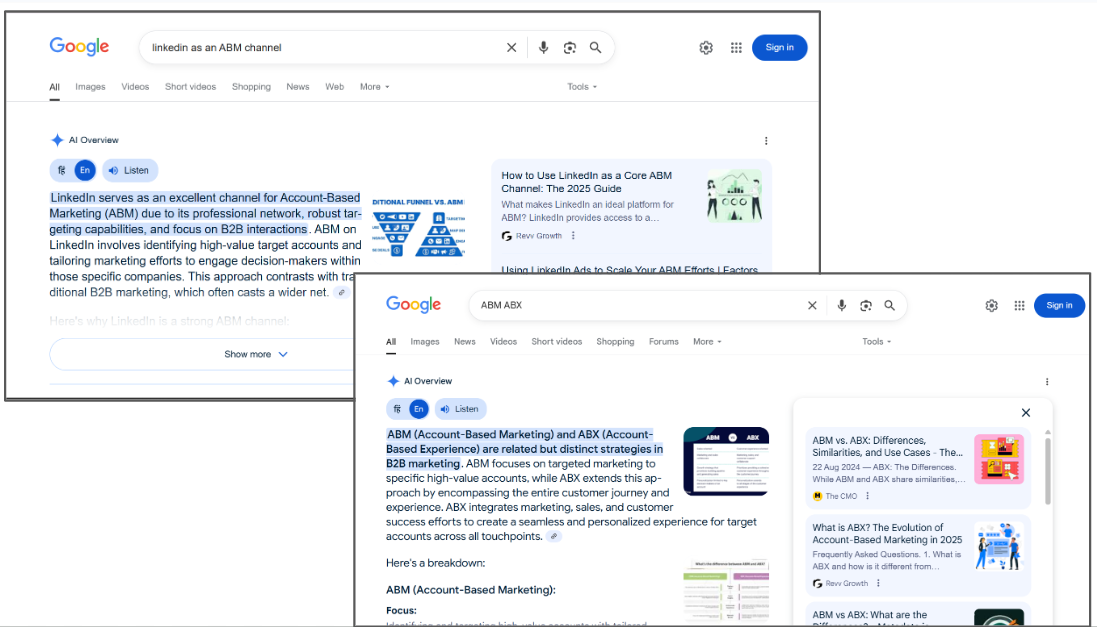
Pro tip: Ask to see the standards writers and editors follow. A documented process helps you judge whether quality can hold as production scales.
4. Verify case studies, reviews, references, and results
Strong case studies give you enough context to understand how the result was achieved. Look for the starting point, work completed, timeframe, and movement across the metrics tied to the engagement.
Useful questions include:
- What was the baseline?
- What work was carried out?
- How long did improvement take?
- Which metrics changed?
- How was performance measured?
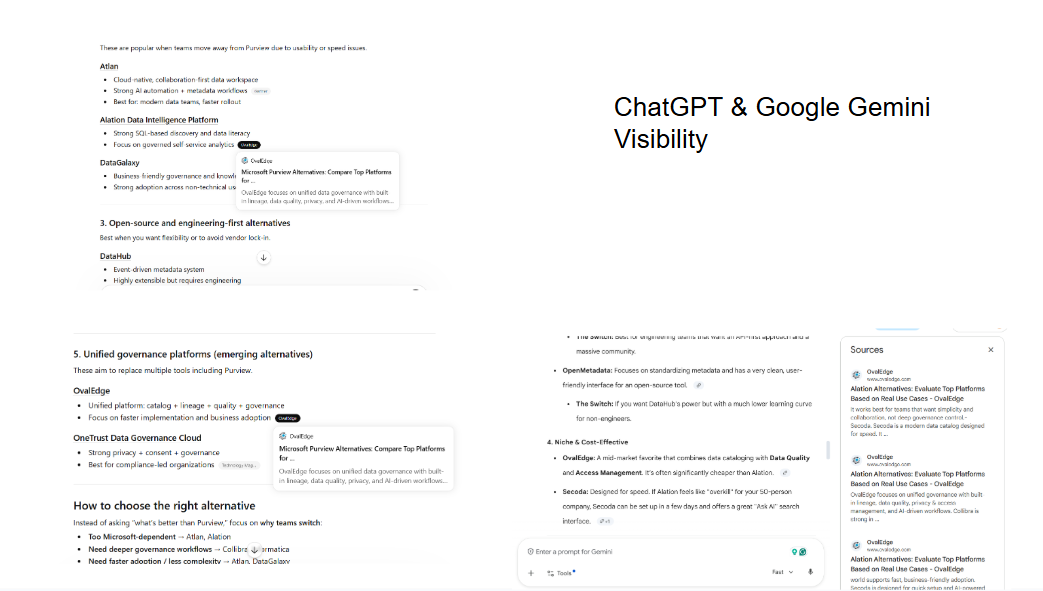
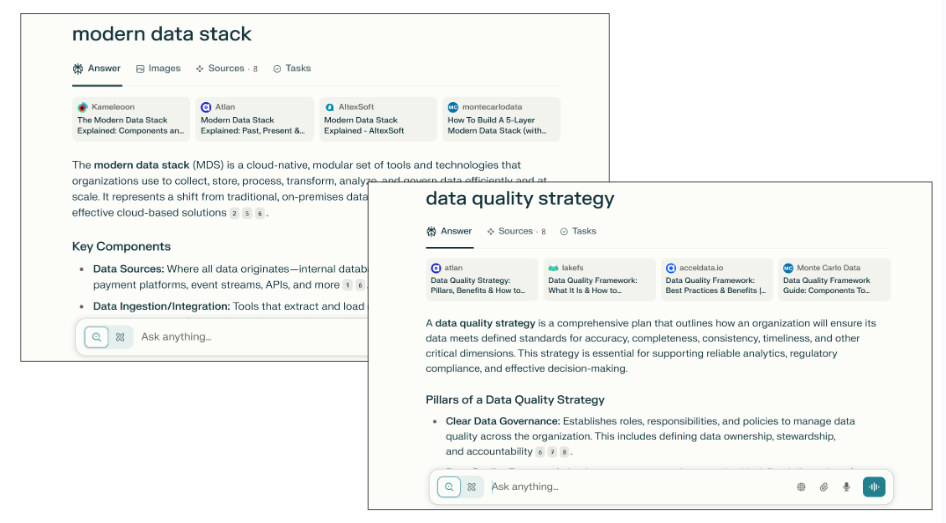
Broader proof across search channels can also help you evaluate how current the agency’s approach is. Through our work with brands including Atlan and OvalEdge, client content has earned visibility and citations across traditional search and AI-driven discovery.
Client reviews and references add another useful layer, giving you a sense of how the team communicates, collaborates, and responds to feedback over time.
5. Assess the agency's strategy, workflow, SEO, and distribution process
Ask the agency to show how content moves from research to publication.
At RevvGrowth, keyword and audience research is combined with manual SERP analysis, People Also Ask results, competitor gaps, and AI-search patterns. Search intent, headings, supporting sources, internal links, examples, and CTA opportunities are mapped before drafting begins.
We applied the same research-led approach to Everstage, producing 150+ long-form assets while supporting visibility across AI Overviews, ChatGPT, and Perplexity.
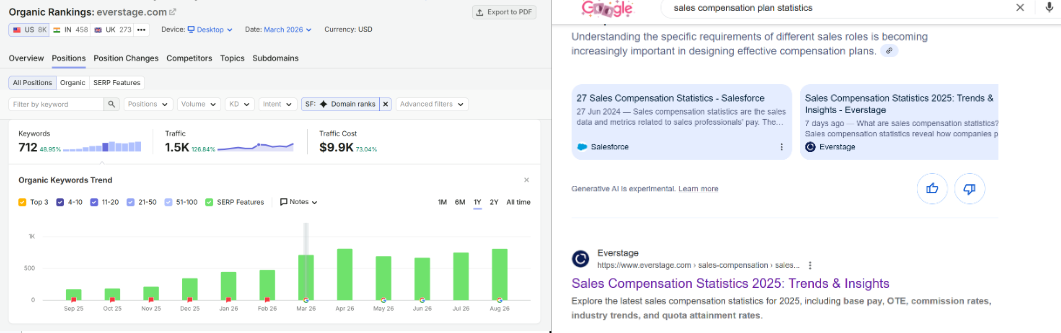
Our SaaS content marketing approach also connects SEO, AEO, and GEO, giving content opportunities to compete across Google Search, AI Overviews, and LLM answers.
6. Evaluate the team, communication, transparency, and cultural fit
The team in the pitch meeting may not be the team working on your account. Find out who stays involved once the engagement begins.
Use practical questions to uncover how responsibility is divided:
For example, RevvGrowth uses AI to support research, outline development, and first-draft production, while final editing, fact-checking, feedback implementation, and QA remain manually owned. Client comments are reviewed individually so changes can be made without weakening search intent, factual accuracy, or overall structure.
7. Review reporting, pricing, and contract terms
Compare proposals based on what you receive, not the monthly fee alone.
The 2026 CMI and MarketingProfs report found that 33% of B2B marketers ranked measuring content effectiveness among their three biggest challenges. This can be overcome by asking the right questions.
Ask what the agency measures and how often reporting is shared. Depending on the engagement, metrics may include keyword movement, qualified organic traffic, conversions, content-assisted pipeline, and AI-search visibility.
At RevvGrowth, published content is monitored against its keyword targets and business goals using tools such as Google Search Console, Ahrefs, and Semrush, followed by a SERP and AIO visibility analysis. Performance data then feeds back into optimization decisions instead of sitting in a monthly report without a next step.
Also review the content marketing proposal for:
- Included deliverables.
- Revision limits.
- Additional costs.
- Content and asset ownership.
- Scope-change rules.
- Notice periods and termination terms.
Before signing, you should know how the agency plans, produces, reviews, measures, and improves content.
What services should a content marketing agency offer?
A content marketing agency should cover the capabilities your team needs across strategy, production, search visibility, publishing, and performance measurement. RevvGrowth brings those areas into one workflow, with AI supporting speed and human strategists and editors retaining control over research, context, accuracy, and quality.
1. Content strategy and research
Before recommending topics, an agency should understand your ICP, buyer intent, funnel stages, competitive landscape, and existing search visibility.
Our process combines keyword research with manual SERP analysis, People Also Ask results, AI Overviews, competitor gaps, and buyer intent. These findings shape the roadmap, angle, structure, and purpose of each asset.
Quick tip: Evaluate whether the agency prioritizes audience needs over publishing volume. SaaS marketers recommend creating useful content around buyer needs instead of committing to a fixed volume of generic posts.
2. Content creation and editorial management
Look for ownership across briefing, writing, sourcing, editing, fact-checking, and final QA.
We use AI for parts of research, outlining, and first-draft production. Human editors strengthen context, add credible sources and examples, refine brand voice, and complete editorial and SEO reviews.
The same editorial model supported Atlan’s content engine as production scaled to 130+ long-form SEO blogs per month, while maintaining structured briefs, search-intent alignment, and human review.
3. SEO, AEO, and GEO
Content now needs to earn visibility across Google Search as well as AI-generated answers. A strong AI SEO strategy should connect SEO, AEO, and GEO within the content workflow.
Our work covers search intent, semantic structure, internal linking, direct-answer formatting, entity signals, and opportunities to earn citations across AI platforms.
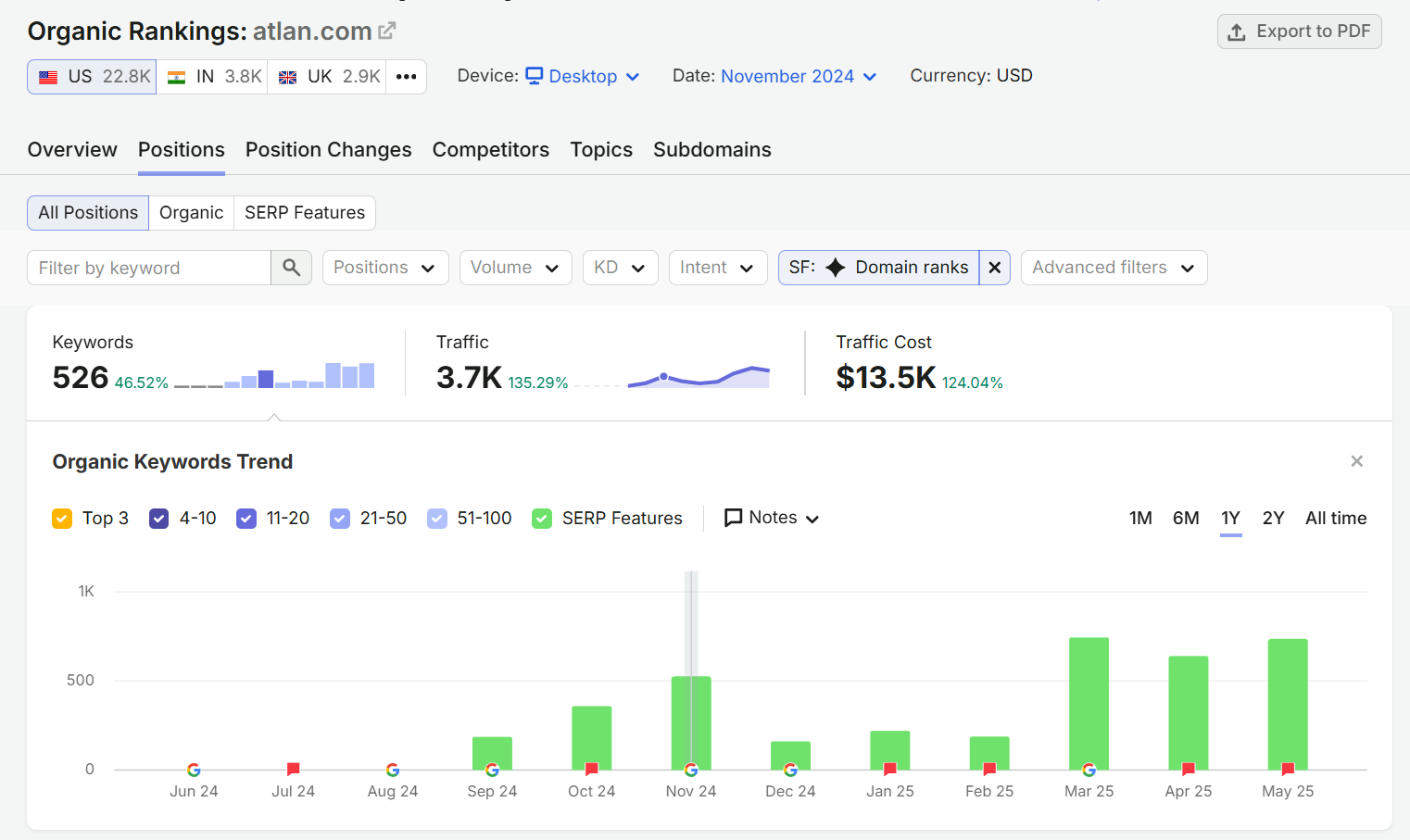
Applying the approach to Atlan helped move the brand from zero recorded AI-platform citations to 6,500+ domain citations and 2,900+ cited pages, with appearances across 7,600+ AI-generated prompts.
4. Publishing and on-page execution
An agency can also take ownership after content approval. Depending on the engagement, support may include CMS publishing, metadata, internal linking, CTA placement, image optimization, and live-page quality assurance.
We handle those steps when required so approved content can move from the editorial workflow to a properly optimized live page without creating another execution layer for the client team.
5. Performance tracking and optimization
Reporting should show whether content is gaining visibility, contributing to qualified demand, and identifying opportunities for improvement.
We track organic performance, keyword movement, AI citations, LLM referral traffic, conversions, and pipeline metrics where attribution allows. The findings inform content refreshes and future priorities.
Atlan’s monthly organic traffic grew from 53,802 to 103,705, while monthly MQLs increased from 120 to 150 alongside growth in traditional search and AI visibility.
Content marketing agency evaluation checklist
Use a consistent set of questions to compare shortlisted agencies. The 2025 4As and ANA report found that the average client-agency relationship lasts about seven years, so the evaluation should go beyond pitch quality.
Red flags to avoid when choosing a content marketing agency
Watch for signals that make execution, accountability, or measurement difficult:
- Guaranteed rankings or immediate traffic gains: Search performance depends on competition, authority, implementation quality, and time.
- Volume presented as the strategy: Every asset should support a defined audience, search, or business goal.
- Generic packages before discovery: Scope should reflect your market, resources, and content gaps.
- No SME or customer-input process: Strong B2B SaaS content requires product and customer context.
- Vague proof or reporting: Case studies and reports should explain what changed and how performance was measured.
- Unclear ownership: You should know who manages the account, produces the work, and remains accountable.
Many mistakes to avoid when hiring a content marketing agency start with unclear expectations around process, ownership, measurement, and scope.
Build a stronger content future with the right partner
Once you have narrowed your shortlist, choose the agency that can translate your priorities into a clear plan with defined ownership and measurable milestones.
Start by reviewing your ICP, existing content performance, search visibility, and pipeline priorities. RevvGrowth can identify where content, SEO, AEO, and GEO are disconnected and which gaps deserve attention first.
You can then decide what your team should keep in-house and where outside expertise can add the most value.
Book a free strategy session with RevvGrowth to identify the visibility, content, and pipeline gaps worth addressing first.
.svg)


.webp)
.avif)