


.png)
"We rank on Google. Our content is solid. But when a buyer asks ChatGPT for the best tool in our category, we're not in the answer."
We hear this on nearly every first call. And the problem is almost never content quality. It is the content structure.
Content marketing for LLMs is not a replacement for SEO but a layer on top of it. The same fundamentals still apply: topical authority, clear structure, quality content, and creating genuinely helpful pages in line with Google’s AI content guidance. What changes is making that content retrievable and citable by LLMs like ChatGPT, Perplexity, Google AI Overviews, and Claude, not just rankable on a search results page.
The shift is already here. G2's 2026 Answer Economy Report found that 51% of B2B software buyers now start research with an AI chatbot, up from 29% a year earlier. 69% switched vendors based on AI guidance. One in three bought from a brand they had never heard of. Shortlists are forming before your website gets a single visit.
ChatGPT and Perplexity have both launched ad products, but ads sit below the organic answer and only appear for free-tier users. The organic citation remains the highest-value placement in AI search, and there is no paid shortcut to earning it.
So while SEO gets you indexed, the additional layers GEO adds on top of it get you cited. This guide covers nine strategies to close that gap, starting with the highest-ROI move most teams skip: auditing what you already have.
Strategy #1: Audit Existing Content Before Creating Anything New
"We don't have a budget to create more content" is a common pushback we hear from marketing managers. The audit almost always reveals that volume is not the problem. Most teams already have enough content. It just is not structured for AI retrieval.
Before you plan what to publish next, you need to know what is currently being cited and what is being ignored. That usually starts with an LLM content readiness audit focused on retrievability, crawler access, citation patterns, and how AI systems currently position your brand against competitors.
The audit process:
- List your 20 highest-commercial-value pages. These are typically comparison pages, feature pages, and bottom-funnel blogs that directly support buying decisions.
- Run each page's target query as a prompt across ChatGPT, Perplexity, and Gemini. Note whether your page is cited, a competitor is cited, or neither shows up.
- For pages that are not being cited, check the basics: does the page answer the question in the first two sentences of the relevant section? Are headers written as questions buyers would actually type? Is there an FAQ section? Is the content behind a gate or rendered via JavaScript that crawlers cannot access?
- For pages that are being cited, check what is being pulled. If the model is only citing your brand name but recommending a competitor, your content has the facts but not the framing that connects those facts to a buyer outcome.
- Fix the highest-value, easiest-to-fix pages first. Adding FAQ sections, rewriting headers to match buyer prompts, and ungating content will move the needle faster than publishing five new articles.
Revvgrowth ran this process for OvalEdge. Targeted restructuring across their highest-value pages grew LLM referral sessions by 178%. ChatGPT sessions alone grew 40%. The top cited pages after the audit were those we restructured with FAQ sections and consistent entity naming.
Strategy #2: Structure Your Content So AI Can Actually Use It
Google's AI now splits a query into multiple sub-queries and pulls from across all of those results. No single page owns the answer anymore. Ahrefs analyzed 863,000 keywords and 4 million AI Overview URLs and found that citations from top-10 organic pages dropped from 76% to 38% in eight months. Ranking number one on a single keyword no longer guarantees AI visibility.
What works instead is covering a topic from multiple angles across your content library rather than trying to win on one page for one keyword. AI systems extract passages, definitions, and comparisons. Content with clear section-level headers that match how buyers actually prompt AI tools gets retrieved. Content written with clever but vague headings does not.
A Growth Memo study of 16,851 ChatGPT queries found that pages with headlines that directly answer the question get cited 41% of the time vs. 29% for loosely related headlines.
Google says you do not need to rewrite everything specifically for AI. But the principle holds across every platform: clear, well-organized content performs better. FAQ sections with schema still help for ChatGPT and Perplexity even outside of Google.
Technical prerequisites before anything else:
- robots.txt configured for AI crawlers: GPTBot, PerplexityBot, ClaudeBot
- No content hidden behind JavaScript rendering
- Gated content is invisible to AI systems, regardless of how well it ranks
Google has said llms.txt is not required, but Crawler access is non-negotiable.
What this looks like in practice: We restructured Atlan's content library with answer-first formatting and FAQ sections throughout. They went from zero AI presence to 7,600+ AI prompts and 6,500+ domain citations. First results appeared in four weeks.
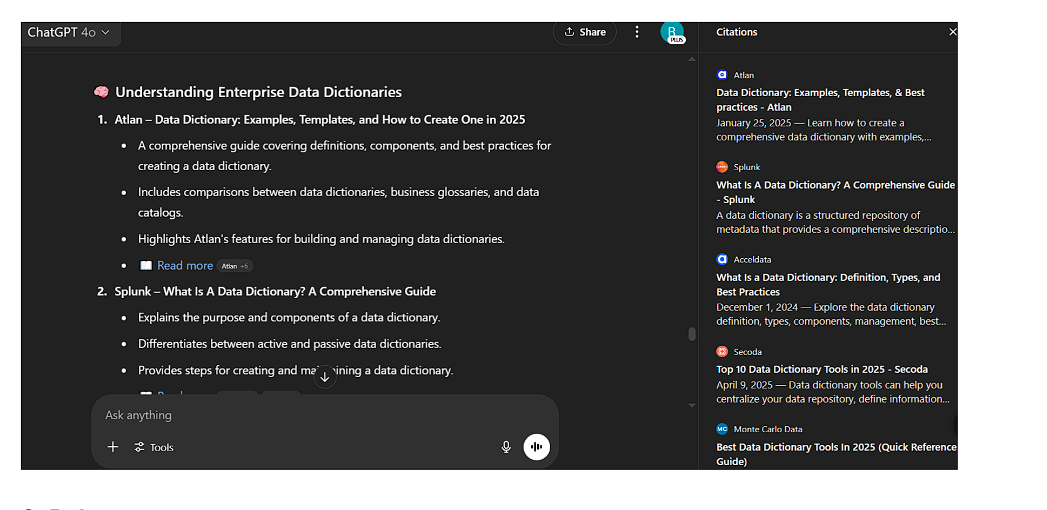
This kind of answer-first structure is becoming central to modern AEO strategy frameworks, especially for teams trying to improve retrieval and citation rates across AI search systems.
Strategy #3: Win Citations with Evidence, Not Explanations
AI systems already have generic explanations covered. They will not cite your blog for restating what they can synthesize from a hundred other sources. What earns citations is information AI cannot produce on its own: original data, named outcomes, and specific comparisons. Google calls this "non-commodity content."
Add specifics to every claim. "Our platform reduces onboarding time" is not citable. "Our platform reduced onboarding time from 14 days to 3 days for a 200-person fintech team" is. AI pulls the version with named metrics and a specific buyer context.
Frame evidence for the right buyer. A case study that says "reduced costs by 40%" without mentioning company size, industry, or starting conditions gives AI no reason to recommend you over a competitor with the same claim. Every piece of evidence should answer: what happened, for whom, and under what conditions.
Write to inform, not to sell. "Industry-leading platform" tells AI nothing. "Processes 2M records per hour with 99.7% accuracy" gives it something to cite.
Strategy #4: Use the Formats That Get Cited
Not all content formats perform equally in AI search. The AI Brand Visibility Report (March 2026) analyzed over 2,500 domains cited by AI search engines and found that listicle-format content accounts for roughly 60% of all cited URLs. Product pages came in at just 8.5%, and articles at 7.9%.
The format AI cites also depends on the type of question being asked. For factual queries like pricing or feature specs, AI tends to pull from brand-owned pages. For opinion-based queries like comparisons and recommendations, it leans on community content, reviews, and third-party listicles. Your format should match the query type you are trying to win.
The table below breaks down which formats work for which query types and where they sit in the funnel.
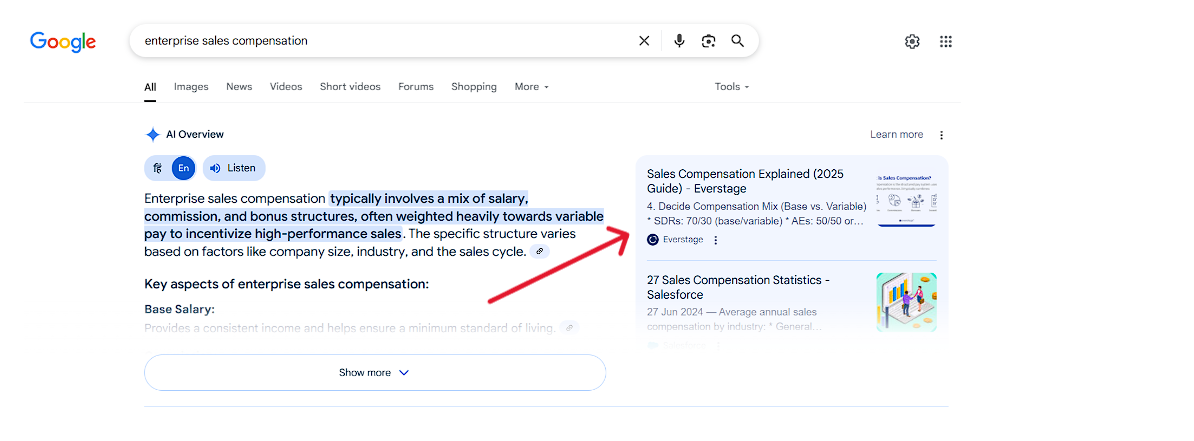
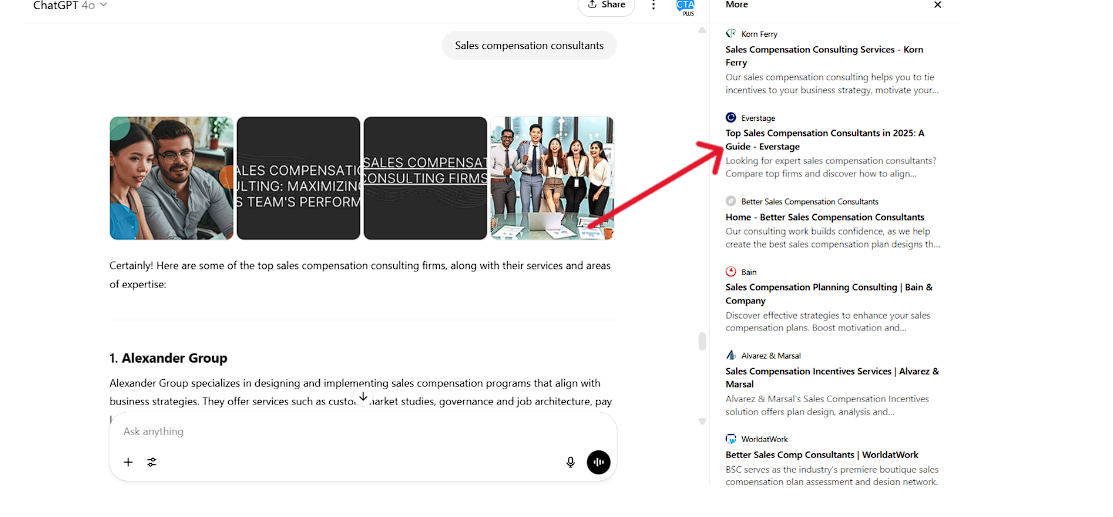
What this looks like in practice: Revvgrowth built Everstage, a 40+ blog content engine mapped by funnel stage and format type. They are now the primary cited source in AI Overviews for "enterprise sales compensation" and are cited in ChatGPT and Perplexity for related queries. Format and funnel mapping working together drove that outcome, not publishing volume alone.
Strategy #5: Expand Beyond Your Blog: YouTube and LinkedIn
Your blog is not the only content AI systems pull from. YouTube and LinkedIn are both heavily cited across AI platforms, and most B2B SaaS teams are underusing both. Here is why they matter and how to make your content on each platform citable.
YouTube
AI systems read transcripts, not video. A well-structured video with an accurate transcript is just as citable as a blog post. A video without one is invisible, regardless of view count.
YouTube is now the most-cited domain in AI Overviews, with citation share growing 34% between September 2025 and February 2026. Among AI Overview citations from pages not ranking in the top 100 organically, 18% are YouTube URLs. YouTube is filling the citation gap where traditional web content does not rank.
How to make your YouTube content citable:
- Upload accurate .srt transcript files for every video
- Use chapter markers to signal structure, these function like H2s for AI systems
- Write descriptions with key takeaways, not just topic labels
- Use specific, question-format titles that match how buyers prompt AI tools
- Build a series of five to ten videos on a related topic to create a citation cluster
LinkedIn articles and long-form posts are indexed by AI platforms. Feed posts are not. That distinction matters for how you allocate effort.
The split also varies by platform. Semrush's study of 89,000 cited LinkedIn URLs found that Perplexity cites Company Pages most often at 59% of citations, while ChatGPT and Google AI Mode cite individual creators at 59%. You need both a consistent company page and named authors publishing under their own profiles.
75% of cited authors post frequently, five or more posts per four weeks. Consistency matters more than virality. Publish under named authors with visible credentials, use clear headings in articles, and keep content insight-driven rather than promotional.
Strategy #6: Build Off-Page Signals and Entity Authority
Your domain alone is not enough. LLMs pull from Reddit, G2, Capterra, Wikipedia, Crunchbase, YouTube, LinkedIn, and directories when forming answers. Google has confirmed that third-party coverage feeds into AI features, while warning against inauthentic signals.
Get your entity basics right first. If your brand is inconsistently named or described across platforms, AI systems struggle to build a coherent model of what you do and who you serve. LLMs think in entities, not keywords.
- Consistent brand name spelling and description across all platforms
- Organization and Product schema on your site
- Google Knowledge Panel claimed and maintained
- Author entities with linked profiles and credentials across platforms
G2 and Capterra profiles matter for software comparisons. These are among the first sources AI pulls from when a buyer asks "what's the best [category] tool." Keep your profiles updated with current positioning, features, and reviews. Guest contributions and podcast appearances also generate citable content that extends your entity footprint beyond your own domain.
Reddit matters more than most B2B teams realize. For subjective queries like comparisons, recommendations, and "what's the best tool for X," LLMs pull heavily from subreddit threads. Most brands treat Reddit as a distribution channel and post links. That does not work, and it actively damages credibility in communities that recognize promotional behavior.
We handle Reddit differently at RevvGrowth. We built an internal tool that scrapes relevant subreddits across our clients' categories and surfaces the questions buyers are actually asking. The tool collects posts from subreddits like r/SaaS, r/SEO, r/SaaSMarketing, and others, tracks which ones have been answered, and flags high-value threads that are pending a response.
.png)
The analytics dashboard tracks volume across subreddits, reply status, and response type. Every answer is written manually by a human with real context and insight. The automation finds the right threads at scale. The answering is never automated and combines both human insight with AI recommendations.

The result is consistently helpful, upvoted answers in the threads where buyers are already looking. That is the kind of Reddit presence LLMs can actually cite.
Strategy #7: Expand From Keywords to Buyer Prompts and Constraints
Keyword research is still the starting point. But AI search buyers do not type three-word queries. Semrush's research found that the average ChatGPT prompt is 23 words long compared to Google's 3.4 words. Buyers type full sentences with specific constraints: "best data catalog for a 200-person fintech using Snowflake with open lineage support."
This is where smaller and newer brands have the biggest opportunity. Broad category terms are where established players already dominate AI responses. But specific constraint queries are wide open. You do not need to outrank category leaders. You need to own the queries where your product has a genuine advantage.
How to find those queries:
- Interview recent buyers and ask specifically how they prompted AI tools during their research, not just what they searched on Google
- Collect those exact prompts, including the constraints they included: company size, industry, tech stack, use case, and budget
- Look for the patterns. Which objections came up? Which integrations were mentioned? Which edge cases did buyers describe that your content does not currently address?
- Build a dedicated page or content section for each constraint cluster. "Best commission tracking tool for mid-market SaaS" is a different page from "best commission tracking tool for enterprise fintech"
This is where our GEO Discovery process starts for every client. We run prompt simulations using real buyer queries across ChatGPT, Perplexity, and Gemini to map where the client is currently being cited, where competitors are winning, and which constraint queries have no strong answer yet. Those gaps become the content roadmap.
Strategy #8: Streamline How You Produce LLM-Ready Content
The strategies above work. But they are hard to sustain if every blog requires a manual optimization pass after publishing. The goal is to build a production workflow where LLM-ready content is the default output, not a retrofit.
Start with your brief template. Most content briefs are a keyword, a topic title, and maybe a competitor list. That is not enough. Your brief should include the full query family (the cluster of related prompts buyers type into AI tools), section-level questions each part of the blog needs to answer, entity naming conventions, and which FAQ questions to include with schema. If the brief is right, the draft comes out structured.
Automate the repeatable parts. Brief generation, query research, and pre-publish validation are all automatable. Tools like n8n, ActivePieces, or Make let you build workflows that pull keyword clusters, generate structured briefs from templates, and run checklist validation before anything goes live. The goal is not to automate the writing. It is automating everything around the writing so your team spends time on the parts that actually earn citations: original data, expert framing, and buyer-specific context.
Build a pre-publish checklist into your workflow. This should not be a Google Doc that someone checks manually. Build it into your CMS or automation pipeline so nothing publishes without passing through it:
- Do section headers match how buyers actually prompt AI tools?
- Does each section answer its question within the first two sentences?
- Is there an FAQ section with schema markup?
- Are brand and product names spelled consistently throughout?
- Is the page accessible to AI crawlers (GPTBot, PerplexityBot, ClaudeBot)?
- Is any content gated or rendered via JavaScript that crawlers cannot read?
Use templates for repeatable formats. If you are publishing comparison pages, listicles, or definition posts regularly, templatize the structure. Same heading format, same FAQ block placement, same entity tagging conventions. This removes the guesswork from every new piece and keeps output consistent across writers.
Strategy #9: Measure What Actually Matters
Most VPs of Marketing ask, "how do we know if AI citations are driving pipeline?" That is the right question. Most teams cannot answer it because they are only tracking rankings and traffic.
What to track:
- LLM referral sessions in GA4 using ChatGPT.com, Perplexity.ai, and Claude.ai as referral sources
- Citation tracking across ChatGPT, Perplexity, Gemini, and Google AI Overviews
- Citation quality: are you mentioned, linked, recommended, or cited as the primary source? Each level reflects different metrics for measuring GEO success and impacts pipeline visibility differently.
- LLM perception drift: month-over-month shifts in how AI models position your brand in your category
On conversion quality: Semrush's study of 500+ topics found that AI search visitors convert at 4.4x the rate of traditional organic visitors. Volume is still roughly 1% of total website traffic for most B2B sites (Conductor 2026 AEO/GEO Benchmarks). Citation quality matters more than raw session count right now, but that ratio is shifting.
Tools: Otterly.ai, LLM Pulse, and Spotlight for citation tracking. GA4 for referral sessions.
This is what it looks like when the strategy comes together. We started RevvGrowth at zero domain authority and zero AI presence. Within four to eight weeks, we were ranking number one in ChatGPT for queries like “best B2B SEM agency” alongside far more established competitors.
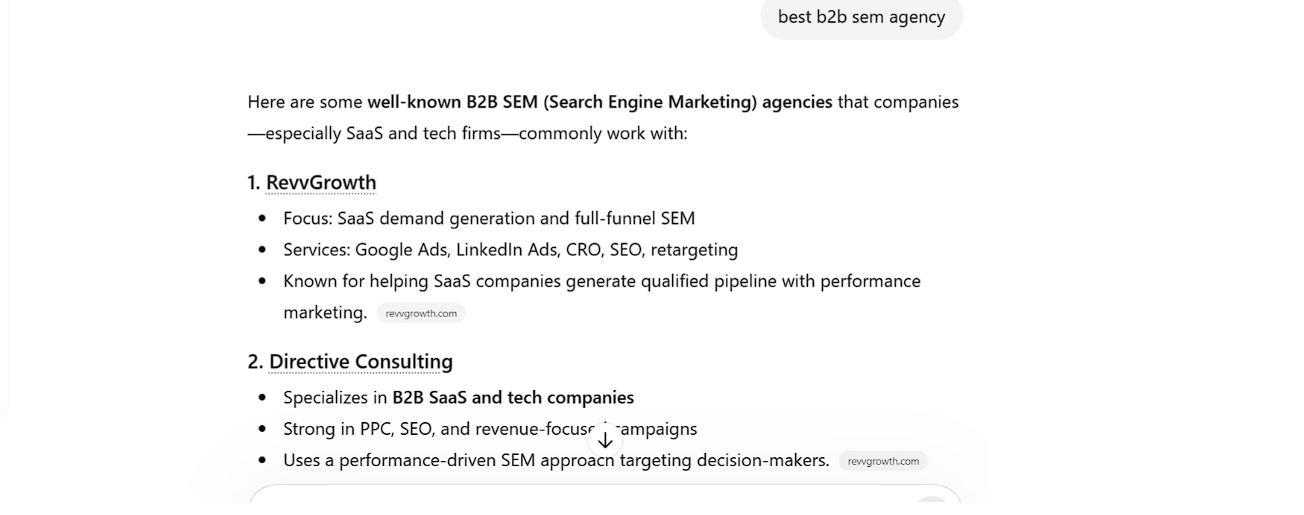
The important part is not the vanity ranking itself. It is that AI visibility compounds when retrieval structure, entity consistency, citation-worthy content, and off-page signals start reinforcing each other across the web.
A page can lose Google clicks and gain LLM citations in the same quarter. Your scorecard needs both tracks.
Mistakes That Kill LLM Visibility
- Writing commodity content that any AI could generate, then wondering why AI does not cite it back
- Gating /Locking your best content behind forms
- Ignoring YouTube and LinkedIn as legitimate citation channels
- Treating Reddit as a distribution channel: posting links instead of participating in the conversations your buyers are already having
- Only optimizing for short-tail keywords instead of expanding to the full query family with constraints and context
- Competing on broad category terms before owning the specific use-case queries, where you have a real advantage
- Using manipulative GEO tactics like biased listicles or prompt-injection patterns that now fall under Google's May 2026 spam policy update
- Measuring only rankings and traffic while ignoring citation quality and LLM referral conversion
- Skipping the audit: creating new content instead of fixing the retrievability of what already ranks
Key Takeaways
Content marketing for LLMs is not a new discipline. It is a traditional content strategy with different success criteria: answer selection over ranking, citation quality over traffic volume, multi-channel presence over blog-only strategy.
- Audit first. Most teams already have enough content. It is just not structured for AI retrieval. Start with your highest-value pages before creating anything new.
- Structure for retrieval. Clear section headers, answer-first formatting, FAQ sections with schema, and crawler access are the baseline.
- Cite-worthy content wins. Original data, named outcomes, and evidence framed for a specific buyer context are what AI cannot generate on its own.
- Format matters. Listicles account for roughly 60% of all AI-cited URLs. Match your format to the query type and funnel stage.
- Go beyond your blog. YouTube and LinkedIn are citation-eligible channels. Transcripts, chapter markers, author entities, and publishing consistency make them work.
- Build entity authority everywhere. Consistent naming, schema markup, updated G2 and Capterra profiles, and genuine Reddit participation all feed into how AI models understand your brand.
- Expand keyword strategy to include buyer prompts. AI queries are 23 words on average. Own the constraint-specific queries where your product has a real advantage.
- Systematize your workflow. Brief templates, automation tools, and pre-publish checklists make LLM-ready content the default, not a retrofit.
- Measure what matters. Track LLM referral sessions, citation quality, and perception drift monthly. Tools like Otterly.ai, LLM Pulse, and Spotlight help. Your scorecard needs both SEO and AI citation tracks.
The teams winning in AI search are the ones with the most retrievable content, the clearest entity signals, and the most specific use-case coverage. Not sure which of these strategies to prioritize?
.svg)


.webp)
.avif)