


Introduction
Content marketing has become harder to resource well. For B2B SaaS companies, marketing teams are expected to increase output, maintain quality, and support search visibility without adding unnecessary headcount.
But with this pressure comes a new kind of decision fatigue: "Who should actually execute your content strategy?"
- A full in-house team?
- A specialized content marketing agency?
- A group of reliable freelancers?
Each model gives you a different mix of cost, expertise, control, speed, and scalability. That makes deciding between a content marketing agency vs. in-house vs. a freelancer more nuanced than simply comparing a salary, retainer, or freelance rate.
If you want to make the decision quickly, start with the comparison below. It shows the main trade-offs at a glance, while the sections that follow explain where in-house teams, agencies, freelancers, and hybrid setups tend to make the most sense in practice.
Content marketing agency vs in-house vs freelancer: Quick comparison
The right content marketing model depends on what your team needs to optimize for.
In-house teams offer the most direct control and company context. Agencies provide broader capabilities without requiring you to build every role internally. Freelancers work particularly well when the scope is clear and specialized.
Here’s how in-house teams, agencies, and freelancers compare across the factors that matter most:
For context, Revv Growth works as the agency or external execution layer for B2B SaaS teams that want to keep product knowledge and strategic oversight in-house. We bring together content strategy, SEO, production, human editing, AI-search optimization, and performance tracking within one workflow.
How in-house, agency, and freelance content models work
Choosing between in-house, agency, and freelance content gets easier when you look at what each model gives you, what your team still needs to manage, and where its limitations show up.
1. What an in-house content marketing team looks like
An in-house content team consists of employees dedicated to your company, from a single content lead to several specialists. But one content hire is not necessarily a complete content marketing function.
A mature content program may need some combination of:
- Content strategy
- Writing
- SEO
- Editing
- Design
- Distribution
- Analytics
- Subject-matter expertise
One person can cover several of these areas, but rarely all of them at the same depth.
According to CMI’s 2025 research, 54% of organizations with dedicated content resources have teams of just two to five people. Even in-house teams may therefore need outside specialists when workload or expertise exceeds internal capacity.
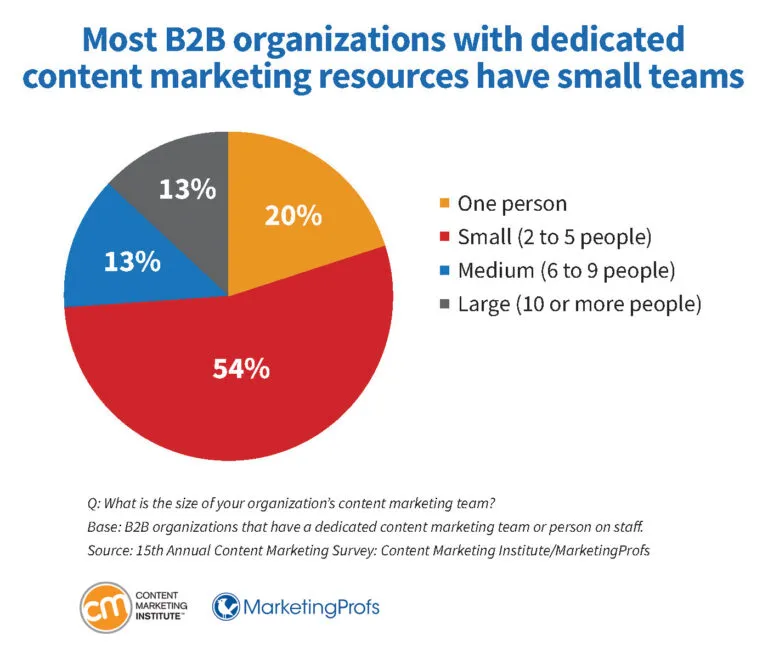
Image source: CMI’s 2025 research
Where in-house content teams have an advantage
In-house teams win on company context. They have direct access to product, sales, founders, and SMEs, which helps them understand customer objections, messaging changes, and business priorities faster.
That proximity also builds institutional knowledge over time and gives the company tighter control over brand voice, priorities, and approvals.
Where the in-house model gets difficult
The model becomes harder when one hire is expected to run the entire content operation.
A content manager may quickly end up owning strategy, SEO, briefs, interviews, writing, editing, reporting, and stakeholder management. Adding specialists solves the breadth problem, but increases hiring time, fixed costs, and management overhead.
Capacity is another constraint. If a product launch suddenly requires ten additional articles, the team may need to reprioritize work, hire, or bring in external support.
Quick note: Marketers highlight stronger product understanding and brand consistency as in-house advantages, while noting that building enough internal expertise can become expensive. In-house therefore works best when content needs consistent, long-term ownership and there is enough ongoing work to justify dedicated headcount.
2. What a content marketing agency brings
Hiring a content marketing agency means buying a coordinated set of capabilities, not simply more writers. Depending on the engagement, that can include:
- Strategy
- SEO
- Writing
- Editing
- Design
- Content operations
- Analytics
- Distribution and repurposing
The value is having those capabilities work through one process instead of hiring and managing each specialist separately.
Where agencies have an advantage
Agencies are strongest when the work requires breadth and sustained execution. A SaaS company can access several skills without recruiting each specialist individually and scale output more easily when demand changes.
With established processes, briefing, editing, QA, project management, and reporting do not need to be built internally from scratch.
The same CMI research found that 39% of B2B marketers cited time, people, or budget constraints among their top content marketing challenges, while 28% struggled to produce enough quality content. Agencies provide external capacity, which becomes valuable when it solves that bottleneck without adding another layer of internal management.
Where the agency model gets difficult
With the agency model, you give up some day-to-day control and need to invest time in onboarding, feedback, and knowledge transfer. Retainers can also be difficult to justify if your content requirements are inconsistent or too narrow.
Quality varies significantly between agencies. Strong sales conversations and case studies do not guarantee that the same people will work on your account, so buyers should ask who will actually own strategy, writing, editing, and client communication before signing.
Agencies therefore work best when you need several content capabilities working together and have enough consistent work to make a coordinated external team worthwhile.
Also read → Best SaaS Content Marketing Agencies: 8 Top Picks
3. What Freelance Content Marketers Offer
A freelancer is often the strongest option when you know exactly what you need.
That might mean SEO articles, technical thought leadership, editing, or temporary production capacity. You hire one specialist for a clearly defined job rather than a broader team.
Where freelancers have an advantage
Strong freelancers can offer deep expertise in a particular industry, format, or skill. You also work directly with the person doing the work, which means fewer communication layers and clearer accountability.
Engagements are typically flexible too, allowing you to bring in a specialist for a specific project or capacity gap without committing to permanent headcount or a broader agency retainer.
Where the freelance model gets difficult
The limitations appear when a focused assignment becomes a broader content program.
One freelance writer may produce excellent SaaS content. But once you add SEO strategy, design, distribution, or higher production volume, you may need several specialists, putting coordination and QA back on your internal team.
Freelancers therefore work best when the requirement is specific, and your team already knows how to direct and review the work.
How much does each content marketing model cost?
A freelancer might look cheapest on paper, and an agency might look expensive next to one content hire. But neither comparison tells you what it actually costs to get the full job done.
The better comparison is what you pay for the level of content capability you need, including the people, tools, management, and specialist support required to keep the program running.
These ranges are useful for planning, but the sticker price is only part of the cost.
With an in-house team, you should also factor in recruiting, benefits, tools, training, management, and any specialists you still need externally. With freelancers, include the internal time spent briefing, editing, coordinating, and reviewing their work.
For example, if you spend $3,000 a month on freelancers but someone internally spends 20 hours each month managing them, the freelancer fee is not the full cost of the content program.
Likewise, comparing an $8,000 agency retainer with an $8,000 monthly employee cost is misleading if the retainer also covers strategy, SEO, editing, project management, and reporting.
How does each model perform? Compare quality, speed, and collaboration
Cost tells you what each model requires financially. Performance depends on something else: whether the people, processes, and capacity behind the model match the work you need done.
1. Quality and expertise
Content quality is not automatically better because the work is in-house, outsourced, or freelance. It depends on product context, subject-matter expertise, editorial standards, and the complexity of the assignment.
Take a technical SEO article about a complex SaaS product:
- In-house: Often strongest on product context and internal knowledge, especially when the writer has direct access to SMEs.
- Agency: Can be stronger when the article needs SEO strategy, research, writing, editing, and production expertise working together.
- Freelancer: Can be an excellent fit when you find a specialist who already understands the category and can work directly with your SMEs.
The people and editorial process matter more than the hiring model alone. As MarketingProfs Chief Content Officer Ann Handley puts it, “Quality matters a whole lot more than quantity these days.”
Whether the work comes from an employee, freelancer, or agency, increasing output only helps if the editorial standard holds.
2. Speed and turnaround
Speed can mean two different things: how quickly work can start and how quickly output can scale.
Suppose you need 10 SEO articles for a product launch within six weeks:
- In-house: Can move quickly if the team already has capacity. If not, other work must be deprioritized or additional help brought in.
- Agency: May be able to increase production by allocating several existing specialists to the project.
- Freelancer: Can often start quickly, but one person's available capacity may limit how much can be delivered within the deadline.
In this scenario, the choice depends on whether your constraint is starting quickly, maintaining production, or scaling output for a temporary spike.
3. Collaboration and communication
Each model also puts the coordination burden in a different place.
Consider a customer case study requiring interviews with sales, product, and the customer:
- In-house: Usually has the easiest access to internal stakeholders and company context.
- Agency: Can own interviews and production, but needs reliable access to stakeholders, customer information, and approvals.
- Freelancer: Gives you direct access to the person creating the asset, although your internal team may need to coordinate interviews, feedback, and approvals.
So the useful question to ask yourself in this case would be, “Who will own the communication and coordination burden?”
Also read → Why SaaS Brands Scale Faster With a Specialized Content Marketing Agency
When does a hybrid content marketing model make sense?
A hybrid model combines internal ownership with external capacity or specialist expertise.
Hybrid sourcing is common across business functions. Deloitte's 2024 Global Outsourcing Survey found that 70% of executives had selectively brought outsourced work back in-house over the previous five years even as third-party outsourcing investment continued to grow.
For a B2B SaaS team, that might look like:
- An in-house content lead owning strategy, brand voice, and alignment with business goals.
- A content marketing agency handling SEO-driven production, long-form content, and analytics.
- Freelancers supporting niche projects such as technical content, case studies, UX copy, or temporary production spikes.
This setup can work well when you need capabilities that would be expensive or unnecessary to hire for full-time. But hybrid only works if ownership is clear.
For example, decide upfront who owns:
- Strategy: Who sets priorities and connects content to business goals?
- Editorial calendar: Who decides what gets produced and when?
- Briefing: Who gives external contributors the context they need?
- Production: Which assets belong to the agency, freelancers, or internal team?
- Approval: Who has final say on accuracy, messaging, and brand voice?
- Reporting: Who measures performance and decides what changes next?
Without that clarity, the flexibility of a hybrid model can turn into coordination overhead, inconsistent messaging, and duplicated work. If your internal content lead spends more time chasing briefs, approvals, and external contributors than running the content strategy, the setup needs simplifying.
A hybrid model makes the most sense when each resource has a defined role: internal teams provide context and ownership, while agencies or freelancers add the specialist expertise and capacity the business needs.
How to choose the right content marketing model for your business stage
Your business stage matters, but it should not decide the model on its own. When comparing agency vs in-house content marketing for SaaS, consider your existing capabilities, workload, management bandwidth, and how much product context needs to stay internal.
Start by asking:
- What’s your content budget?
Under $5K/month, freelancers may offer more flexibility. At $5K–$15K, an agency can provide more structured capacity. Larger budgets may support hybrid or in-house investment.
- Do you need strategy or execution?
Freelancers can fill production gaps when the roadmap is already set. If you also need positioning, audience research, and SEO, an agency can add that strategic layer.
- How quickly do you need to scale?
Agencies and freelancers can usually add capacity faster than hiring an internal team.
- How important is brand and message control?
If positioning is central to your GTM strategy, keep strategy and final review in-house even when execution is outsourced.
- Do you have internal bandwidth to manage content partners?
If not, working with one agency may be simpler than juggling multiple freelancers. If you do, a hybrid setup gives you more control and cost flexibility.
Your answers should narrow the options naturally. The right model can also change as your content program matures. Choose the setup that solves your current constraint without creating a bigger management problem elsewhere.
Also read → 7 Steps to Choose a Content Marketing Agency for B2B SaaS
Choose Your Content Marketing Model
If you have decided that outsourcing or a hybrid setup makes more sense, the next step is to evaluate what a potential partner can genuinely take off your team's plate.
RevvGrowth combines content strategy, SEO-led planning, production, human editing, AI-search optimization, and performance tracking for SaaS teams that want coordinated execution while retaining product knowledge, positioning, and approvals internally.
If that matches the gap you are trying to solve, book a demo with RevvGrowth and see what you could outsource and what should remain with your team.
.svg)


.webp)
.avif)