


Introduction
Enterprise content marketing changed faster in the last 18 months than most teams expected.
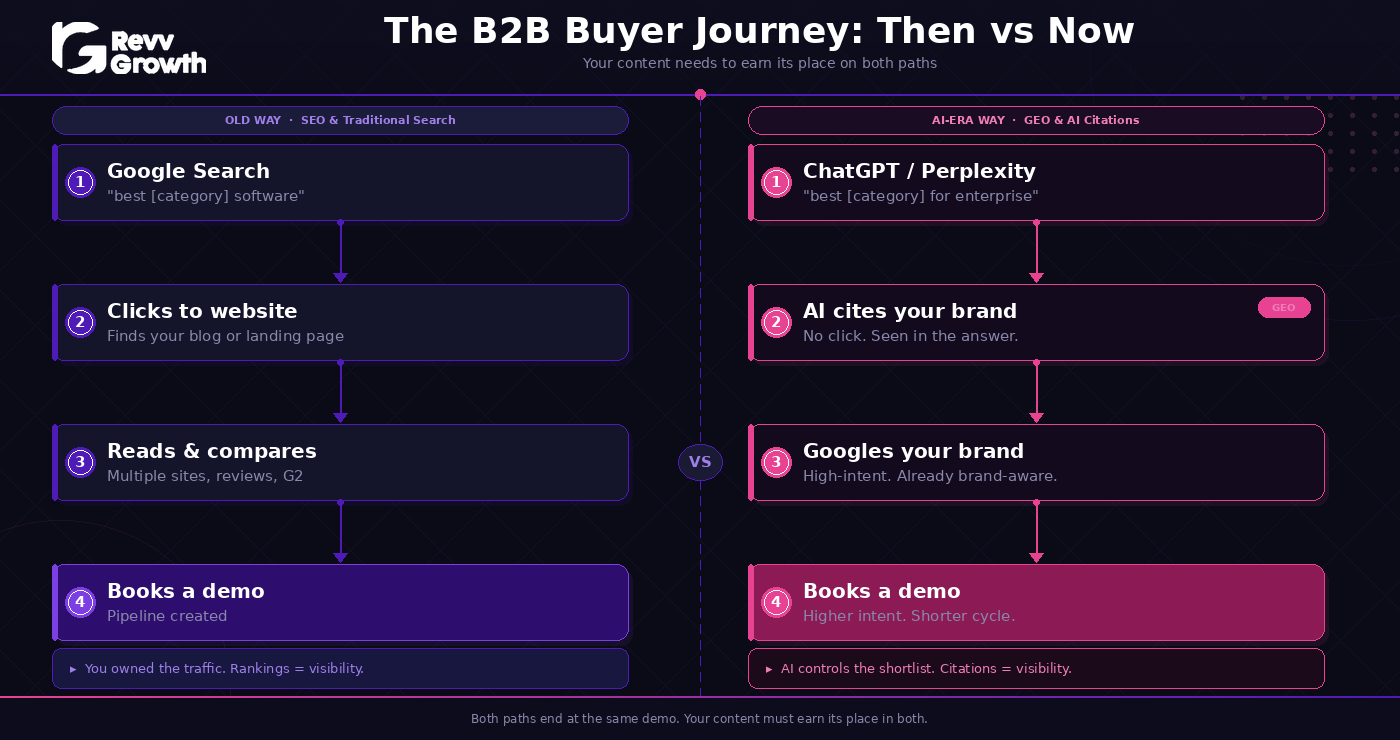
B2B buyers still research vendors. They still compare products, pricing, reviews, and analyst opinions. But now, a growing part of that research happens inside AI tools before someone clicks on a website.
51% of B2B software buyers now start research with AI chatbots more often than Google, while 71% use AI somewhere in the buying journey. Forrester Research reports that 94% of B2B decision-makers now use large language models during vendor evaluation.
That changes what content needs to do.
Ranking on Google and driving traffic is no longer enough if your brand is missing from the AI-generated answers buyers increasingly rely on for shortlists, comparisons, and recommendations.
This guide breaks down what enterprise content marketing looks like in 2026, which formats are actually influencing AI-assisted buying journeys, and how to build a strategy that drives measurable business impact.
What Is Enterprise Content Marketing?
Enterprise content marketing is a strategic, large-scale approach to creating and distributing content that drives measurable business outcomes — pipeline, revenue, and retention — across multiple channels, teams, and buyer personas.
What separates it from standard B2B content marketing is operational complexity. Enterprise programs run across multiple business units, geographies, and product lines. Buying cycles involve six to eight decision-makers. Content goes through legal and compliance before it goes live.
That complexity is also why most programs underperform. According to the Content Marketing Institute, only 28% of enterprise marketers say their content strategy is extremely or very effective, while 61% call it merely "moderately effective." The publishing cadence exists. The budget exists. The strategy connected to revenue usually does not.
In 2026, there is an additional layer. Buyers are increasingly starting research in ChatGPT, Perplexity, and Google's AI Overviews, often before they visit your website. Visibility in those surfaces now requires tactics that most enterprise programs have not yet built for.
Results-Driven Enterprise Content Marketing Strategies to Follow in 2026
Enterprise content marketing has always been about getting the right content in front of the right buyer at the right time. But the way buyers find that content has fundamentally shifted.
AI tools have changed where research starts, how vendors get discovered, and which brands make the shortlist, often before a buyer ever visits your website. The strategies below cover how to adapt what already works and what new tactics the AI era demands.
Strategy 1: Build Your Keyword List Around Buying Intent, Not Search Volume
This is the foundational shift. Stop prioritizing keywords by search volume and start prioritizing them by where the buyer is in their decision process.
The keyword tiers that drive the pipeline:
Category keywords — "enterprise [use case] software," "best [use case] platform for large teams," "[use case] software with Salesforce integration." These capture buyers who are already in evaluation mode. Start here.
Competitor and alternative keywords — "[Competitor] alternatives," "[Competitor] vs [Your product]," "tools like [Competitor]." Buyers searching for these are actively shortlisting. If you are not in this conversation, you are not in the deal.
Pain point and use case keywords — "[Problem] enterprise solution," "how to [do specific thing] at scale," "[industry] [use case] platform." These capture buyers who know the problem and are looking for a category of solution.
What to deprioritize: Broad educational keywords that attract researchers instead of active buyers. The Ehrenberg-Bass Institute’s 95:5 rule suggests only 5% of B2B buyers are in-market at a given time, which means a large share of TOFU content drives traffic visibility without contributing meaningfully to the pipeline.
For AI search: The same intent logic applies. AI tools are more likely to cite content that directly addresses evaluation-stage queries: comparisons, alternatives, "best for [use case]", than broad informational content. ChatGPT and Perplexity are increasingly used by buyers to shortlist vendors, not to understand basic concepts.
Strategy 2: Get Real Expertise Into Every Piece
The single biggest differentiator between content that gets cited and content that gets ignored is whether it contains information that cannot be found anywhere else.
Run SME interviews before every post. Not to polish the brief. To extract the actual insights, the frameworks your team uses internally, the counterintuitive lessons from real client work, and the specific reasons a common approach fails. A 30-minute call with the right internal expert produces material that no writer researching the SERP can replicate.
Publish original data. Surveys, benchmark reports, proprietary usage data, and aggregated client outcomes. AI tools prioritize primary sources. According to Ahrefs' study of 75,000 brands, branded web mentions correlate 0.664 with AI Overview visibility — versus just 0.218 for backlinks. The foundational signal for traditional SEO matters three times less than brand visibility for GEO. Original research earns those brand mentions at scale, and the data your company already has is the fastest way to produce something worth citing.
Put real names on opinions. "Based on our experience working with 50 enterprise SaaS companies..." is credible. A generic third-person overview is not. Named executives, named clients, specific situations: this is what AI systems treat as high-trust content.
The test: After writing a piece, ask whether any of the information in it required talking to a real person or accessing proprietary data. If the answer is no, the content can be replicated by any competitor with a content brief and an AI tool.
Strategy 3: Mention Your Product in the Body of the Post, Not Just the CTA
This is the most counterintuitive point for teams trained to keep content "educational."
If someone is reading "best data governance software for enterprise," they want to know if your product is relevant to their problem. Hiding that behind a generic "Book a Demo" banner at the bottom is not neutral — it actively hurts conversion.
How to do this without making it feel like an ad:
- Introduce your product naturally in the section that covers what it solves. "We built [Product] specifically to handle this problem — here is how it approaches [feature]."
- Use specific features, not marketing language. "Automated lineage mapping" is specific. "Powerful data governance capabilities" is not.
- Reference real client outcomes inline. "One of our clients, a 3,000-person financial services firm, reduced data quality incidents by 60% within 90 days."
- If you are writing a competitor comparison, include yourself as an option with honest strengths and limitations.
The goal is to be the most useful and specific source on that topic — not the most promotional, and not the most neutral. According to the CMI B2B Content and Marketing Trends: Insights for 2026 report (survey of 1,015 B2B marketers), the top performers consistently point to content relevance and quality — not volume — as the primary driver of results. Publishing more generic content does not close this gap.
Strategy 4: Optimize for AI Search Alongside Traditional SEO
AI tools — ChatGPT, Perplexity, Google's AI Overviews, Gemini — are now part of how enterprise buyers research vendors. According to Conductor's 2026 AEO/GEO Benchmarks Report, AI answers now appear in roughly one in four Google queries — and in industries like financial services and healthcare, that number approaches half of all queries. Being cited in those responses is the new top-three ranking.
What drives AI citation (GEO):
Structure content for extraction. AI tools parse and quote from content they can cleanly extract. That means: direct answers at the top of each section, clear H2 and H3 hierarchies, short paragraphs, and no burying the point in a three-sentence intro. If an AI tool tried to quote your content to answer a buyer's question, would the quote make sense on its own? It should.
Answer real buyer questions explicitly. Write sections that directly address "what is the best [type of software] for enterprise companies with [specific constraint]?" — not because that is the exact keyword, but because that is the question AI tools are being asked, and they pull from content that answers it directly.
Get cited on third-party platforms. According to Ahrefs' brand correlation study of 75,000 brands, the top three factors correlated with AI Overview visibility are all off-site signals: branded web mentions (0.664), branded anchors (0.527), and branded search volume (0.392). Your website alone is not enough. G2 reviews, Reddit threads, industry listicles, analyst mentions, and press coverage are primary GEO levers. The same study found brands in the top quartile for web mentions earn over 10x more AI Overview citations than the next quartile.
Use FAQ sections strategically. Put a structured FAQ at the bottom of every post targeting the specific questions buyers search. Keep answers under 60 words. Add FAQ schema markup. These get pulled directly into AI Overviews and featured snippets.
What drives featured snippets and AI Overviews (AEO):
- Put the answer in the first sentence after the heading, not after context-setting
- Use numbered or bulleted lists for process-based answers
- Define terms clearly and early — "Enterprise content marketing is..." not "Content marketing at enterprise scale involves many considerations..."
- Keep definition answers to 40 to 60 words
Track it: Ahrefs' updated study found that AI Overviews grew 116% following Google's March 2026 Core Update, and that YouTube brand mentions are now the single strongest correlating factor with AI visibility across all three platforms (AI Overviews, AI Mode, and ChatGPT). This means video presence on YouTube — even simple thought leadership clips — is now a meaningful GEO signal, not a nice-to-have.
Strategy 5: Build a Distribution System That Creates Third-Party Signals
Publishing is not the endpoint. For both traditional SEO and GEO, external mentions and citations are what build real authority.
The distribution actions that actually matter:
Get into industry publications. A bylined article or a quote in a relevant industry outlet does three things: builds brand awareness with the right audience, creates a backlink, and creates a third-party citation that AI tools treat as an authority signal. Per the Ahrefs brand correlation research, unlinked mentions on external pages have far more impact on GEO than on traditional SEO — meaning even a mention without a link in a trade publication or analyst report contributes to AI visibility.
LinkedIn executive posts. Short-form, no-link posts from founders and senior leaders that take a clear stance on something in your category consistently drive more pipeline than blog posts in 2026. The CMI 2026 B2B report found LinkedIn rated as the most effective social platform for B2B content distribution among their survey respondents, and exec posts contribute to the brand mention footprint that GEO depends on.
Community presence on Reddit, Slack communities, and forums. Per Ahrefs' AI Overview growth analysis, Reddit's share of AI Overview citations shot up significantly following Google's March 2026 Core Update — it now accounts for 5.5% of all AI Overview queries and is by far the most dominant single domain in AI citation share. Genuine, helpful responses from real experts in the right communities get indexed and cited.
Internal distribution. Sales and customer success teams need to know what content exists. A post that generates qualified conversations in sales cycles counts as a pipeline contribution even without a direct attribution click. Build a simple internal newsletter or Slack digest that surfaces new content to revenue teams every two weeks.
Strategy 6: Set Up Attribution That Connects Content to Pipeline
Without this, everything above is invisible to the people who decide whether the content budget survives next quarter. According to the CMI Enterprise Content and Marketing Trends 2026 report, 34% of enterprise marketers say there has been no measurable change in content performance, and the measurement gap is one of the most consistently cited challenges. The teams that solve attribution hold their budgets in downturns. The ones that cannot get cut.
The minimum viable attribution setup:
- UTM parameters on all content-driven links in email, social, and paid
- HubSpot or Salesforce source tracking on every form submission
- First-touch and last-touch attribution both tracked — they tell different stories
- A monthly report that shows: number of qualified leads sourced from organic content, pipeline value, and close rate compared to other channels
The AI visibility tracking layer:
- Track brand citation frequency for five to ten priority keywords monthly using tools like Profound, Peec, or AthenaHQ
- Note whether citations are accurate and positive — incorrect AI citations are worth fixing through content updates and third-party corrections
- Track branded search volume as a proxy for AI-driven awareness (users who see your brand in an AI response often search for you directly before converting). Ahrefs' study found that branded search volume correlates 0.392 with AI Overview visibility — making it a useful leading indicator.
The quarterly review: Every quarter, pull your GSC data and your pipeline data side by side. Reconsider posts that have been live for more than 12 months with no traffic and no pipeline contribution. Refresh posts ranking on page two with decaying traffic. Double down on topics and formats where you have clear pipeline attribution.
The Formats Enterprise Teams Should Prioritize
Not all content formats are equal for pipeline or AI visibility. Pick based on what your team can execute well, not what the list says.
High pipeline, high AI visibility:
- Comparison and alternative pages ("best [competitor] alternatives for enterprise")
- Use case and feature pages structured for specific buyer problems
- Original benchmark reports and data studies
High pipeline, medium AI visibility:
- Customer case studies with specific outcomes and named clients
- Bottom-of-funnel guides targeting evaluation-stage queries
Medium pipeline, high AI visibility:
- Pillar pages with strong structural markup and FAQ sections
- Executive thought leadership with original takes and named attribution
High brand signal, supporting AI visibility:
- LinkedIn-native posts from leadership
- Guest bylines and quotes in industry publications
- YouTube thought leadership clips (now the strongest single correlating factor for AI visibility per Ahrefs)
- Community responses in buyer forums
How Can RevvGrowth Help You Create Your Enterprise Content Strategy?
You may have the strategy and the budget. What most teams are missing is the execution — the consistent, structured output that actually moves content from a publishing calendar into a pipeline report.
That's where RevvGrowth comes in. We plug into your content operation wherever the gap is: full ownership of the program, a specific layer like BOFU or AI visibility, or a focused sprint to fix what's already broken.
What This Looks Like in Practice
The two case studies below show the same pattern: an enterprise content program that was producing output but not pipeline, and a specific set of changes that fixed it.
HyperVerge: From 11 MQLs a Month to 47 by Focusing on the Right Industry
HyperVerge is an identity verification platform working with banks, fintechs, and financial services companies. They already had a content program running, decent traffic, and regular publishing — but it was only bringing in 11 MQLs a month and was not contributing meaningfully to revenue.
The challenge
Their content strategy was too broad. They were creating content for fintech, hiring, onboarding, compliance, and several other areas without a clear focus. BOFU content was limited, especially comparison and alternative pages that buyers usually search for during vendor evaluation. There was also no connection between the sales team and content planning, so content decisions were mostly based on assumptions.
What we did
We analyzed closed-won deals and found that financial services was their strongest-performing vertical. Based on that, we rebuilt the content strategy around banking and financial services use cases like digital onboarding, KYC compliance, and AML workflows.
We also created BOFU comparison and alternative pages targeting competitors buyers were actively considering. To improve relevance, we introduced a feedback loop between sales and marketing so real customer questions and objections could directly shape future content.
At the same time, we updated high-traffic pages with clearer Q&A structures, better formatting, and semantic markup to improve AI search visibility.
The outcome
MQLs increased from 11 to 47 per month, a 327% growth. Conversion rates improved by 400%. MRR grew from $12K to $70K, and the sales pipeline crossed $2M.
Vymo: Improving MQL-to-SQL Conversion From 4.5% to 18%
Vymo is a sales engagement platform serving enterprise customers in financial services and insurance. They already had good brand awareness and an active content program, but only 4.5% of MQLs were converting into SQLs. Most of the pipeline generated through content was not moving forward.
The challenge
Most of the content was aimed at senior decision-makers too early in the journey. Mid-funnel content was weak and did not answer the questions sales teams were hearing during actual conversations. Different stakeholders in the buying process had different concerns, but the content was not tailored to any of them.
Sales reps also were not using marketing content during deals because very little of it helped with real buyer objections.
What we did
We mapped out the buying committee for enterprise deals and created separate content tracks for each group — business decision-makers, IT and security teams, and end users.
We rebuilt mid-funnel content around common sales objections like ROI, security concerns, compliance requirements, and integrations. We also created more technical content for IT and InfoSec teams.
To support sales conversations, we developed ROI calculators, comparison assets, battle cards, customer stories, and other practical content reps could use directly in deals.
The outcome
MQL-to-SQL conversion improved from 4.5% to 18%, nearly a 4x increase. Total pipeline reached $41.5M. Content became more than a traffic channel — it became a direct support system for closing deals.
If your team is sitting on a strategy that needs execution, or a strategy that needs to be rebuilt for the AI search shift, our content marketing services and GEO/AEO services are designed to plug into existing teams and accelerate without adding headcount.
Key Takeaways
Enterprise content marketing in 2026 is shaped by two forces: AI search changing how buyers discover vendors, and the persistent gap between content output and revenue attribution. The strategies that work now combine intent-driven keyword targeting, real expertise, product visibility in content, AI search optimization, third-party distribution, and proper attribution.
- 51% of B2B software buyers now start research with AI chatbots more often than Google, making AI citation a core part of content visibility.
- Keyword strategy should prioritize buying intent (comparisons, alternatives, use cases) over search volume.
- Content that includes original data, named experts, and real client outcomes gets cited more by both AI tools and buyers.
- Mentioning your product naturally in the body of a post, not just in a CTA, improves conversion without making it feel promotional.
- AI Overviews now appear in roughly one in four Google searches. Structured content with direct answers, clear hierarchies, and FAQ schema gets pulled into these results.
- Off-site signals like branded mentions, G2 reviews, Reddit responses, YouTube clips, and industry bylines matter more for AI visibility than backlinks.
- Distribution through executive LinkedIn posts, community engagement, and internal sales enablement drives both the pipeline and the brand signals AI tools rely on.
- Attribution is the most common gap. Teams that connect content to the pipeline hold their budgets. Teams that only track traffic get cut.
- The hybrid model of a small in-house team paired with an agency for execution and AI search optimization consistently outperforms going fully in-house or fully outsourced.
FAQs
.svg)


.webp)
.avif)