


TL;DR
- SEO remains essential for AI search. Strong technical SEO, quality content, and brand authority improve visibility across ChatGPT, Perplexity, and Google AI Overviews.
- Optimize content for AI discovery and citations. Focus on direct answers, clear structure, search intent, original insights, and relevant internal links.
- Build authority and measure impact. Strengthen third-party brand mentions and track AI citations, referral traffic, and conversions to assess business results.
Your next customer might discover your brand before they ever click a traditional search result.
They could ask ChatGPT to compare tools in your category, use Perplexity to explore a problem, or read a Google AI Overview while narrowing their options. Your website analytics may never show that research, but the answers they see can shape which brands make their shortlist.
SEO for AI search helps your content become easier for AI systems to find, understand, and reference when those questions arise. This guide explains how AI search surfaces content and shares 10 practical ways B2B SaaS companies can improve their visibility.
Does SEO still matter for AI search?
The short answer: Yes.
The long answer: SEO still matters for AI search because AI systems rely on high-quality content to generate answers. Factors like technical accessibility, content quality, relevance, and authority continue to influence whether your content can be understood and surfaced by AI systems.
What changes, however, is the optimization approach. Brands now need to focus on elements like answer-focused content, clear entity signals, citation readiness, and building broader brand authority across the web.
How AI systems choose content to display
AI systems evaluate multiple signals when deciding which content to use in generated answers. While the exact ranking processes behind AI search platforms are not publicly available, the same fundamentals that make content useful for search engines also help AI systems understand and surface relevant information.
1. Relevance to the user’s query
AI systems prioritize content that closely matches the user’s intent. Pages that answer specific questions, explain use cases, and address real problems are easier to match with relevant queries.
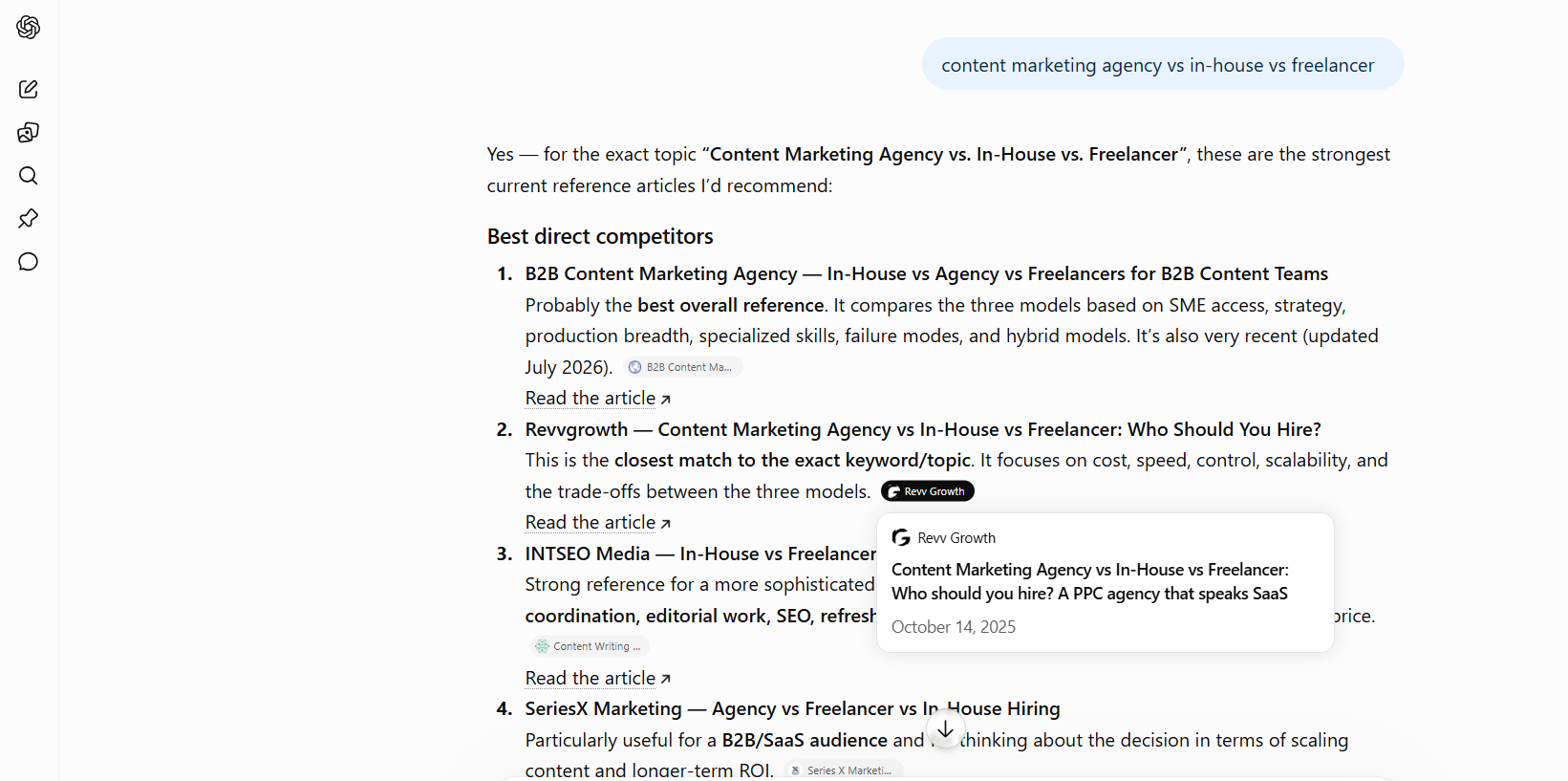
Take this blog for example: Content Marketing Agency vs In-House vs Freelancer
It directly answers a comparison query by helping readers evaluate their options instead of covering unrelated content marketing topics, raising its chances of appearing in LLMs when people ask for such comparisons.
2. Content quality and helpfulness
Content that is accurate, original, and based on real expertise provides more value than generic summaries. Clear explanations, practical examples, and first-hand insights help demonstrate that the content is useful.
3. Authority and trust signals
AI systems look for signals that help establish credibility. Consistent brand information, relevant mentions, and trusted references across the web can strengthen how a brand is understood. These can include:
- Brand mentions
- Expert authorship
- Customer reviews
- Industry references
- Backlinks
4. Technical accessibility
Before content can be considered, AI systems need to access and understand it. A crawlable website, clear site structure, and technically sound pages create the foundation for AI visibility.
5. Content structure
Well-structured content is easier for both users and AI systems to interpret. Clear headings, direct answers, organized sections, and structured information help highlight the most important parts of a page.
Also read → 7 Best AI SEO Agencies for SaaS: Get Your Brand Cited by AI
10 Best practices for SEO for AI search
Improving AI visibility does not require a separate SEO playbook. The strongest approach is to get the fundamentals right, then make your content easier for AI systems to understand, retrieve, and reference.
1. Build a strong technical SEO foundation
AI visibility starts with making your content accessible and understandable.
You do not need a separate technical system for AI search. Google recommends continuing to follow existing SEO fundamentals, including crawlability, indexing, page experience, internal linking, and structured data where relevant.
For B2B SaaS websites, focus on:
- Making important pages crawlable and indexable
- Maintaining a clear site structure
- Ensuring pages load quickly and work well on mobile
- Using structured data that accurately reflects visible content
If AI systems cannot access or understand your content, even strong content will struggle to get visibility.
2. Create content that directly answers user questions
AI systems need clear answers they can understand and use. Start by identifying the questions your audience is asking, then answer them directly near the beginning of the page.
For example:
- Weak: AI SEO helps companies improve visibility.
- Better: SEO for AI search helps companies improve their chances of appearing in AI-generated answers by creating content that clearly answers user questions and demonstrates expertise.
The second version gives readers a clearer answer and provides AI systems with more context about the topic.
In simple words, a good rule of thumb is: if the heading asks a question, answer it in the first one or two sentences before adding supporting detail.
3. Structure content for AI retrieval and citations
Structure is one of the strongest signals AI systems rely on to understand content hierarchy and intent. A clean structure makes it easier for models to isolate complete, reusable answers.
At a practical level, this means:
- Using a logical H2–H3 hierarchy that reflects how topics relate
- Keeping paragraphs to 2–4 sentences, each covering a single idea
- Introducing bullets or tables only when they improve clarity or comparison
Quick tip: A strategic way to prepare content for AI systems is to monitor how your brand or site is already being cited or mentioned across web and social channels to see where visibility gaps exist and prioritize pages that aren’t yet surfacing in AI results.
Take an example from our work with Everstage, a sales compensation platform, where content was built from the ground up with AI extraction and reuse in mind.
Each page was structured using H2s and H3s informed by SERP analysis, AI Overview patterns, and “People also search for” queries, resulting in headings framed as direct, answerable questions rather than abstract topic labels.
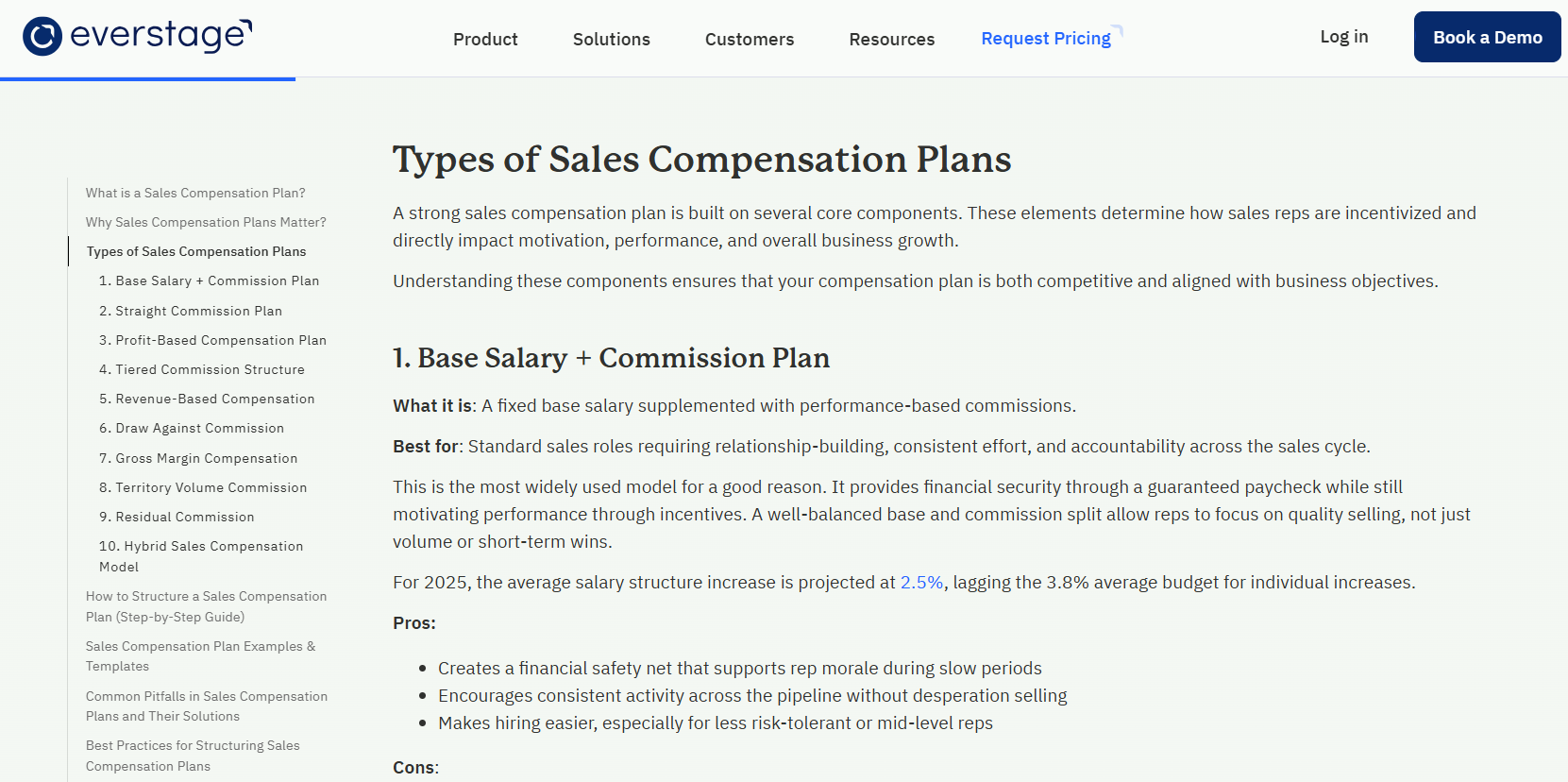
This ensured that every section aligned with what users were actively searching for, while also making each block self-contained and meaningful when surfaced independently in AI-generated responses.
4. Demonstrate first-hand experience and expertise
Show expertise through original examples, expert insights, case studies, practical recommendations, and lessons from actual work. Content that reflects hands-on experience gives readers more confidence and provides stronger signals of credibility.
For B2B SaaS companies, this could include customer examples, product insights, industry observations, or frameworks developed from solving real problems.
Here’s what that kind of positioning looks like:
- Weak: “We can write good content for you.”
- Better: “This is how we helped a B2B SaaS company increase organic traffic by X% through a content strategy built around high-intent topics.”
First-hand experience is becoming increasingly important in AI search. Elizabeth Reid, VP of Google Search, noted that users want to “hear directly from others who have experienced something,” highlighting why original examples, expert perspectives, and real-world insights matter.
5. Build topical authority through comprehensive content coverage
A single article rarely covers everything a user needs to know. Building topical authority requires creating a connected group of content around a subject.
In our work with Atlan, an active metadata platform, we built topic clusters around core themes such as data catalog, data lineage, and metadata management. Each cluster included:
- A core pillar article covering the broader topic
- Supporting posts answering related questions
- Internal links connecting related topics logically
This created a connected content ecosystem rather than a collection of isolated articles, helping establish Atlan’s relevance across its core topics. Our efforts contributed to a 93% increase in organic traffic, 6500+ domain citations across AI platforms, and a 25% MQL lift from AI search visibility.
Read the full case study here → How Atlan Doubled Organic Traffic and Dominated High-Intent SERPs
6. Optimize content around search intent, not just keywords
AI search relies on understanding meaning and context, not just matching exact keywords.
Create content based on what users are trying to achieve at each stage of their journey. This includes:
- Educational content → Informational queries
- Comparison content → Evaluation-stage searches
- Decision-focused pages → Users looking for solutions
For example, someone searching for “AI SEO” may want to understand the concept, while someone searching for “AI SEO service providers” is likely evaluating platforms and doesn’t require a definition of the concept.
7. Strengthen internal linking and content relationships
A strong internal linking structure helps create topic clusters where each page supports the others and provides more context around a subject. They highlight relationships between topics, identify important pages, and strengthen topical authority.
Instead of adding links randomly, build connections between related content.
For example, a blog about AI search optimization should link to supporting pages about:
- AI SEO
- Content optimization
- Service explainers
- And towards the end, platforms that provide AI SEO services
Internal linking was handled with the same level of intent for Everstage. Product pages, feature explanations, and related blogs were linked contextually, only where they naturally supported the concept being explained.
This approach helped cluster related topics, reinforce semantic relationships, and build topical authority across the sales compensation domain, making it easier for AI systems to understand not just individual pages, but Everstage’s depth and credibility across the broader subject area.
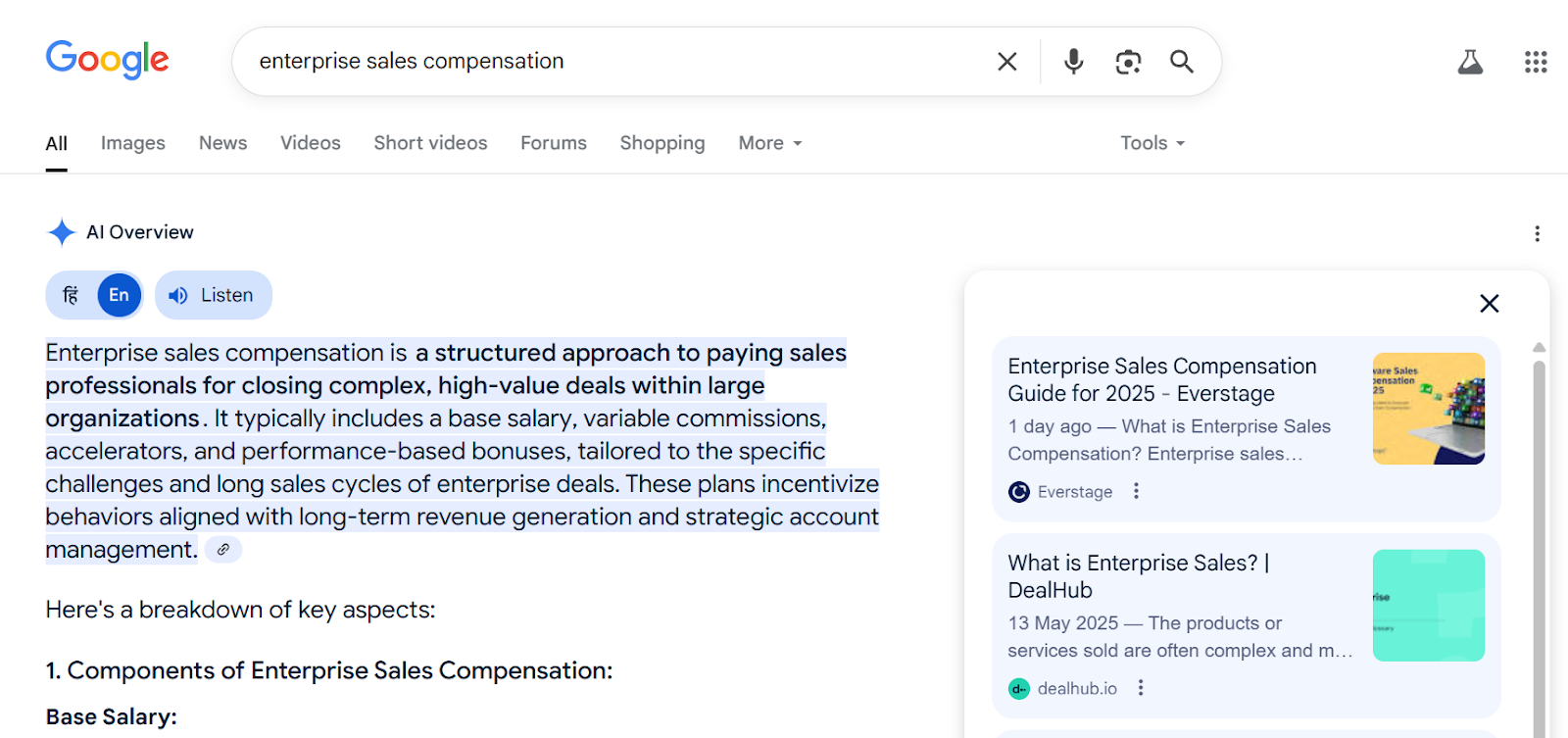
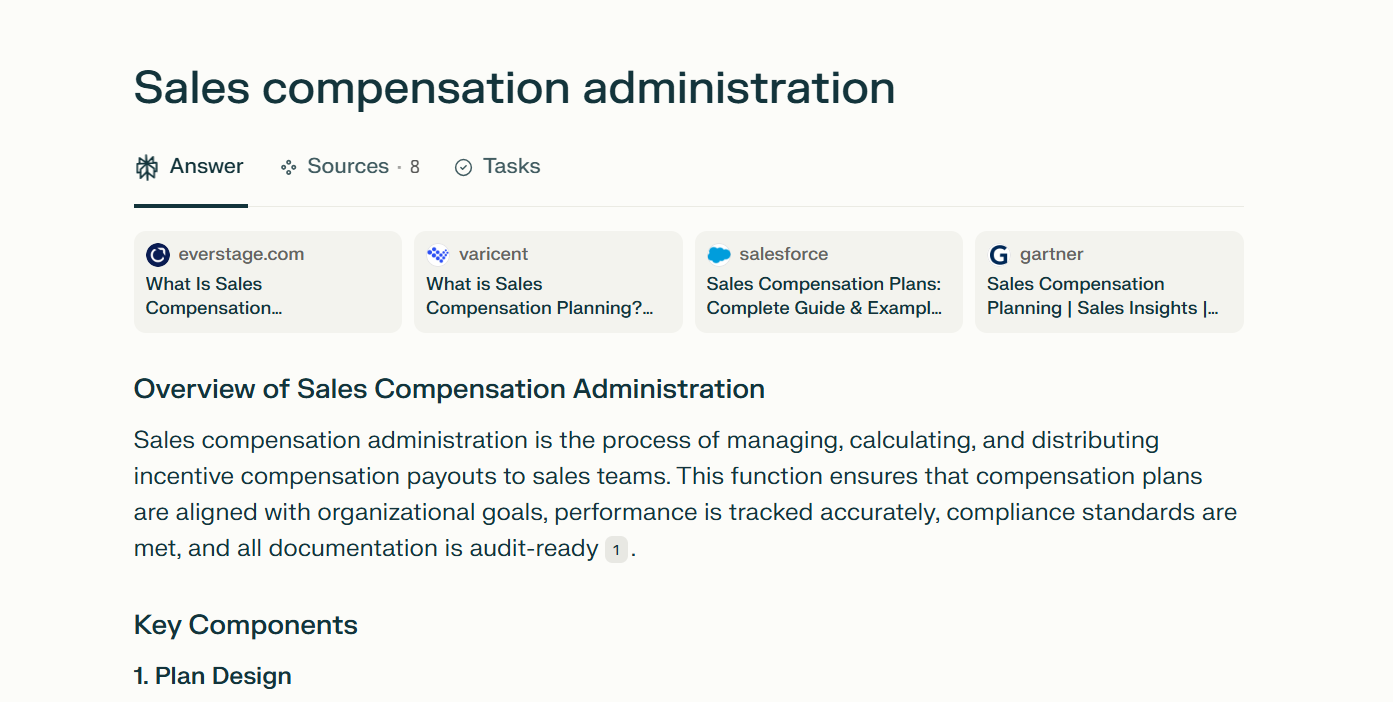
Everstage’s results show what happens when content is built with AI visibility in mind. If you want to create a similar foundation for your SaaS brand, book a demo with RevvGrowth and talk about building a content strategy tied to visibility and pipeline.
8. Add original insights, data, and examples
AI systems have access to large amounts of similar information, which makes original insights a key differentiator.
Go beyond summarizing existing knowledge by adding first-party research, unique frameworks, customer examples, expert opinions, or lessons from real-world experience.
For example, a generic guide might explain what AI SEO is, while a stronger piece could include original data, examples from campaigns, survey results, or a framework showing how a company approaches AI search optimization.
9. Build authority beyond your website
AI visibility depends on more than what you publish on your own website. Broader brand credibility also comes from how your company is represented across the web. You can build authority through:
- Digital PR and industry coverage
- Mentions from relevant websites
- Trusted third-party references
- Community discussions where your expertise is relevant
These signals help AI systems better understand your brand and expertise, even though these alone do not guarantee that your content will be cited in AI answers.
10. Measure and improve AI search visibility
Content visibility in AI search is dynamic. What gets surfaced can change based on search behavior, content quality, and how AI systems interpret information. This makes it important to track more than traditional rankings.
Monitor whether your content is being surfaced across platforms like ChatGPT, Perplexity, and Google AI Overviews, along with:
- AI citations and brand mentions
- AI Overview appearances
- AI referral traffic
- Query visibility
- Conversion and pipeline impact
A Pew Research Center analysis found that users were less likely to click traditional search results when a Google AI summary appeared, making visibility within AI-generated answers an increasingly important consideration for content teams.
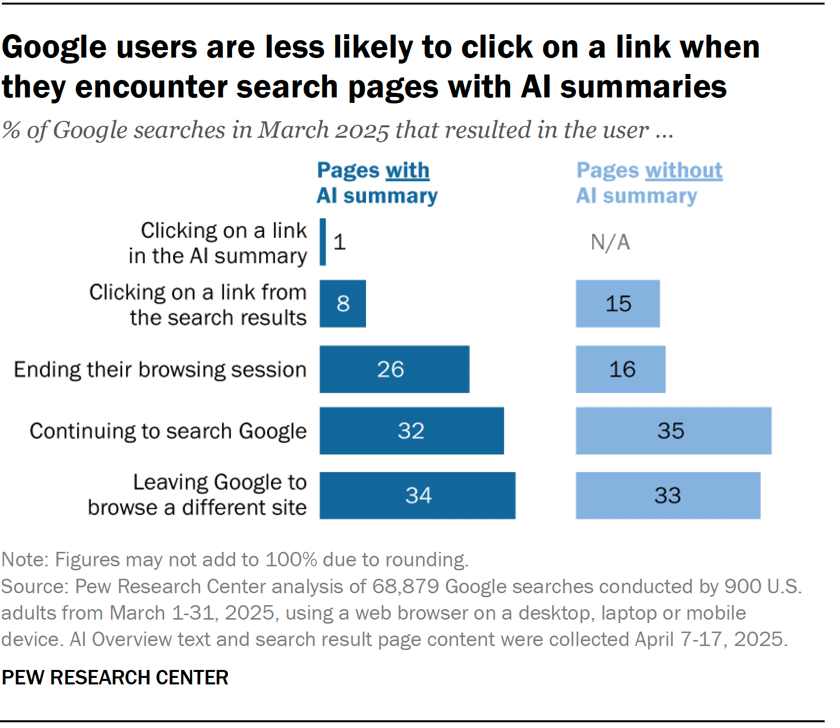
Image Source: Pew Research Center
Strategy Tip: Use data from platforms like Google Search Console to identify underperforming sections quarterly. Refresh introductions, questions, examples, and summaries based on changing search patterns and emerging AI queries.
Also read → Hiring an AI SEO Agency: 10 Questions to Ask Before You Partner
How RevvGrowth helps SaaS companies improve AI search visibility
At RevvGrowth, we bring AI SEO, AEO, and GEO together: strong technical foundations and content strategy, answer-focused optimization for AI search, and brand authority building to improve visibility across platforms like ChatGPT, Perplexity, and Google AI Overviews.
We create content that AI systems can understand, users can trust, and your pipeline can benefit from. Using an AI + human workflow, RevvGrowth has helped:
- 50+ B2B SaaS brands improve organic visibility
- Drive 1M+ organic visits
- Earn 6,500+ AI platform citations
If you want to see how this approach works in practice, schedule a 30-min demo with RevvGrowth today.
.svg)


.webp)
.avif)