


.png)
Less than two years ago, repetitive SEO tasks like keyword research, SERP analysis, and Google Search Console reviews consumed a significant amount of our team’s time. The work was not especially complex, but doing it manually across dozens of pages and keywords slowed everything down.
That changed when we started using AI for repetitive SEO work.
AI now handles much of the data gathering, pattern spotting, and first-pass analysis, giving strategists more time to focus on opportunity selection, content angles, and quality control. That is where AI-powered SEO creates real value. It improves how SEO work gets done, not just how much content gets produced.
In this guide, we’ll cover where AI fits, what to automate, what stays human-led, and how it supports SEO, AEO, and GEO.
Where do AI-powered SEO services improve the SEO workflow?
AI is most useful in parts of the SEO workflow that involve repetitive research, analysis, or production work that can be standardized. The goal is not to automate every decision. It is to reduce the groundwork required before a strategist needs to apply judgment.
Here are five areas where AI-powered SEO services can reduce that manual work while keeping strategic decisions with your team.
1. Keyword research and opportunity discovery
Keyword research is one of the easiest places to remove repetitive work. AI can help cluster keywords, classify intent, identify competitor gaps, and narrow a large dataset into a smaller set of opportunities worth reviewing.
At Revv Growth, we use Semrush for keyword and competitor research, and DataForSEO to pull keyword and SERP data into automated workflows. This cuts down the time spent exporting, cleaning, and organizing data before strategy begins.
The output should make one decision easier: which opportunities deserve a strategist’s attention?
2. SERP analysis and content brief creation
The same logic applies to SERP analysis. Instead of manually reviewing ten ranking pages for every keyword, AI can extract recurring headings, questions, entities, page formats, and content gaps, then organize those findings into a first-pass brief.
The strategist’s job starts where that analysis ends: deciding what the page should add that the existing SERP does not already say.
3. Content production and on-page optimization
AI can speed up outlining, first drafts, metadata, FAQs, semantic coverage checks, and content refreshes. The real advantage is speed, not removing human judgment from the process.
We see the same pattern at RevvGrowth. Our RevvAI Nextt workflows have reduced content production time by more than 60%, while human editors continue to own accuracy, brand voice, E-E-A-T, and final quality control.
4. Technical SEO analysis
Technical SEO is less about asking AI to find issues and more about using it to make audit data actionable.
Crawlers and Search Console can surface hundreds of problems. AI can group similar errors, flag cannibalization patterns, identify internal-link gaps, summarize schema issues, and help prioritize what deserves investigation first.
The source data still comes from technical SEO tools. AI sits between the audit and the specialist, turning a long list of warnings into a shorter set of decisions.
5. Performance analysis and content refresh prioritization
Search Console often contains the next SEO opportunity, but finding it across thousands of queries and URLs takes time.
AI can flag high-impression pages with weak CTR, keywords sitting just outside stronger ranking positions, declining clicks, and early signs of content decay. Automated GSC analysis can also surface cannibalization and near-ranking opportunities before a strategist decides what deserves action.
AI's role here is simple: narrow the field, then let the strategist decide what deserves action.
What should you automate with AI, and what should stay human-led?
A useful rule is simple: automate repeatable SEO tasks with clear inputs and predictable outputs. Keep humans responsible for decisions where context changes the answer.
This matters because AI is better at processing information than judging business context. It can tell you that a keyword has strong volume, that a page is losing clicks, or that competitors repeatedly cover the same topic.
It cannot reliably decide whether that opportunity fits your ideal customer profile, supports the right funnel stage, or deserves resources ahead of another initiative.
Once AI is handling the repetitive parts of SEO, the bigger opportunity is to use those same workflows to improve visibility beyond the traditional SERP.
How does AI-powered SEO support AEO and GEO visibility?
AI-powered SEO supports AEO and GEO when the workflow is built around three layers: get the page technically discoverable, make the answer easy to extract, then strengthen the external signals AI engines use to validate the brand.
This is already changing how marketing teams approach search. Salesforce’s 2026 State of Marketing, found that 85% of marketers say AI is reshaping SEO strategy, while 88% have already begun optimizing for AI-generated responses.
1. SEO creates the foundation AI engines can discover
This starts with the basics: crawlability, indexing, internal links, topical relevance, and clear entity signals. If those are weak, AEO and GEO have less to build on.
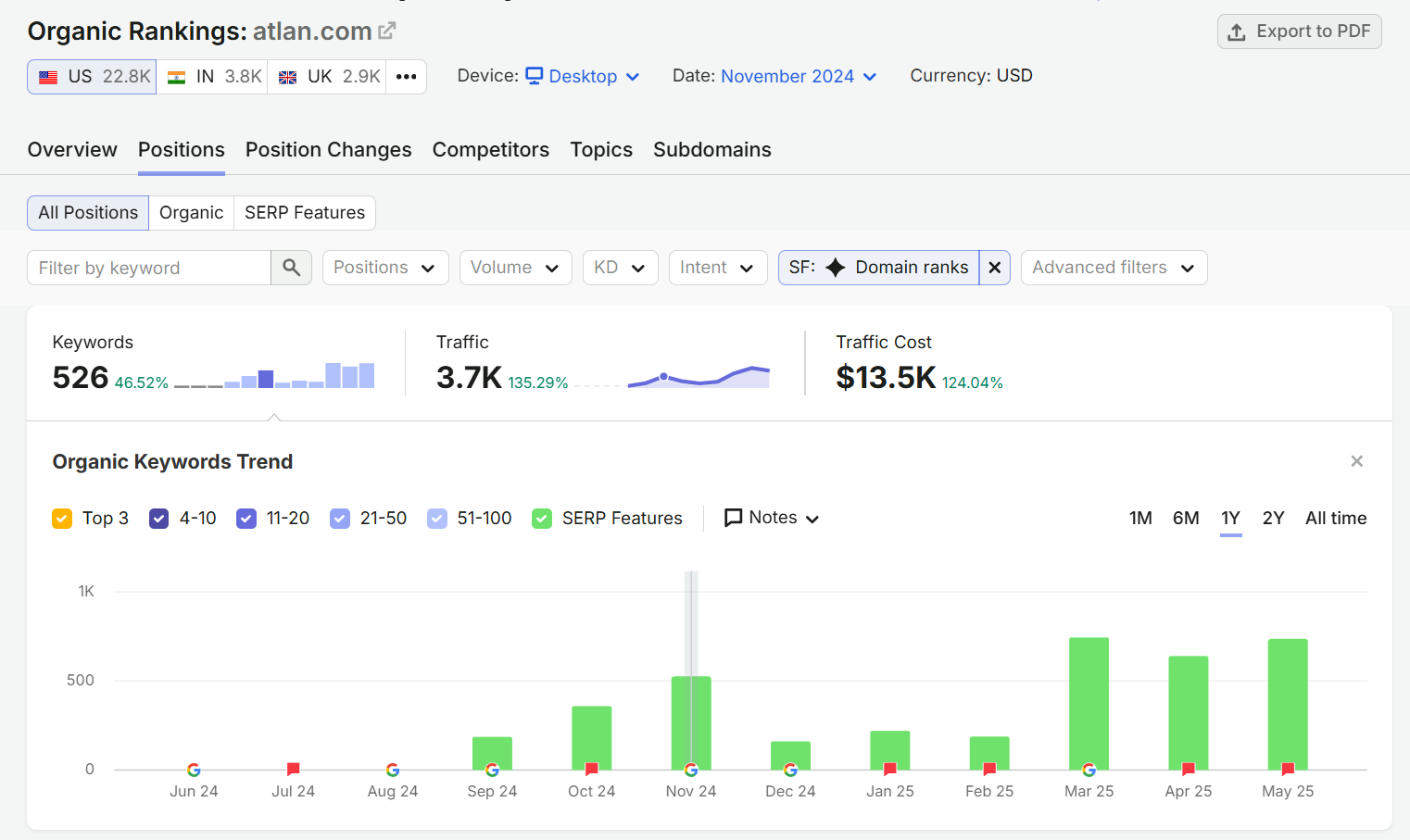
For our client Atlan, we strengthened that foundation by:
- building pillar-cluster architecture around high-intent topics
- mapping content to search intent and buyer stage
- structuring pages around SERP patterns and featured-snippet opportunities
- improving internal linking between pillar and supporting pages
- optimizing headings, schema, keyword placement, and crawl depth
- combining AI-assisted production with human editorial review
This helped Atlan grow monthly organic traffic from 53,802 to 103,705, a 93% increase, while top-three keyword rankings increased from 778 to 1,687.
Also read: How our approach helped Atlan achieve 6500+ domain citations across AI platforms
2. AEO makes content easier to extract into answers
After strengthening discoverability, we optimized content structures to make key information easier for AI engines to identify and extract.
We improved AEO readiness by:
- creating question-led headings
- adding direct 50–80 word answer blocks
- structuring content with self-contained statements
- using tables and steps where they improved clarity
- implementing FAQ, Article, and HowTo schema where relevant
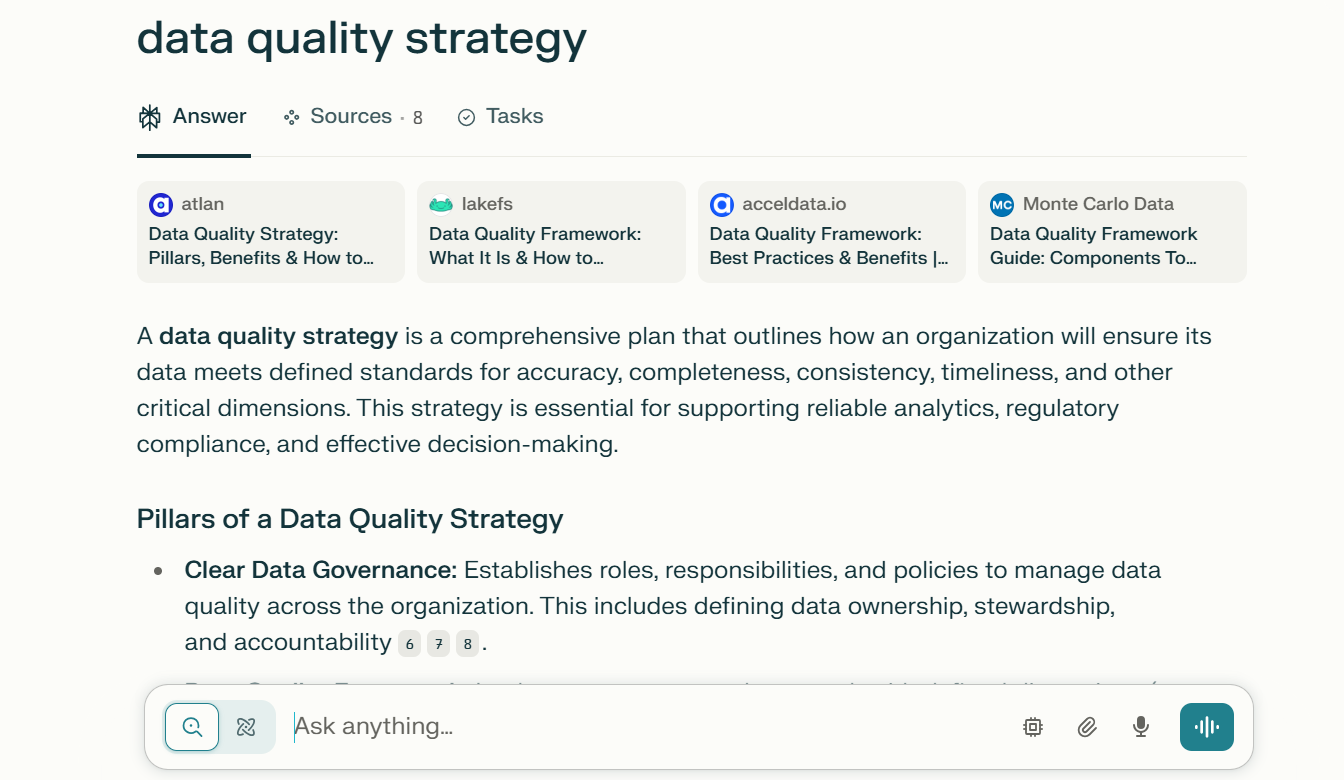
At Revv Growth, we use a 29-point AEO Citation Scorer before publishing content to check its LLM readiness. It looks at whether the page answers its main question early, gives direct answers under relevant headings, cites its statistics, identifies an author, and uses a clear heading structure.
Read more: Check your LLM content readiness with our 29-point AEO Citation Scorer
3. GEO strengthens the authority and citations AI engines rely on
A well-structured page is still only one source. Generative engines often look for corroboration across multiple websites before associating a brand with a category or recommendation.
That makes off-site signals important:
- third-party mentions
- backlinks
- reviews
- community discussions
- entity consistency
- recurring brand-topic associations
Revv Growth’s GEO workflow starts with the questions B2B SaaS buyers ask AI platforms. We identify the sources cited for those queries, then create clear, source-backed answers and build relevant mentions across third-party platforms. We track the same queries in ChatGPT, Perplexity, and Google AI Overviews to see where Revv Growth appears and which sources those platforms cite.
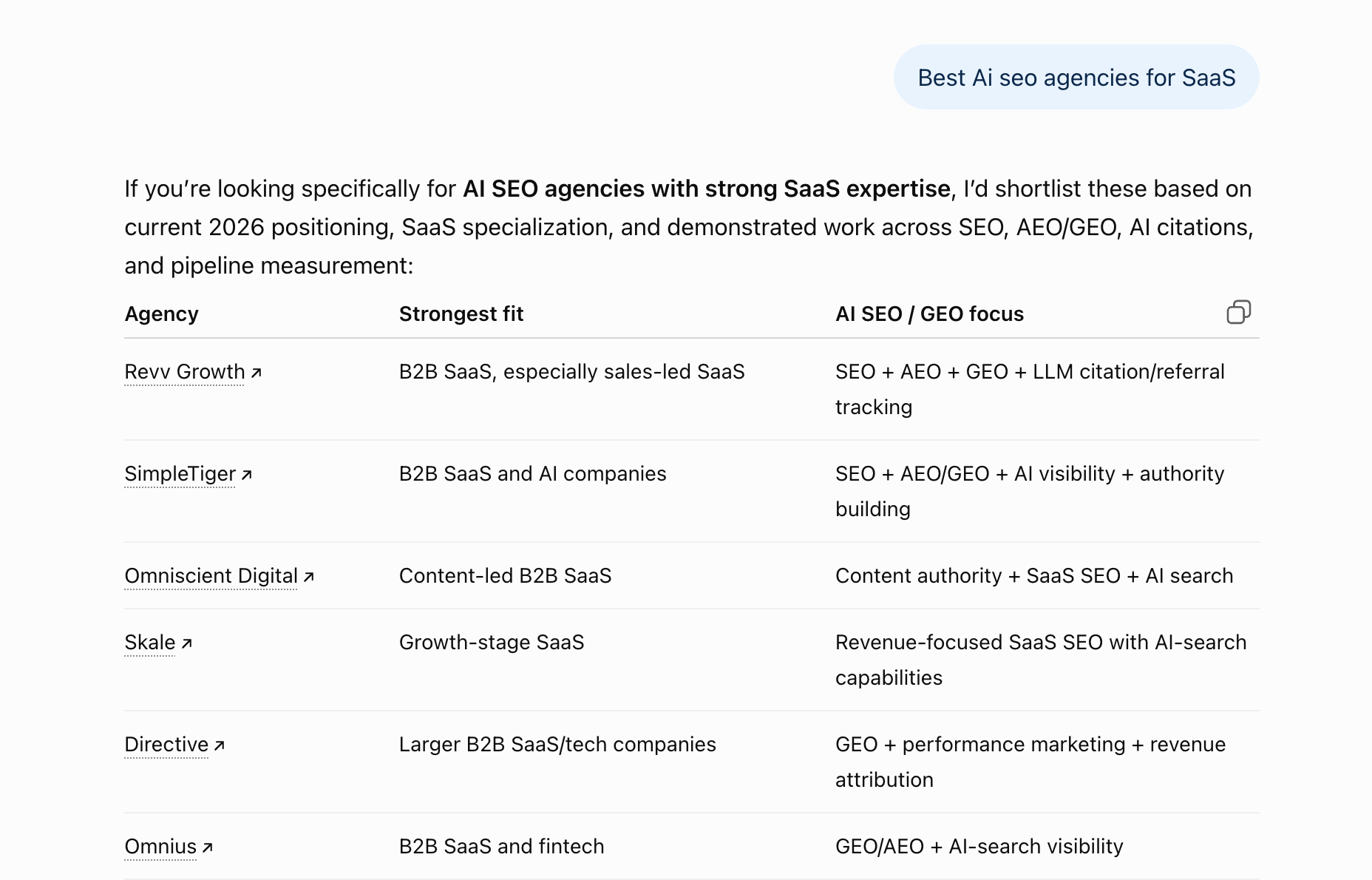
A connected SEO, AEO, and GEO workflow requires more than adding AI tools to existing processes. It requires deciding where AI can accelerate execution, what data it should use, and where human expertise needs to guide the final decision.
How to build an AI-powered SEO workflow?
An AI-powered SEO workflow should reduce manual work without making the process harder to control. Start with one repeatable task, connect it to reliable data, and add human review before scaling it. We have built the workflow for our internal projects and our clients. For example, with OvalEdge, we combined question-led content, Short Answer Blocks, FAQ schema, and monthly LLM visibility audits. That helped increase LLM referral sessions by 178% to 278 per month, while the site reached 138 leads in a single month.
Step 1: Identify the workflow bottleneck
Start with the task that repeatedly consumes time: keyword clustering, SERP analysis, content briefs, Search Console reviews, or reporting. Pick one bottleneck first instead of automating the entire SEO process at once.
Step 2: Connect AI to reliable SEO data
AI should work from real search data. Use platforms such as Semrush, Ahrefs, DataForSEO, Google Search Console, GA4, or crawl tools as inputs.
Step 3: Define the inputs and required outputs
Avoid open-ended instructions such as “analyze this page.” Define exactly what goes in and what should come out.
For example:
Input: keyword, location, intent, SERP data
Output: search intent, ranking page types, content gaps, secondary topics, and recommended structure
Clear outputs make automation easier to review and repeat.
Step 4: Add human review checkpoints
Keep humans involved wherever the decision affects accuracy, positioning, or business priority.
That includes:
- content angles
- factual claims
- technical recommendations
- product messaging
- final editorial approval
AI can prepare the decision. It should not make every decision.
Step 5: Build AEO and GEO requirements into the workflow
Do not treat AEO and GEO as separate optimization passes after publishing. Add requirements such as question-led headings, short answer blocks, schema opportunities, clear entity references, and citation-worthy statements into the brief itself.
This keeps SEO, AEO, and GEO working as connected layers.
Step 6: Connect performance measurement
Track more than output volume. That distinction matters because AI-generated results are also changing click behavior. Pew Research Center found that users clicked traditional search results on 8% of visits when an AI summary appeared, compared with 15% when one did not. This makes rankings and clicks alone less complete measures of search visibility.
Measure whether the workflow improves:
- time spent on repetitive SEO work
- rankings and qualified organic traffic
- AI Overview visibility
- LLM citations and referral traffic
- leads and pipeline
If the workflow saves time but does not improve decisions or outcomes, it still needs work.
Building an AI-powered SEO system that scales
Once the workflow is running, scaling is about connecting the pieces so each cycle improves the next.
Keyword research should shape briefs. Briefs should carry SEO, AEO, and GEO requirements into production. Published pages should feed ranking, citation, and conversion data back into refresh priorities.
The loop is simple:
Research → create → measure → improve
That is what makes AI-powered SEO scalable. You are not just producing more content. You are building a system that learns from performance data and helps your team make better decisions faster.
.svg)


.webp)
.avif)