


.png)
TL;DR
- AI SEO pricing varies by service model. Tools start below $100/month, while managed agency programs typically cost $7,500–$25,000+ per month.
- Scope determines cost. Pricing depends on AI engines tracked, prompt coverage, content production, technical SEO, third-party authority building, and reporting depth.
- Choose based on execution needs. Use software for tracking, audits for strategic direction, and agencies for end-to-end implementation.
- Evaluate value before increasing budgets. Compare deliverables against existing SEO services and prioritize AI-specific work that improves visibility, citations, and conversions.
We get AI SEO pricing questions almost every week, and the answer depends on what you are actually buying. A visibility tracking tool, a one-time audit, and a managed agency program can all fall under “AI SEO,” but they involve very different levels of work.
A tracking tool shows where your brand appears across AI search platforms. An audit helps identify why competitors are being cited instead of you. A managed program can include research, content, technical optimization, citation building, and ongoing measurement designed to improve those results.
That difference is what makes AI SEO pricing comparisons difficult. This guide breaks down the major pricing models, what you actually get at each level, and how to determine the right mix of tools, consulting, and managed execution for your budget.
How much does AI SEO cost in 2026?
AI SEO can cost less than $100 per month for entry-level visibility software or move into five figures per month for managed execution. The range is wide because software access, specialist advice, and a team responsible for implementation are different purchases.
Current U.S. GEO market data gives a useful service-side benchmark. Clutch September 2026 U.S. GEO pricing data reports hourly rates of roughly $150 to $300 for senior AI and SEO specialists, $7,500 to $25,000+ monthly retainers for ongoing programs, and $25,000 to $75,000 for larger 8- to 12-week pilots.
The numbers become easier to interpret once you separate the buying models.
1. AI SEO software and self-service tools
Software is the lowest-cost entry point because it primarily provides measurement. A visibility platform can track the prompts where your brand appears, identify citations and source URLs, compare competitors, and monitor performance across AI engines.
OtterlyAI, for example, currently lists monthly plans at $29, $189, and $489, with prompt allowances increasing from 15 to 400. ChatGPT, Google AI Overviews, Perplexity, and Microsoft Copilot are included in the standard engine set, while Gemini, Claude, and Google AI Mode are available as add-ons.
The dashboard does not resolve the problem for you.
If a competitor repeatedly appears for a high-intent prompt and you do not, your team still has to determine whether the cause is weak content, technical accessibility, unclear category associations, missing third-party authority, or the sources AI platforms currently trust.
Software therefore makes the most sense when you already have people who can diagnose and execute on the data.
If your team already has the execution capability and mainly needs better measurement, stronger AI visibility tracking, and GEO tools may be enough without adding another full execution partner.
2. One-time AI audits and strategic consulting
If you know AI visibility matters, but you do not yet know where the gaps are or what deserves investment first, AI audits and consulting are the solution.
A useful audit should establish where your brand currently appears across priority buyer prompts, which competitors are being surfaced instead, what sources influence those answers, and where technical, content, entity, or authority issues are limiting visibility.
The breadth of that diagnosis affects the fee. Testing a small set of branded prompts in ChatGPT is a much narrower engagement than evaluating commercial prompts across ChatGPT, Perplexity, Gemini, Claude, Google AI Overviews, and AI Mode.
The output matters just as much as the research. Your team should finish the engagement with a prioritized roadmap that separates quick fixes, deeper technical work, content opportunities, off-site authority gaps, and measurement requirements.
If you are comparing audit proposals, our AEO audit checklist provides a practical reference for the content, technical, entity, authority, internal-linking, and visibility areas worth examining.
3. Monthly managed AI SEO agency retainers
A managed program becomes more expensive because the provider owns the work after the diagnosis. The engagement may include buyer-prompt research, existing-page optimization, new commercial content, technical implementation, entity work, third-party authority building, AI citation tracking, and reporting tied to traffic, leads, or pipeline.
That is also why the retainer number alone is a poor comparison.
A provider advising your internal content team once a month should not be compared with an agency responsible for producing content, implementing technical fixes, building external authority, monitoring several AI engines, and reporting on the commercial result.
The more execution responsibility you move outside your team, the more useful the managed model becomes.
What affects AI SEO pricing?
Once you know which buying model you need, the next question is why two providers offering the same model can still quote very different prices.
Six factors usually explain most of that difference.
1. Prompt and topic coverage
A program tracking 25 high-intent buyer prompts requires a different level of research and monitoring from one covering hundreds of category, comparison, alternative, and use-case questions. More prompts also create more opportunities to diagnose visibility gaps and more work to prioritize.
2. AI engines covered
ChatGPT, Perplexity, Gemini, Claude, Google AI Overviews, and AI Mode do not always use the same sources or surface the same competitors. Adding platforms expands the monitoring, analysis, and reporting scope.
3. Content requirements
Refreshing ten high-value pages is less resource-intensive than building a continuous pipeline of new comparison, category, use-case, and educational content. Ask whether the quote includes strategy only, briefs, writing, editing, publishing, or the entire workflow.
4. Technical implementation
A consultant may identify crawlability, entity, structured-data, or internal-linking issues. A managed provider may also own the fixes. Implementation responsibility can materially change the fee.
5. Third-party authority work
AI visibility is influenced by more than the company's own website. Editorial coverage, digital PR, review platforms, credible industry sources, and relevant communities can become separate workstreams when a brand needs stronger external validation.
6. Measurement depth
A basic monthly brand-mention report is relatively simple. Prompt-level competitor tracking, citation-source analysis, share-of-model reporting, LLM referral attribution, and conversion measurement require a deeper reporting layer.
The takeaway: Two $8,000 retainers are only comparable once you normalize the work sitting behind the number.
That brings us to the more useful package question: what should actually be included?
What should an AI SEO package include?
An AI SEO package should make scope and ownership obvious.
You should be able to see which prompts are tracked, which AI engines are covered, how much content is included, whether technical and off-site work is implemented, how success is measured, and which responsibilities remain with your team.
This framework gives you a much cleaner way to compare proposals than names such as Starter, Growth, or Enterprise.
How To Tell Whether The AI SEO Premium Adds New Work
The easiest test is to place the proposed AI SEO scope next to the SEO work you already pay for.
Google's guidance for AI features in Search is particularly useful here because it removes some of the noise around AI-search services. Google says the same foundational SEO practices remain relevant for AI Overviews and AI Mode. There is no separate special schema required purely for those AI features.
If your existing SEO program already covers technical fixes, content, internal linking, and authority building, the AI SEO premium should introduce clearly additional work. Look for deliverables such as prompt-level tracking, citation and share-of-voice analysis, entity optimization, third-party visibility, and AI-specific reporting.
A growing number of buyers are running into exactly this overlap. When the proposed "AI SEO" work is mostly traditional SEO under a new label, the premium does not add new capability. A useful way to evaluate the package is to compare those added deliverables with your standard SEO scope before accepting a premium.
The service labels can also overlap. GEO, AEO, and AI SEO may describe different parts of the same engagement, which makes deliverables more useful than acronyms when comparing price.
Also read → GEO vs AEO vs AI SEO: Which one should a B2B SaaS company prioritize first?
AI SEO tools vs. agencies vs. in-house teams: Which is right for you?
The right ownership model depends on what happens after you find the visibility gap.
Tools give you data. In-house teams give you direct ownership. Agencies become useful when several specialist workstreams need to move together.
When AI SEO software is enough
Software is usually the most cost-efficient option when your internal team already has the ability to act on the findings.
Your platform may show that a competitor is present across several commercial prompts. If your team can identify the source of that advantage, update the relevant content, handle technical changes, strengthen third-party authority, and monitor the result, you may not need a managed program.
In this model, the problem is mostly visibility measurement, not execution capacity.
When an in-house or hybrid model makes sense
In-house ownership works well when AI search creates enough recurring work to justify dedicated time and expertise. The advantage is context. Your team already understands your buyers, products, subject matter, internal approval process, and existing SEO strategy.
A hybrid model can then fill narrower capability gaps. For example, your internal team might own technical SEO and content while an external specialist supports citation research, digital PR, prompt monitoring, or strategic audits.
This model works best when ownership is explicit. If content, SEO, PR, and analytics all assume another team is responsible for AI visibility, the company can spend more without building an actual operating process.
When a managed AI SEO agency makes sense
A managed program becomes more useful when the visibility problem crosses several disciplines. You may need audits, technical improvements, commercial content, stronger entity associations, third-party authority, recurring prompt monitoring, and measurement connected to conversions.
That is where our AI SEO services fit. We combine SEO, AEO, GEO, content execution, technical work, citation monitoring, and commercial measurement so clients do not have to coordinate each workstream separately.
The value of that structure becomes clearer when a company already has organic visibility but needs AI visibility and conversion performance to move with it.
Take OvalEdge for example. The data governance platform had a strong product, but its organic presence did not reflect that. There was limited visibility for key category terms, content was not structured to build authority over time, and the brand was not consistently appearing in AI-driven search results.
We ran the SEO and GEO program end-to-end: auditing the foundation, building topic clusters around core areas like data governance, data catalogs, and metadata management, fixing technical gaps, optimizing existing content for search performance, and producing around 40 SEO-focused blogs every month with content structured for AI inclusion.
The results:
- Top 10 keyword positions grew from 161 to 1,300 (707%)
- AI citations increased from 344 to 3,700, roughly a 10x increase
- Monthly organic clicks grew from 2.1K to 8.2K
- Average Google position improved from 16.2 to 7.9
- Inbound MQL pipeline became consistent at 8 to 18 per month
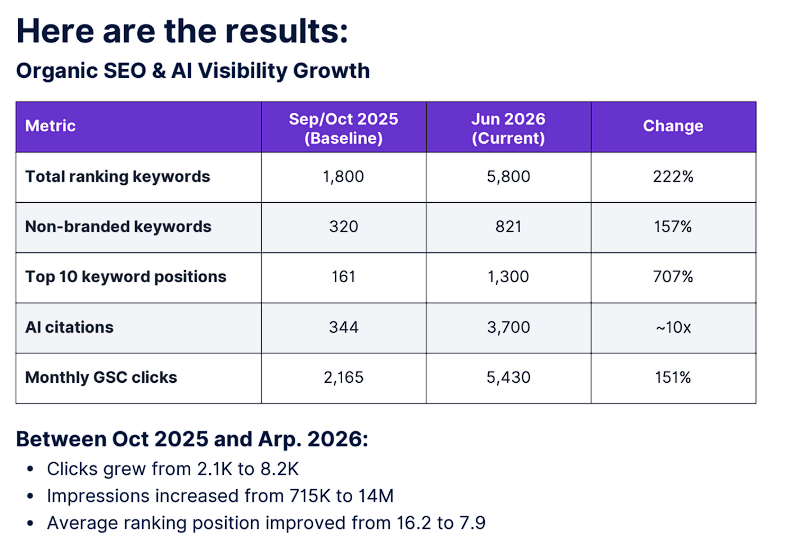
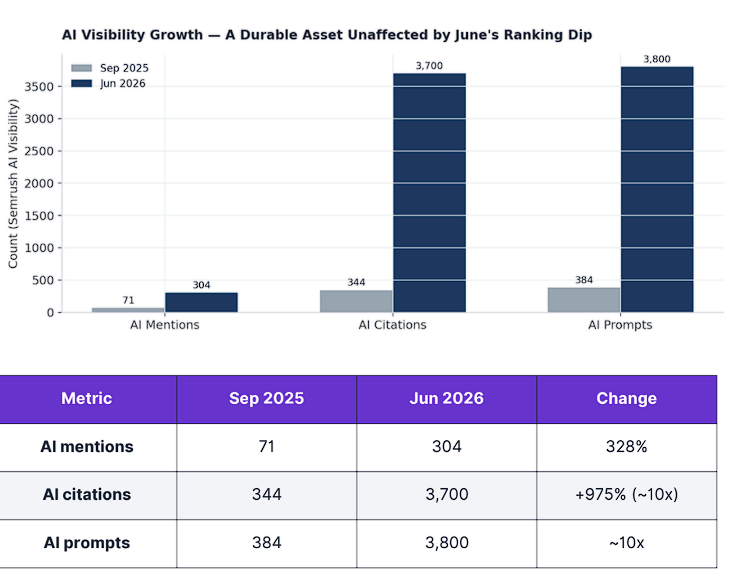
The point is not that every managed program produces the same outcome. It shows what the fee can represent when research, content, technical work, AI visibility, and measurement are managed together.
How much of your Seo budget should go toward AI search?
There is now enough market data to give buyers a directional benchmark.
A 2026 Search Engine Land survey of 343 U.S. marketing decision-makers found that marketers allocate an average of 24% of their search or content budgets to AI-search visibility.
Your own allocation depends on what your current program already covers and where the actual AI-search gaps sit.
1. Keep funding the SEO foundation
Technical health, useful content, crawlability, internal links, and authority still matter. Moving budget away from strong foundational SEO simply because AI search has become important can weaken the same signals the new program depends on.
2. Add budget where the work is genuinely incremental
Additional spend makes more sense when it funds capabilities you do not currently have, such as multi-engine prompt tracking, citation-source analysis, entity remediation, AI-specific content work, third-party citation strategy, or dedicated LLM referral and conversion attribution.
A mature SEO team may need relatively little additional execution. A company with weak content and technical foundations may need a broader program before specialized AI-search investment can do much.
3. Compare scope before comparing price
The same Search Engine Land research found that 36% of marketers consider excessive buzzwords without clear explanation their biggest AI-search vendor red flag.
That matters directly when reviewing a proposal.
Before moving budget, make sure the providers are quoting against similar prompt volumes, AI engines, content requirements, implementation responsibilities, authority work, and reporting depth.
If you are already at the proposal stage, our guide to hiring an AI SEO agency goes deeper into the questions worth asking about methodology, execution, reporting, and accountability.
The right AI SEO budget starts with the visibility gap and your team's ability to close it.
Once both are clear, it becomes much easier to decide whether the next dollar belongs in software, strategic advice, managed execution, or the SEO work you already have.
.svg)


.webp)
.avif)