


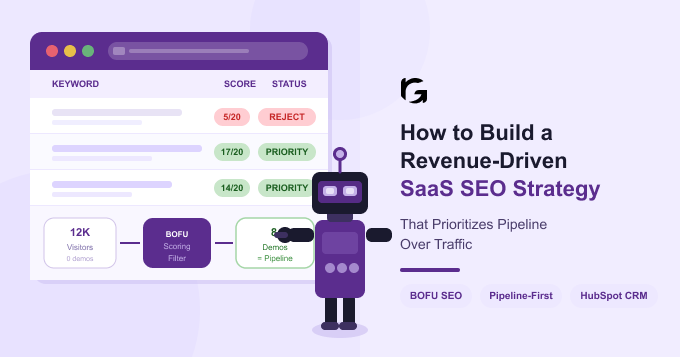
"Why is our SEO driving traffic but no demos?"
We hear this question on almost every first call with a new client. And the answer is almost always the same: because the content was built for search volume, not for buyers.
Most SaaS SEO strategies are designed to rank. They are not designed to convert. The two goals look similar: target keywords, publish content, and build authority, but they produce radically different outcomes depending on which keywords you target and what intent sits behind them.
A keyword with 5,000 monthly searches and informational intent will attract 5,000 researchers. A keyword with 200 monthly searches and commercial intent will attract 200 buyers. At 0.1% and 4% conversion rates, respectively, the second keyword generates 8 demo requests per month. The first generates 5, from people who will never buy.
Most teams are optimising for the 5,000 keyword and wondering why the 8 never shows up.
This guide gives you a framework for building a SaaS SEO strategy around the second number: pipeline. You will get our keyword scoring model, the content architecture that sequences conversion pages before awareness content, six BOFU page types with real conversion benchmarks, and a CRM attribution setup that makes every demo from organic fully traceable.
If you are tired of defending traffic reports in pipeline meetings, this is where to start.
Is SEO the Right Channel for You Right Now?
Before you build anything, answer this question honestly.
SEO is not the right investment at every company stage. We have seen founders pour 12 months of effort and budget into organic search, only to realise their buyers don't use Google to find solutions like theirs. Starting with the wrong channel is one of the most expensive growth mistakes you can make.
Three questions. If any answer is no, your sequence needs to change.
Q1. Are your buyers actively searching for solutions like yours?
Open Ahrefs or Semrush and search your top five ICP pain points, not your product name, not your category. The actual language your buyers use to describe the problem they have.
If the combined monthly search volume is under 500 and your closest competitors are not building content either, your buyers are finding solutions through analyst recommendations, LinkedIn, and word-of-mouth referrals, not organic search.
That does not mean SEO will never work for you. It means the demand does not exist yet. You cannot rank for searches that are not happening.
Q2. Is your average sales cycle longer than 30 days?
SEO compounds. The pages you publish today will typically generate pipeline in months 4–9, depending on your domain authority and how competitive your keyword targets are.
If your product converts on a PLG motion in under a week, free trial to paid with minimal sales involvement, paid search, product virality, and community will outperform SEO in speed for the foreseeable future.
If your product involves multiple stakeholders, a procurement process, and a 30–90 day evaluation cycle, SEO is structurally aligned with how your buyers buy. The content that educates a VP during that evaluation period is the highest-ROI marketing asset you can build because it works at no marginal cost once it ranks.
Q3. Do you have at least 6 months before you need pipeline from this channel?
This is the question most founders answer wrong because they conflate "starting SEO now" with "needing results from SEO now."
Pipeline impact from organic search typically becomes measurable between months 4 and 9. If you need a pipeline in 60 days, SEO is not the lever to pull. Use paid search to buy time, and use the conversion data it generates to tell you exactly which BOFU keywords are worth targeting in your SEO programme.
The best-performing programmes we run at RevvGrowth run both in parallel, paid search funds short-term pipeline, while SEO compounds in the background. By month 9, organic is self-sufficient. By month 18, the CAC from organic is typically 30–50% lower than paid.
HubSpot's 2025 State of Marketing Report confirms: Website, blog, and SEO is the #1 ROI-driving marketing channel for B2B brands, ranked above paid social, email marketing, and content marketing. Source: HubSpot 2025 State of Marketing
If you answered yes to all three questions, keep reading. This guide is built for you.
If you answered no to one or more, do not walk away from SEO entirely. Use the keyword scoring model in Section 5 to identify your top 10 BOFU targets. Build those pages now, even at low publishing velocity, so the foundation is in place when your ICP's search behaviour matures or your runway expands.
The founders who regret SEO are almost always the ones who started it too late, not too early.
The 5 Signs Your SaaS SEO Strategy Is Broken
Most broken strategies don'tlook broken. Traffic is up, rankings are climbing, and the report has greenarrows everywhere, until someone asks how many demos came from organic, andnobody has the number.
1. High Traffic, Zero Demo Requests from Organic
Organic sessions are up,rankings are improving, and the CRM's conversion column is empty or shows"direct" for everything. The keywords were chosen by search volume,not by who was searching, the content is attracting the right number of the wrongpeople. Fix: score your top 20 traffic-driving pages on ICP fit and searchintent; most will score below 8 out of 20.
2. Your Top Keywords Are Almost All Informational
Pull your top 20 rankingkeywords from Google Search Console. If most start with "what is,""how does," or are broad category terms, you've built a library forresearchers. Per Ahrefs' B2B SEO research, commercial-intent keywords convertat 10x the rate of informational ones. Fix: re-score your full list against the4-factor model below; anything scoring under 10/20 comes off the active plan.
3. Your Content Calendar Is Built Around Volume, Not Page Types
If the first planning questionis "how many blogs can we publish this month," the calendar is brokenbefore it starts. Volume is an output metric, not a direction. Fix: start fromyour SQL target and work backward, SQLs needed → demos needed → BOFU sessionsneeded → BOFU pages needed, and let that number drive the calendar.
4. No Comparison, Alternative, or Use-Case Pages in Your Top 20
Pull your top 20 pages byorganic clicks. If none are comparison, alternative, or use-case pages, youhave no BOFU content in the pages that are actually ranking. Comparison pagesconvert at 3–5%; how-to guides convert at 0.1–0.3%. Fix: the next sprint startswith six BOFU pages before any new TOFU content is briefed.
5. Your CRM Shows "Direct" for Most Organic-Sourced Leads
Filter contacts by originalsource. A significant share showing "direct" or "unknown"over the last 90 days means tracking isn't in place, and when SEO can't beproven to generate pipeline, it's the first budget line cut in a downturn, evenif it's actually working. Fix: implement the HubSpot attribution setup coveredlater in this guide.
A quick self-assessment: If three or more of these signs apply to your current SEO programme, the problem is not execution quality. No amount of better writing, more consistent publishing, or sharper on-page optimisation will fix a strategy built around the wrong keywords and the wrong page types.
Stop Tracking Traffic — Track These Metrics Instead
Here is the uncomfortable truth about most SaaS SEO dashboards.
They are built to make the programme look healthy. Traffic up. Rankings up. Domain authority up. Every metric is moving in the right direction, and none of them tells you whether organic search is generating revenue. It is a structural mismatch between what the metrics reward and what the business actually needs.
The Publisher Metric Problem
Traffic metrics were designed for media companies. A publisher makes money when someone visits a page. Every session is a revenue event. Optimising for traffic is the correct strategy when traffic is the product.
SaaS companies do not sell traffic. They sell subscriptions. A session from a student researching a definition is worth exactly the same to your revenue line as a session that never happened, zero.
Yet most SaaS SEO programmes report on sessions, rankings, and domain authority as primary success metrics. These numbers grow easily with TOFU content. They look convincing in a monthly report. And they tell you almost nothing about whether organic search is contributing to pipeline.
The RevvGrowth Metric Stack
Before we publish a single page for any client, we build this reporting infrastructure. If you cannot measure these numbers before the first BOFU page goes live, you will not be able to prove the strategy is working when it does.
Why "SEO Leads Close at 14.6%" Changes the Budget Conversation
According to HubSpot's B2B marketing data, SEO leads close at a 14.6% rate, compared to just 1.7% for outbound leads.
That gap exists for one reason: intent. A buyer who finds you through an organic search is already researching a problem, already in a buying cycle, and already further along than any cold outreach sequence could manufacture. They came to you. You did not interrupt them.
When you track demo requests from organic and SQL conversion rate by content type, instead of sessions and rankings, that 14.6% close rate starts showing up in your pipeline data. And that number is what makes organic search genuinely defensible when budgets are under pressure.
What to Do If You Are Currently Reporting on the Wrong Metrics
Do not tear down your existing dashboard. Add to it.
Start with two additions this week. First, create a saved filter in your CRM that shows all demo requests where the original source is organic search, broken down by the page the visitor converted on. Second, add a column to your monthly SEO report that shows conversion rate by page type, not just sessions and rankings.
Those two changes will immediately show you which content is generating pipeline and which is generating pageviews. Within 30 days, the contrast will be sharp enough to justify rebuilding the entire keyword strategy around what is actually working.
Also read → How to Measure SEO Success for your SaaS Business in 2026?
Before You Publish Another Blog, Run This Audit
At RevvGrowth, Phase 1 of every client engagement is a full strategic audit. It runs for two to three weeks. We do not write a single brief, produce a single outline, or recommend a single keyword until this is complete.
Here is exactly what we audit, and why.
Step 1: Website and Technical Health Check
Before content strategy, we verify that the site can rank.
A technically broken site will underperform regardless of how strong the content is. Great content on a slow, miscrawled, or cannibalised site is like a high-converting landing page with a broken form; the work is there, the result is not.
We run this using Screaming Frog and Semrush, covering four areas:
- Core Web Vitals: LCP, INP, and CLS compliance across every key page. Google uses these as ranking signals. Pages that fail on mobile or load slowly lose ground to technically sound competitors even when the content is stronger.
- Crawlability: blocked pages, broken internal links, redirect chains, and canonicalisation errors. A crawl waste problem means Google is spending its budget on the wrong pages, and your best content may never get properly indexed.
- Duplicate content and keyword cannibalisation: two or more pages competing for the same query, splitting authority and preventing either from ranking as strongly as a single consolidated page would. This is extremely common in SaaS content libraries that have been publishing for two or more years without an architecture review.
- Site architecture: URL structure, crawl depth from the homepage, topical silo integrity, and internal link distribution. A flat, well-structured site with clear topic clusters passes authority efficiently. A sprawling site with random internal linking bleeds it.
Technical issues are fixed or formally handed to the client's dev team with a priority-ordered brief, before content production begins. There is no point building new pages on a site that cannot surface the ones it already has.
Step 2: Full Content Audit — The 4-Bucket Decision
We pull a complete inventory of every existing URL: every blog post, landing page, case study, ebook, and resource page. Every URL is scored on five dimensions: organic traffic, keyword rankings, backlinks, conversion rate, and ICP relevance.
Then every URL gets assigned to one of four buckets:
- Update: the page ranks but underperforms. Traffic is declining, the conversion rate is low, the statistics are outdated, or the content is too thin to compete with what is currently ranking. We refresh the data, strengthen the BOFU CTA, add ICP-specific examples, rebuild internal links, and improve schema markup. This is almost always the fastest pipeline win available, a page that already has some authority, converted properly.
- Consolidate: two or more pages are targeting the same keyword or overlapping topic, splitting link equity between them and preventing either from ranking at its potential. We merge them into one authoritative piece, 301-redirect the weaker URLs, and combine the strongest content from each. The result is a single page with concentrated authority that ranks significantly higher than either original did.
- Redirect: the page has zero traffic, no backlinks, no ranking potential, and no realistic update path. We 301 redirect it to the most relevant live page. No effort is spent on recovery. The goal is a clean site architecture and retained residual link equity from the old URL.
- Create New: the ICP is actively searching for this topic, no page exists on the site, and the keyword scores 14 or above in our prioritisation model. A full BOFU brief is written against SERP intent. The new page is published, schema-marked up, and cross-linked into the existing cluster. This is the only bucket that requires net new content investment.
In almost every content library we audit, 30–40% of URLs fall into the Consolidate or Redirect bucket. That is 30–40% of past content investment generating zero pipeline value and in some cases, actively suppressing the pages that could.
Also read → How to Run a Page-Level SEO Audit That Actually Finds Lead Loss (Not Just Traffic Drop)
Step 3: Competitive Content Intelligence
We identify three to five direct competitors in collaboration with the client. Not aspirational comparisons, the actual companies appearing alongside the client in their prospects' shortlists during an active evaluation.
For each competitor, we map four things:
- Keyword gaps: keywords the competitor ranks for in positions 1–10 that the client does not rank for at all. These are the fastest-path opportunities in the entire keyword universe. The search demand is proven, the ICP relevance is confirmed by a competitor's presence, and a well-built page can often rank within three to five months because a direct competitor has already validated the query converts.
- SERP feature ownership: which competitors dominate featured snippets, People Also Ask boxes, and AI Overview citations across the client's target keyword set. According to Ahrefs, featured snippet ownership drives significantly higher CTR than standard position-one rankings. We identify every open snippet in the client's keyword universe and build every brief with snippet capture as a primary structural objective.
- Backlink profile comparison: domain authority gaps that determine how aggressively we can target competitive keywords in Q1 versus Q3.
- Content architecture analysis: how competitors have structured their topic clusters, where their Tier 3 conversion pages sit, and what internal linking patterns they use to concentrate authority toward commercial keywords.
Step 4: ICP Intent Mapping from CRM and Sales Data
This is the step most SEO agencies skip entirely. It is often the most valuable one.
Before we open a keyword tool, we talk to the client's sales team. Not a 15-minute intro call, a structured conversation built around four specific questions:
- What language do prospects use to describe their problem? Not the category language in your marketing copy. The actual words buyers use on discovery calls when they explain what they were Googling before they found you.
- What did closed-won accounts search for before they first contacted sales? If your CRM captures first-touch source and your sales team does discovery calls, the trail exists. Closed-won accounts who arrived via organic search often searched queries that are not in your current keyword list.
- Which pain points come up in every single discovery call? These are the topics your ICP is actively trying to solve right now. If "how do we know which accounts are in-market" surfaces in 80% of discovery calls, there is a keyword cluster hiding in that phrase that your content programme has not touched yet.
- What objections appear most in late-stage deals? Late-stage objections are BOFU content briefs waiting to be written. A comparison page that pre-empts the most common competitor objection handles the sales conversation before the sales call happens.
The language from these four questions becomes the seed keyword input for Phase 2. It means the entire content programme is anchored to how buyers actually describe their problem.
The RevvGrowth Keyword Scoring Model
Phase 2 of our process is keyword research and prioritisation. Every keyword that enters a content plan must pass through our scoring model first.
Keywords scoring 14 or above out of 20 are priority targets. Below 10, deprioritised, regardless of search volume.
This model is drawn directly from Phase 2, Stage 3 of our keyword research process: scoring across Business Value, Search Intent, Keyword Difficulty, and SERP Opportunity.
The 4-Factor Scoring Model
How to Apply the Model to Your Existing Keyword List
Open your keyword masterlist. For every keyword, assign scores 1–5 on each factor. Add the four scores. Any keyword with a total above 14 gets a BOFU brief in the next sprint. Any keyword below 10 gets removed from the active list.
Expect to eliminate 60–70% of your current keyword list. That is not a failure; that is what an ICP-first strategy looks like.
A Worked Example
Take a revenue intelligence platform. Two keywords appear in research:
Keyword A — 'what is revenue intelligence' — Business Value 1 (researchers, not buyers), Intent 1 (pure awareness), KD Inverse 2 (KD 45 exceeds domain authority), SERP Opportunity 1 (AI Overview absorbs this query). Total: 5/20. Deprioritised.
Keyword B — 'revenue intelligence software for B2B sales teams' — Business Value 5 (VP Sales, exact ICP), Intent 4 (solution evaluation query), KD Inverse 4 (KD 18, achievable), SERP Opportunity 4 (featured snippet available, weak incumbents). Total: 17/20. BOFU brief in Week 1.
Keyword B has 26× less search volume. At 3% conversion with 200 monthly sessions, it generates 6 demo requests per month. Keyword A at 0.1% conversion with 800 sessions generates fewer than 1, from an audience that will never buy.
For a deeper breakdown of our full keyword discovery process, see: Advanced Keyword Research Strategies for SaaS.
The 3-Tier Content Architecture We Use for Every Client
Scoring tells you which keywords to target. Architecture tells you what to build and in what order. Phase 3 of our process is the Pillar & Sub-Pillar framework, the structure that turns individual pieces of content into compounding topical authority.
The Non-Obvious Rule: Build Tier 3 Before Tier 1
Every agency and every blog will tell you to start with a pillar page. We start with conversion pages.
Tier 3 conversion pages score highest in our keyword model and generate pipeline the fastest. Tier 1 and Tier 2 content build the topical authority that makes Tier 3 rank over time. But they don't need to exist first.
The sequence we follow: Tier 3 pages go live in Q1. Tier 1 pillar is published in Q2 once conversion pages are live and indexed. Tier 2 sub-pillars follow in Q2–Q3 as we expand the cluster.
Internal Linking Architecture
The three tiers only work if they are correctly linked. Here is the rule we follow:
- Every Tier 2 sub-pillar links back to its Tier 1 pillar using keyword-rich anchor text
- Every Tier 1 pillar links forward to all Tier 2 sub-pillars in its cluster
- Every Tier 3 conversion page receives internal links from both Tier 1 and the most relevant Tier 2 pieces
- New content is cross-linked with existing related articles within 48 hours of publication
- Internal link architecture is audited monthly for breaks, gaps, and new cross-link opportunities
Gartner predicts traditional search engine volume will drop 25% by 2026 as AI chatbots replace informational queries. BOFU content is least impacted — buyers comparing tools still need to visit pages and talk to sales. Source: Gartner Research, February 2024
Build Tier 3 first. Not because Tier 1 and Tier 2 don't matter, they do. But in a world where AI Overviews are absorbing informational query traffic, your conversion pages are the most protected surface area you have.
See our complete framework for how we structure this: SaaS SEO Content Strategy: A Complete 8-Step Guide.
The 6 BOFU Page Types That Generate Demo Requests
Search intent isn't just aboutwhat someone is looking for, it's about the format they expect. Match it andyou rank and convert; miss it and you rank and bounce. In order of typicalconversion rate:
1. Comparison Pages — [Your Product] vs [Competitor]
The highest-converting page typein B2B SaaS SEO. Open with an honest summary of what each product does best,use a structured comparison table, include a genuine "best for"recommendation, and place the demo CTA after the recommendation, not before.
2. Alternative Pages — Best [Competitor] Alternatives
Captures buyers already unhappywith a competitor. Lead with the specific switch trigger, list genuinealternatives (not just your product), and position against the exact pain pointcausing the switch.
3. Use-Case Pages — [Product] for [Role/Industry]
Open with the ICP's specificproblem in their language, show the outcome in concrete terms, include a casestudy from the same role, and use a role-specific CTA instead of a generic"book a demo."
4. Integration Pages — [Product] + [Tool] Integration
Underestimated, overperforms foralmost every client. Answer the compatibility question in the first paragraph,explain what syncs in plain language, address setup complexity upfront, androute to a demo CTA right after.
5. Help Center and Documentation SEO — [Competitor] How to Do X
The most underestimated BOFUtype. Answer the how-to question in full, then introduce the alternativenaturally: "If you find yourself doing this frequently, it may be worthknowing how [Client Product] handles this natively."
6. Best-Of and Category Pages
The MOFU-to-BOFU bridge. Defineevaluation criteria upfront, rank products honestly, include a "bestfor" summary per product, and keep it updated, outdated pricing killscredibility fast.
Six well-built BOFU pagesgenerate more pipeline than 30 TOFU blogs. For related reading: How to Write B2B Content That Converts: Strategy and Proven Formats.
How RevvGrowth Writes BOFU Content That Converts
Building the right page types is necessary. Writing them in a way that converts is the other half. Here is the execution standard we apply to every BOFU page we produce, for clients and for ourselves.
The 6 Non-Negotiable Elements of a BOFU Page
The 5-Point Quality Gate We Run Before Publication
Phase 5 of our content process is a pre-publication quality gate. Every article must clear all five checks before it goes live:
- SEO content score of 75+ in Surfer SEO or Clearscope confirms keyword density, topic coverage, and semantic optimisation
- Primary keyword in H1, first 100 words, meta title, and meta description, non-negotiable
- Minimum 3 internal links confirmed and contextually placed, not forced
- Featured image added with descriptive alt text; schema markup (FAQ, HowTo, or Article) implemented
- Demo CTA placed at intro, mid-page after the key insight, and at the close, three minimum of three.
Pages that do not clear the quality gate go back for revision before they are scheduled. We have seen clients publish content that passes this gate and convert at 5%+ within 60 days of ranking. We have also seen clients publish content that skips it and sits at 0.2% for a year.
AIO and Featured Snippet Optimisation
Every BOFU page we write is structured for AI Overview citations, not just traditional rankings. This is Phase 6 of our process: AIO and GEO optimisation.
For every targeted keyword, we identify whether Google shows a featured snippet and what format it uses: paragraph, numbered list, or table. We then write a direct answer to the search query within the first 100 words of the relevant H2 section, in exactly the format Google is already rewarding.
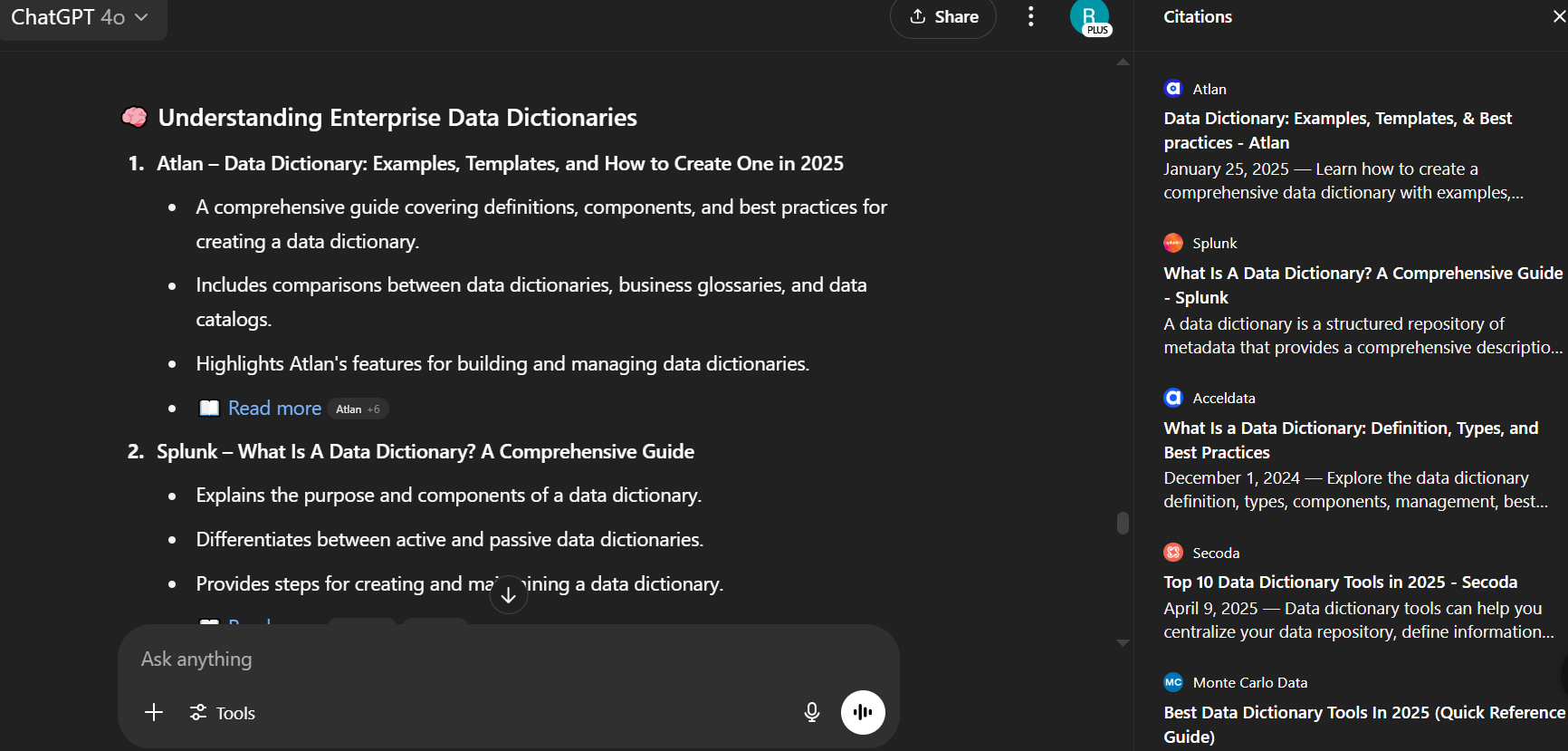
For Atlan, this approach resulted in multiple Google featured snippets secured across competitive data governance keywords and citations in ChatGPT and Perplexity without any additional promotion effort.

How We Attribute SEO to Pipeline in HubSpot
The worst outcome in SaaS SEO Strategy is results that exist but cannot be proven.
Organic content drives a demo. The demo converts to an SQL. The deal closes. In the CRM, it shows as 'direct' because nobody set up organic source tracking. Marketing looks like it contributed nothing. The investment gets cut.
Here is the five-step setup we implement for every RevvGrowth client: After this is live, you can show a direct line between a specific blog post and a closed deal, in a board deck, not just in a spreadsheet tab nobody opens.
Tools We Use for Attribution
- Google Search Console — keyword-to-click data for every organic session
- HubSpot Marketing Hub — contact attribution, deal influence, and multi-touch reports
- Looker Studio — custom monthly attribution dashboard combining GA4 + HubSpot data
- Surfer SEO and Clearscope — pre-publication content quality scoring and semantic optimisation
Once this is in place, you will typically find that organic content influences a significantly larger proportion of your pipeline than last-touch attribution shows. Most clients are surprised by how many closed deals had an organic touchpoint they never credited.
SEO leads close at a 14.6% rate, compared to just 1.7% for outbound leads. The gap reflects the difference between a buyer who found you when they were actively looking versus one you interrupted. Source: HubSpot B2B Marketing Data
That 14.6% vs 1.7% gap is what makes organic search worth the attribution investment. Buyers who find you through SEO have already researched their problem, identified a solution category, and reached a level of intent that cold outreach cannot manufacture.
For a full breakdown of our SEO content process for SaaS: 10-Step B2B SaaS SEO Strategy to Outrank Competitors.
If Your SEO Drives Traffic But Not Pipeline — You Know Why Now
Traffic is easy to grow. It responds to volume. Pipeline is harder. It responds to intent, and you cannot manufacture intent by publishing more content on the wrong keywords.
The gap between a high-traffic SaaS SEO Strategy and a high-pipeline one is almost always three things: wrong keywords, wrong page types, and a broken attribution setup that makes the problem invisible.
Fix those three things and organic search becomes the most defensible pipeline channel you have. Compounding. Lower CAC than paid. And fully attributable in a board conversation, if you have built the infrastructure to prove it.
If you want RevvGrowth to run the keyword scoring model on your current list, audit your content against the four-bucket framework, and give you a clear view of what to build next, book an audit call.
.svg)


.webp)
.avif)