


Introduction
Organic search has changed.
In 2026, ranking on Google alone is no longer enough. Buyers are discovering software through ChatGPT, Perplexity, Gemini, and Google AI Overviews before they ever visit a website. That means modern SEO is no longer just about rankings. It is about visibility across both search engines and AI engines.
The SaaS brands that are still growing organically are adapting faster.
They are optimizing for AI retrieval, rebuilding pages already ranking in positions 8–20, and focusing on the pipeline instead of vanity metrics.
This guide breaks down the exact playbook we use at RevvGrowth to improve organic keyword rankings in a search landscape increasingly shaped by AI.
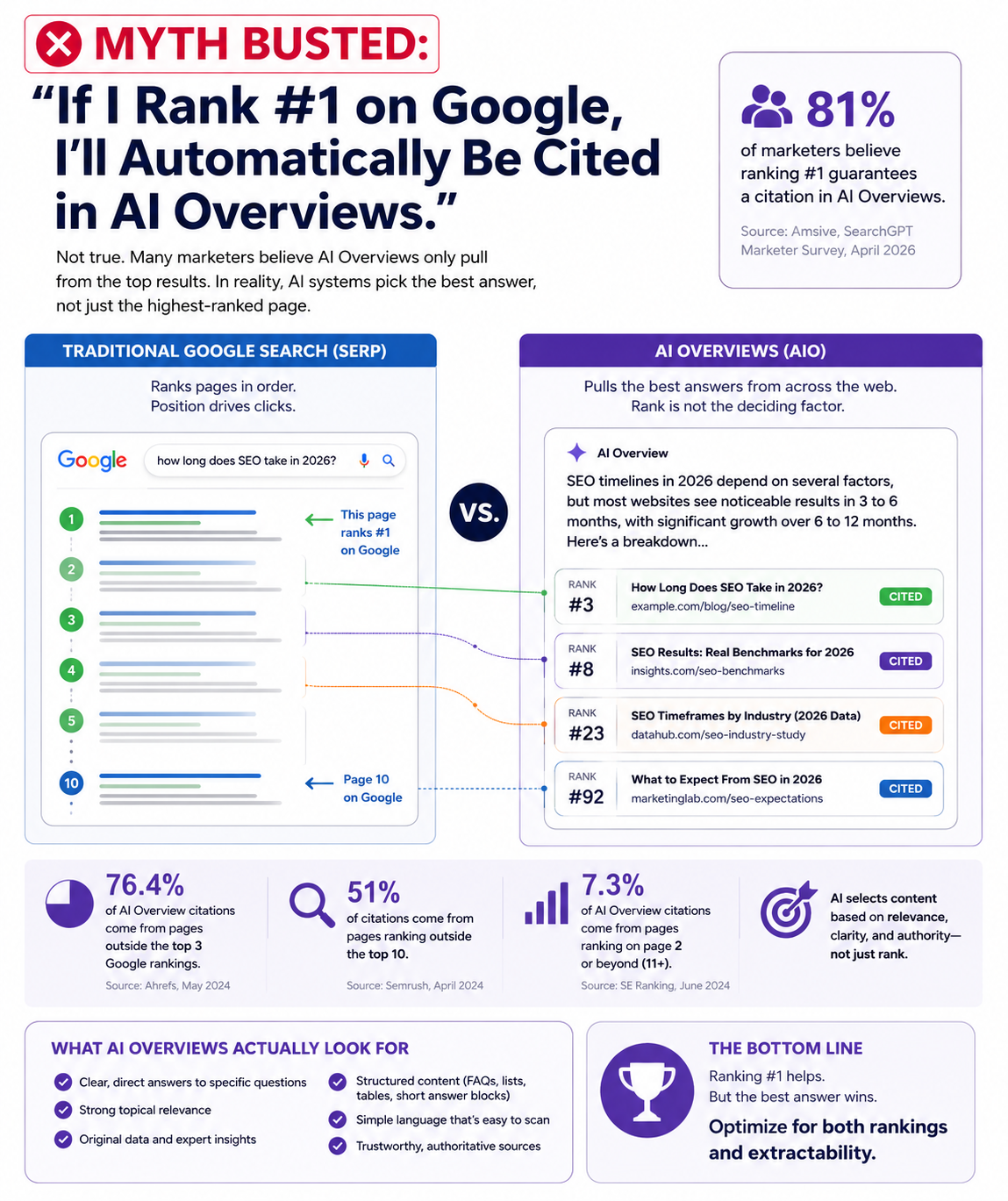
How to Improve Your Organic Keyword Ranking: 8 Steps That Actually Work in 2026
Here are some actionable steps that you can follow to see results:
Step 1: Improve the Keywords Already Close to Ranking
The fastest way to improve rankings is not to publish new content. It's to improve what you already have.
Pull your data
Open Google Search Console. Go to Performance > Search Results. Set the date range to the last 90 days. Export the full query and page report.
Now filter for:
Pages ranking between positions 8 and 20. These are your biggest opportunities. Google already thinks these pages are relevant enough to show on page one or two. They just need more depth, better structure, or tighter intent matching to break into the top 5.
Queries where impressions are growing but clicks are flat or falling. This usually means one of two things: your title and meta description aren't compelling enough to earn the click, or a Google AI Overview is sitting above your result and answering the query before anyone scrolls down.
Pages where the average position has dropped over the last 90 days. If something was at position 6 three months ago and now sits at position 13, a competitor published something better. Pull up the current top 5 results for that keyword and compare. What did they add that you haven't?
How to prioritize
A page is worth optimizing immediately if it meets at least three of these:
- Ranks in positions 8-20 for a keyword you care about
- Has been live for at least 3 months (so it has baseline authority)
- Targets a commercial or bottom-of-funnel keyword (comparisons, alternatives, pricing, use cases)
- Has at least a few backlinks pointing to it
Skip pages already in the top 5 (limited upside from content changes alone). Skip pages with thin or duplicate content (merge or delete them instead). Skip pages targeting keywords with zero buying intent unless they feed into a larger topic cluster.
How this played out for client OvalEdge
OvalEdge offers enterprise data catalog and governance software, but despite having hundreds of pages, many were ranking just outside the first page of search results.
Rather than publishing new blogs, we ranked every existing page by potential impact and optimized the highest-opportunity ones first. The content was there. It just needed better structure, deeper coverage of the actual questions buyers were asking, and clearer answers up front.
Six months later:
- Impressions went from 2.75M to 5.08M per month.
- Average position improved from 9.4 to 8.9 across their keyword set.
- And March 2026 was their highest-ever lead month at 138 leads.
Step 2: Map Every Keyword to Buyer Intent, Not Search Volume
Search volume matters, but it should never be the only factor guiding your content strategy.
The intent shift you need to understand
Organic rankings improve when your content matches what the searcher actually wants. Google now prioritizes intent alignment over simply matching keywords. That’s why commercial and comparison-focused keywords often rank well and drive better conversions, while educational keywords help build topical authority.
This also impacts AI Overviews. Informational searches are often answered directly in search, while high-intent commercial queries still generate clicks. Strong intent alignment improves both organic rankings and AI visibility.
How to organize your keywords
Tier 1 (highest priority): Bottom-of-funnel. Comparisons ("Alation vs Collibra"), alternatives ("Salesforce email alternatives"), pricing queries, and review searches. The person typing these is evaluating options right now.
Tier 2: Mid-funnel use cases. These describe a problem, not a product. "How to automate sales commissions" or "best way to track data lineage across systems." The searcher knows what they need but hasn't picked a vendor.
Tier 3: Category-level educational. Broader terms rarely convert directly, but they build topical authority that helps your Tier 1 and Tier 2 pages rank. They're also the pages most likely to earn GEO visibility, because AI engines frequently pull from educational content when answering broad questions.
Tier 4: Tangential. Related topics your audience might search for, but that don't connect back to your product. Lowest priority. Only create these if they're part of a planned topic cluster.
How this played out for our client: Everstage
Everstage sells sales compensation and ICM (Incentive Compensation Management) software. These are niche topics with smaller search volumes, but the people searching are serious buyers doing due diligence.
We built the content roadmap around keywords like “sales compensation,” where searchers are actively trying to understand the problem before evaluating potential solutions. This approach helped the blog reach Google’s first page by targeting a topic that combines strong educational value with clear commercial intent.
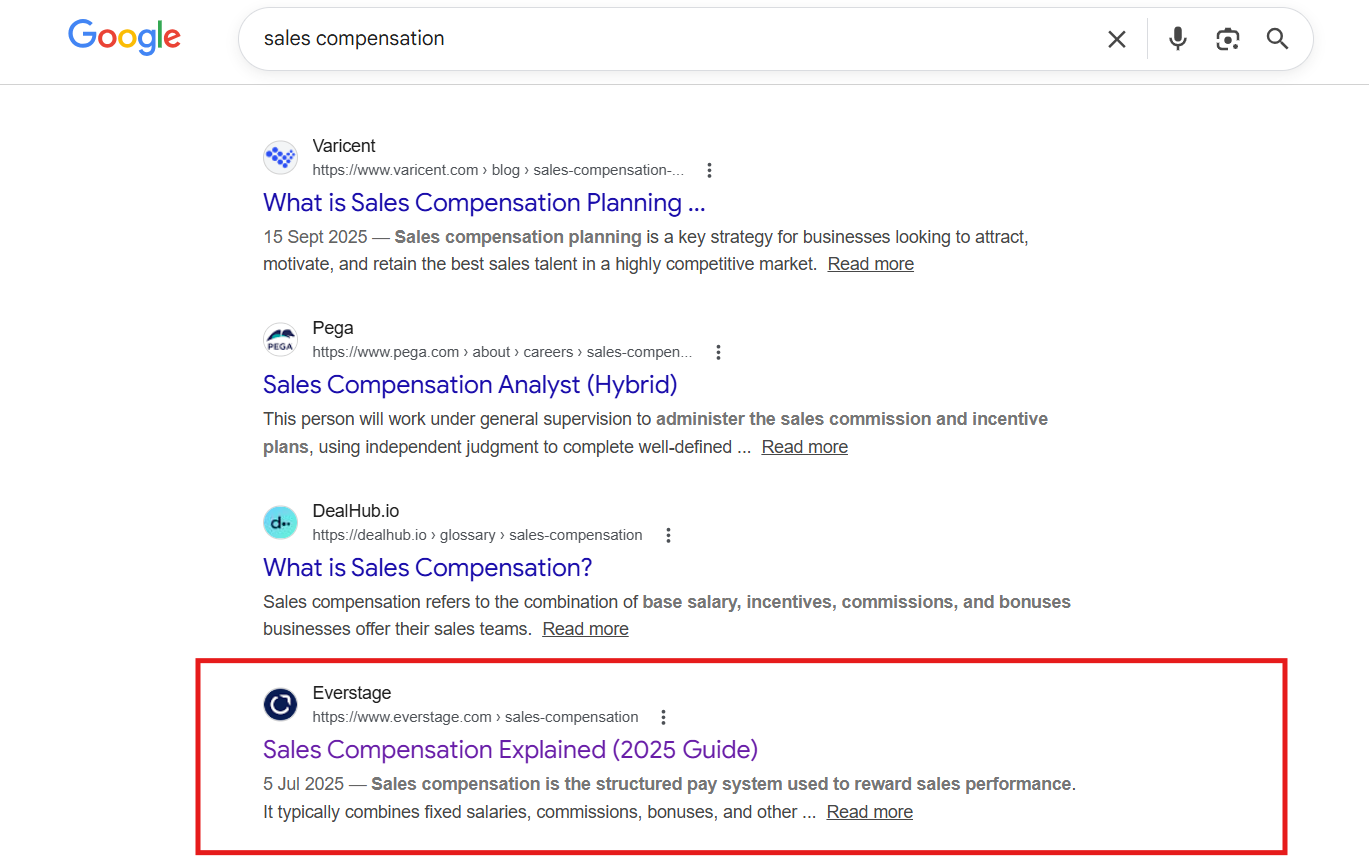
Screenshot: Keyword ‘sales compensation’ ranking at #7 on SERP
Step 3: Study the SERP Before You Write a Word
Every keyword has a content pattern that already performs well in search. Before creating a page, study the top-ranking results and understand what they actually cover. Look at the depth of information, the subtopics included, the type of examples used, the statistics they reference, and how directly they answer the query.
Also, check the AI Overview if one appears. See which pages are being cited and why. Some queries reward detailed educational content, while others favor comparison-driven or commercially focused pages. If your content misses the dominant intent or fails to cover the topics users expect, ranking becomes much harder, even with strong SEO fundamentals.
What to check (takes 15 minutes per keyword)
- What topics and subtopics appear consistently across the top 10 results?
- How detailed are the ranking pages?
- Are they using statistics, examples, templates, or expert opinions?
- What questions appear in People Also Ask?
- Is Google rewarding informational, commercial, or transactional content for this keyword?
- If an AI Overview appears, what type of content is it citing?
When to update existing content vs. start fresh
If a competitor is winning with a fundamentally different format (they have a listicle, you have a long-form guide), optimization won't fix the gap. You need a new page in the right format. If the formats match but their content is deeper, more current, or better structured, updating your existing page is the right move. Existing pages carry accumulated authority that new pages don't have.
Step 4: Write Content That Ranks Well and Delivers Real Value
In 2026, the content that performs best in organic search is the content that genuinely helps readers. Google's recent updates increasingly reward pages with original insights, real examples, trustworthy information, and clear structure, while thin SEO-first content continues to lose visibility.
The same qualities also improve AI visibility. Content that is well-structured, easy to understand, and backed by real expertise is more likely to be extracted and cited by AI systems. In other words, creating genuinely useful content now improves both traditional organic rankings and AI-generated visibility.
Seven things to do on every page
1. Answer the main question in the first 100 words. Don't bury the answer below three paragraphs of setup. State it clearly at the top, then go deeper. AI engines pull from content that answers questions in a concise, direct block. If your answer is in paragraph six, it's invisible to them.
2. Write subheadings that match actual search queries. Write H2s in a way someone would type or speak the question. "How long does SEO take in 2026?" beats "Timeline Expectations for Modern Optimization Programs."
3. Add a Short Answer Block for every major question the page covers. This is a 40-60-word paragraph that directly answers one specific question. It's the format AI engines are most likely to extract and cite. Place these right after the relevant subheading.
4. Include specific, quotable data. Princeton's GEO research found that content with statistics, citations, and quotations achieves 30-40% higher visibility in AI responses. Every stat you include, every specific number, every data-backed claim makes your page more citable. Don't just say "many companies are shifting to AI search." Say "ChatGPT handles 20% of search-related traffic worldwide (Graphite, March 2026)."
5. Write in simple language and avoid jargon. SE Ranking's study of 2.3 million pages found that content with plain language literally gets cited more than complex writing.
6. Build topic clusters, not standalone posts. One pillar page covers a broad topic and links to 10-20 supporting articles. Every supporting article links back. This creates a web of topical authority that helps both Google and AI engines understand that you own the subject.
7. Add human review before publishing. AI can speed up research and drafting, but every page still needs human editing. Review content for clarity, accuracy, tone, examples, and readability to ensure it actually helps real readers, not just search engines. The content that performs best in 2026 is content that feels genuinely useful and human-written.
How this played out for OvalEdge
OvalEdge is an enterprise data catalog and governance platform that helps organizations manage, discover, and govern data at scale. As part of their SEO strategy, we restructured key pages to better serve both search intent and content extractability.
Their “AI-powered open source data catalogs” page reached 519 monthly clicks after the update. Another page targeting “Data Collection” grew from 76 to 277 monthly clicks, a 260% increase. The topic and URL stayed the same. The improvement came from rewriting the page with clearer answers, stronger subheadings, and more specific, data-backed insights throughout.
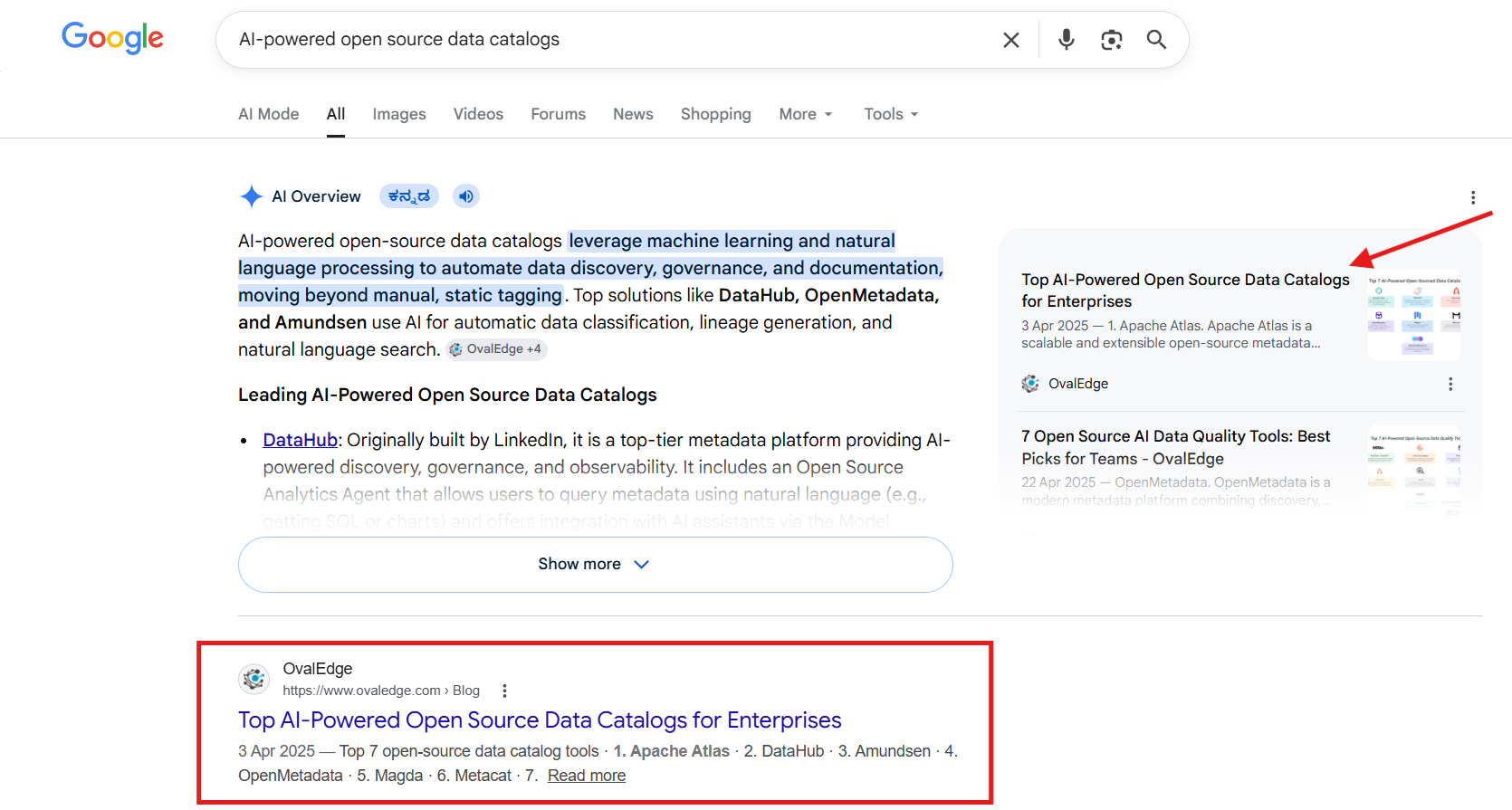
Screenshot: Ovaledge ranking for the keyword
Step 5: Fix Technical SEO and Build a Real Internal Linking System
Technical SEO isn't going to make a weak page rank. But technical problems can absolutely prevent a strong page from ranking.
The technical checklist for 2026
- Core Web Vitals. Google's thresholds: LCP (Largest Contentful Paint) under 2.5 seconds, INP (Interaction to Next Paint) under 200ms, CLS (Cumulative Layout Shift) under 0.1. Test every key page with PageSpeed Insights. If any of these fail, fix them before spending time on content.
- Indexing. Go to Google Search Console > Pages. Look at excluded pages. Check for accidental noindex tags, crawl blocks in robots.txt, or pages returning 404/500 errors. You'd be surprised how often important pages are invisible to Google because of a simple configuration mistake.
- AI crawler access. This is new, and most sites haven't thought about it. LLM bots now crawl 3.6x more volume than Googlebot. But many sites block them without knowing. Cloudflare recently changed its default to block AI crawlers. Check your robots.txt and make sure GPTBot, ChatGPT-User, PerplexityBot, and ClaudeBot are allowed access. If you want AI engines to cite your content, they need to be able to read it.
- Mobile performance. Most B2B searches now happen on phones, even for enterprise software. If your pages load slowly or break on mobile, you're losing both rankings and visitors.
- Poor URL hygiene hurts rankings. Fix duplicate content URLs, unnecessary redirects, and pages disconnected from your site structure.
How this played out for our client: Cygnet
Cygnet is an enterprise digital transformation company. When we ran their initial technical audit in January 2026, we found noindex tags incorrectly applied to dozens of pages they wanted to rank. A simple configuration error was making those pages invisible to Google.
Fixing that one issue unlocked indexing for over 50 pages. No content changes. No link building. Just removing what was blocking them.
The lesson: before you invest in content or links, make sure Google (and AI crawlers) can actually see your pages.
How to build internal links that actually help
Internal links do three things: they help search engines discover pages, they pass authority from strong pages to weaker ones, and they help AI crawlers understand how your content relates to itself.
Link from your strongest pages to the pages you want to rank better. Check Google Search Console for your highest-traffic pages. Add links from those pages to newer or weaker pages you're trying to boost.
Use descriptive anchor text. The link text should describe what the linked page is about. "Read more" tells Google nothing. "Guide to sales compensation automation" tells Google exactly what to expect on the other end.
Find and fix orphan pages every month. An orphan page has zero internal links pointing to it. Google has a harder time discovering and valuing these. Run a crawl with Screaming Frog or Sitebulb and look for pages with zero inlinks. Every important page should have at least 3-5 internal links.
Step 6: Build Authority Through Links and Brand Mentions
Backlinks still play a major role in organic rankings in 2026, but quality matters far more than quantity. Google increasingly rewards links and mentions from trusted, relevant sources that demonstrate real authority within your industry.
What actually improves rankings
- Publish original research and data: Unique statistics, benchmarks, and reports naturally attract backlinks because other sites reference them as sources. This strengthens both rankings and brand authority.
- Earn links from relevant industry websites: Contextual links from respected publications in your niche carry far more SEO value than large volumes of low-quality links.
- Turn unlinked mentions into backlinks: If another site already mentions your brand, requesting a link is often an easy win that strengthens your authority signals.
- Build visibility in industry communities: Discussions on platforms like Reddit, Quora, review sites, and industry forums help increase brand awareness and trust around your topics.
- Get listed in trusted directories: For B2B SaaS companies, platforms like G2 and Capterra help strengthen credibility and improve discoverability.
Strong authority signals also improve AI visibility because AI systems tend to cite brands and pages that are consistently referenced across the web. But the primary goal remains the same: building trust and improving long-term organic rankings.
What this looks like at scale
For our client, MassMailer, we deliver 18-20 backlinks per month, a mix of contextual editorial links from Salesforce ecosystem publications and high-authority directory listings. That link velocity, combined with strong content, is a key reason their new blogs consistently hit top positions.
Step 7: Optimize Specifically for AI Search Visibility
If you've followed Steps 1-6, you've already done most of the foundational work for AI search. Clear content structure, Short Answer Blocks, original data, readable writing, and accessible crawling all make your content more likely to get cited by AI engines.
This step covers the specific, additional things you can do to increase your chances.
Why is this important
Seer Interactive's 2026 analysis found that brands cited in AI Overviews earn roughly 120% more organic clicks per impression compared to uncited brands on the same queries. Being in the AI Overview doesn't just help AI visibility. It actually doubles your click rate on regular search results, too, because people see your brand in the summary and then click your link below.
AI referral traffic is still small, about 1% of all website traffic, but it's growing roughly 1% month over month, with ChatGPT driving 87.4% of that traffic. And early data suggests AI-referred visitors convert better than traditional search visitors.
What to do
Add FAQ sections with structured data markup. BrightEdge found that sites using structured data and FAQ blocks saw a 44% increase in AI search citations. This is one of the easiest, highest-impact changes you can make. Add 4-6 FAQ items at the bottom of every key page, with proper FAQ schema markup.
Keep your content fresh. BrightEdge also found that pages updated within 60 days are 1.9x more likely to appear in AI answers compared to older content. Set a calendar reminder to review and update your highest-value pages every two months. Even small updates (new stats, refreshed examples, updated screenshots) signal freshness.
Strengthen entity signals. AI systems use entity recognition to match content to queries. Make sure your brand name, product name, and category terms appear clearly and consistently. If you sell "sales compensation software," use that exact phrase. Don't rotate between five different ways to describe what you do.
Build an extractable content library. For every major topic you cover, your content should include at least one Short Answer Block (40-60 words directly answering the question), at least 3 specific data points or statistics with sources, and at least one clearly stated perspective or recommendation. These are the elements AI engines look for when deciding what to cite.
Monitor where you show up (and where you don't). Tools like Otterly, Superlines, and Semrush's AEO module can track how often your brand appears in AI-generated answers. Only 14% of marketers currently track AI visibility, so just measuring it puts you ahead of most competitors.
How this played out for Everstage and OvalEdge
Every piece of content we published for Everstage was built with AI extraction in mind from day one. Short Answer Blocks at the top of every article. Specific stats are called out clearly. Structured FAQ sections at the bottom. Within weeks of publishing, Everstage started appearing in ChatGPT and Perplexity responses for ICM and commission automation queries.
For OvalEdge, we tracked LLM referral sessions as a distinct metric. Over six months, those sessions grew from 100 to 278, a 178% increase. That's real traffic coming from AI platforms, from people who discovered OvalEdge through a ChatGPT or Perplexity response rather than a Google search.
Step 8: Measure Rankings, Clicks, AI Citations, and Pipeline Together
Rankings by themselves don't tell you if your SEO program is working. A page can rank #3 for a keyword and generate zero pipeline if the keyword attracts the wrong audience.
The four metrics that matter
Rankings: Monitor where your target pages appear in search results. Track performance weekly using tools like Google Search Console, Semrush, or Ahrefs.
Clicks: Measure how much traffic search is actually driving. If rankings stay stable but clicks decline, weak titles and meta descriptions, or AI Overviews absorbing clicks, may be the reason.
AI citations: Track how often your brand appears in AI-generated answers across platforms like OpenAI ChatGPT, Perplexity AI Perplexity, Google Gemini, and Google AI Overviews. Tools like Otterly, Superlines, and Semrush can help monitor visibility.
Pipeline: Track leads, demo requests, and revenue influenced by organic traffic. This is the metric that ultimately matters, everything else is just a leading indicator.
How to read the signals
- Rankings up, pipeline flat: You’re attracting traffic, but not the right traffic. Your keywords may have search volume, but the intent doesn’t align with your product or offer. Revisit your keyword strategy and prioritize terms with stronger commercial intent.
- Impressions up, clicks down: Your pages are appearing more often, but fewer users are clicking. This usually points to weak titles and meta descriptions or AI Overviews capturing clicks directly in search results. If AI Overviews are showing for your target queries, optimize your content to earn citations within them and focus more heavily on high-intent commercial keywords.
- Traditional SEO metrics are strong, AI visibility is weak: Your content may rank well traditionally, but still be difficult for AI systems to extract and cite. Improve structure with concise answer sections, statistic callouts, FAQ schema, and clear formatting that AI engines can easily parse.
- All four metrics trending upward: Rankings, clicks, AI citations, and pipeline growth together usually indicate the strategy is working. Continue iterating through regular content audits, refreshing older pages, strengthening internal links, and expanding topic clusters over time.
Build one dashboard
Pull Google Search Console, GA4, and your CRM (HubSpot, Salesforce, whatever you use) into a single Looker Studio dashboard. Rankings, clicks, AI citations, and pipeline should all sit in one view so you can see the cause-and-effect chain clearly.
Weekly: Quick performance snapshot. Any sudden drops or gains worth investigating?
Monthly: Deep-dive report with prioritized actions. Which pages gained? Which lost? What should we optimize, publish, or update next month?
Quarterly: Strategic review. Is the content architecture still right? Are we targeting the right keyword tiers? Should we reallocate the budget between new content, optimization, and link building?
Key Takeaways
Here is a quick snapshot of the points covered in this blog:
- Organic growth in 2026 requires visibility across both traditional search and AI-driven search experiences.
- The fastest SEO wins often come from optimizing pages already ranking in positions 8–20.
- Keyword intent matters more than search volume alone. Commercial and comparison-focused keywords usually drive better rankings and conversions.
- Content that genuinely helps readers performs best in both organic search and AI citations.
- Studying top-ranking pages helps you understand the depth, structure, and intent Google rewards.
- Technical SEO, internal linking, and high-quality backlinks still play a major role in rankings.
- AI visibility supports SEO, but strong organic rankings remain the foundation.
- Measure rankings, clicks, AI visibility, and pipeline together to understand real SEO impact.
RevvGrowth runs SEO, AEO, and GEO programs for B2B SaaS companies. If you want results like the ones in this guide, book a call with us now.
Frequently Asked Questions (FAQs)

Shalini Murthy
.svg)
Director of SEO & Content
Shalini Murthy is a B2B SaaS writer and strategist with over eight years of SEO and content marketing experience. You can connect with her on LinkedIn. When not immersed in the world of words, she enjoys a good coffee, reading books, and spending time with her family.


.webp)
.avif)