


Introduction
A founder we worked with last year had 120 MQLs coming in, but conversions were nowhere close to what he expected.
We hear this from almost every new client during their first audit call. They’re hitting MQL targets, but the pipeline is not moving, and sales are frustrated. The root cause is usually the same: nobody has a clear definition of what a qualified lead actually looks like. The numbers across the industry reflect it too.
Most B2B SaaS teams convert 18-22% of MQLs to SQLs. Top performers convert 35-40%. The difference isn't volume. It's how tightly they define "qualified." And 37.7% of marketers admit they're hitting MQL targets regardless of quality.
This guide is built to help you attract the right buyers, not just more leads. These are the same strategies that helped us deliver real, measurable pipeline for our clients.
Types of Qualified Leads
Before you pick a channel or build a campaign, you need to know which kind of lead you're trying to generate. "Qualified" means different things at different funnel stages, and the same prospect can be qualified under one definition and unqualified under another.
These are the 4 types worth knowing:
1. Information Qualified Lead (IQL)
An IQL is the earliest type of qualified lead. They've shown interest in your category by downloading a guide, signing up for a newsletter, or attending a webinar, but they haven't expressed intent to buy yet.
Example: Someone who downloads your "State of B2B SaaS Marketing 2026" report. They care about the topic, but you don't know yet if they're a buyer.
What to do with them: Guide them gradually rather than going straight for the pitch. Send them more educational content and watch for behavioral signals (pricing page visits, demo page visits, repeat content downloads) before promoting them.
Best channels to generate them: SEO, content marketing, social media posts, and webinars.
2. Marketing Qualified Lead (MQL)
An MQL is a lead that has shown enough interest and alignment to deserve sales attention. This is typically based on a mix of company fit (industry, company size, job role) and engagement signals like repeated website visits, content downloads, or email interactions.
Example: A Vice President (VP) of Marketing at a 200-person SaaS company who downloaded 3 pieces of content, visited the pricing page twice, and opened the last 4 emails.
What to do with them: Send sales-ready leads to your sales team, and continue nurturing less-engaged prospects with more conversion-focused campaigns. This stage heavily impacts pipeline generation.
Best channels to generate them: Google Ads, LinkedIn Ads, content + email nurture, mid-funnel webinars.
3. Sales Qualified Lead (SQL)
An SQL is an MQL that the sales team has qualified as a genuine sales opportunity. The lead matches your ideal customer profile and shows strong intent to buy.
Example: The same VP of Marketing, after a discovery call where they confirmed they have a budget, a defined timeline, and are actively evaluating solutions.
What to do with them: Move into an active sales process with demos, follow-ups, proposals, and closing conversations. SQLs are the foundation of accurate pipeline forecasting.
Best channels to generate them: Inbound demo requests, ABM (Account-Based Marketing), outbound with intent data, referrals.
4. Product Qualified Lead (PQL)
A PQL is a prospect who has demonstrated buying intent through actual product usage, not just marketing engagement. They’ve reached meaningful usage milestones, explored key features, or shown behaviors linked to paid conversion.
Example: A free trial user who's logged in 5 times, invited 2 colleagues, and used the core feature your paying customers use most.
What to do with them: Launch an automated sales workflow based on their product activity. PQLs often convert at much higher rates because they’ve already seen value firsthand.
Best channels to generate them: Free trials, free-plan products, and product-led growth strategies. PQLs usually exist in product-led SaaS companies where users experience the product before speaking to sales.
Which types should you focus on?
This depends on your go-to-market (GTM) and average contract value (ACV):
- Product-led growth (PLG) with low to mid ACV: PQLs are the primary focus, while IQLs and MQLs help feed the pipeline.
- Demo-led with mid ACV: The core funnel is usually MQL to SQL, with IQLs driving top-of-funnel awareness.
- Enterprise with high ACV: SQLs matter most. These funnels are often driven by ABM and outbound efforts that bypass the MQL stage entirely.
The mistake most teams make is treating all 4 types as the same thing. They send PQLs to a generic nurture sequence, hand IQLs to sales too early, or measure MQL volume as if it were SQL volume. Knowing which type you're working with shapes every downstream decision: scoring, routing, sales handoff, and reporting.
Once you know which type of qualified lead you're after, the channel question becomes easier.
Channels To Generate Qualified Leads
Below are 10 channels worth knowing in 2026, including 3 that have shifted significantly in the last 12 months. Pick 2 to 3 that match your ICP (Ideal Customer Profile) and ACV (Annual Contract Value) and stay consistent.
1. Organic SEO
Organic search drives 76% of all trackable B2B website traffic, and SEO leads close at 14.6% vs 1.7% for outbound. For B2B SaaS, it's still the highest-ROI channel for generating qualified leads over time.
But in 2026, SEO alone leaves a lot of pipeline unrealized. With 94% of B2B buyers now using LLMs during their purchase journey, you need SEO working in tandem with AEO and GEO. The content that ranks on Google is increasingly the same content that gets cited by ChatGPT and Perplexity. Build for one, build for all three.
Actionable steps:
- Build topical authority around keyword clusters, not scattered blog posts. Google is stricter now about whether your brand has real depth on a subject.
- Prioritize internal linking to guide users through the funnel and distribute ranking power across your cluster.
- Fix technical SEO foundations: crawl errors, page speed, schema markup. None of your content strategy matters if Google can't index your site properly.
- Optimize existing blogs before publishing new ones. Outdated content is the most common SEO leak.
- Build BOFU pages (comparisons, alternatives, pricing) after you've established topical authority. They convert at much higher rates but need the authority foundation to rank.
- Target LSI and long-tail keywords as low-hanging fruit. Lower volume, much higher intent.
- Publish original research and first-party data. It makes you a citable source for both journalists and AI engines.
- Add structured data (FAQ, product, how-to schema) to feed featured snippets and AI Overviews.
What doesn't work:
- Publishing blog posts that get clicks but no conversions
- Writing generic content that says the same thing as the top 10 results
- Ignoring AI search completely
Time to results:
- Early movement in 4-6 months for less competitive keywords
- Most B2B SaaS companies break even on SEO around 7 months
- Returns get stronger over 2-3 years as your content library grows
2. Answer Engine Optimization (AEO)
AEO is the discipline of getting your content cited directly inside AI-generated answers. According to Tinuiti's AI citations report, social and editorial sources now account for over 9% of all AI citations, and that share is growing every quarter. AEO is becoming the entry point to your funnel.
Why this brings qualified leads: when a buyer asks ChatGPT or Perplexity "what's the best [your category] tool for [their use case]," they get a shortlist of 3 to 5 vendors. That shortlist replaces page one of Google for an increasing share of buyers. If you're not cited, you're not in the consideration set.
Actionable steps:
- Lead every page with a direct, citable answer in the first 30% of the content.
- Use consistent H2/H3 hierarchy with 120-180 words between headings.
- Write in formats AI loves: comparative listicles, definition-led intros, structured FAQs.
- Add explicit author bylines, credentials, and "last updated" dates. Recency matters.
- Include relevant statistics from sources. AI engines pull quoted stats with attribution far more often than unsourced claims.
- Audit AI citations monthly. Query each engine with your top 10 keywords and document what's cited.
What doesn't work:
- Stuffing pages with FAQ schema while saying nothing distinctive
- Long paragraphs before the actual answer
- Treating ChatGPT, Perplexity, and Google AI Overviews as one channel (each retrieves differently)
Time to results:
- 30 to 60 days for citation appearance on lower-competition queries
- 3 to 6 months for consistent presence on high-competition category queries
Interested in improving your AEO strategy? Connect with our team today. Connect with our team today.
3. Generative Engine Optimization (GEO)
GEO is about increasing your brand’s visibility inside AI-generated responses, whether or not your site gets linked. AEO is specifically focused on getting your content cited as a source. They overlap, but they are not identical strategies.
AI engines pay attention to how often your brand is referenced across the web, not just whether you have great content.
Why this brings qualified leads: when ChatGPT recommends 5 vendors for "best CRM for early-stage SaaS," buyers treat that list with the same trust they'd give a recommendation from a peer. Being in that list creates pre-qualified inbound. Being absent means you have to spend more on every other channel to compensate.
Actionable steps:
- Get listed on G2, Capterra, and TrustRadius with active review collection. These are heavily weighted by LLMs.
- Build a presence on review-aggregator listicles ("best X for Y" posts on third-party sites). Pitch yourself to writers covering your category.
- Build brand awareness with digital PR campaigns, podcast features, and thought leadership content published under the founder’s name.
- List your founders and team members on industry-recognized expert platforms like Built In, Crunchbase, and LinkedIn Top Voices.
- Maintain a clean, structured Wikipedia entry if you qualify, since it's heavily cited by ChatGPT.
- Get your product mentioned in Reddit and YouTube content (see channels 4 and 5 below).
- Monitor branded sentiment across AI engines monthly. Tools like Profound, Otterly, and GEORaiser can automate this.
What doesn't work:
- Treating GEO as a one-time content fix
- Optimizing for a single AI engine
- Paying for visibility on generic SEO listicles is no longer a reliable strategy, since AI engines increasingly prioritize trustworthy and authoritative sources.
Time to results:
- 60 to 90 days for first brand mentions in AI answers if you have an existing footprint
- 6+ months to build presence from scratch
Explore how GEO can increase your brand’s presence across ChatGPT, Perplexity, Gemini, and other AI platforms. Reach out today.
4. Reddit
Reddit is the highest-leverage channel in 2026 that most B2B SaaS teams are still ignoring. Semrush data shows Reddit accounts for 40.1% of all LLM citations, more than Wikipedia and YouTube combined. Perplexity sources 46.7% of its citations from Reddit. This isn't a social channel anymore. It's the training set behind every major LLM.
Why this brings qualified leads: B2B buyers are more likely to trust peer recommendations than branded marketing pages. Discussions in communities like Reddit threads for SaaS, marketing, or DevOps often influence buying decisions far more than ads. A genuine recommendation in these communities can drive significantly higher conversion rates, while also creating content that AI search engines may reference over time.
Actionable steps:
- Identify the 3 to 5 subreddits where your ICP actually hangs out. r/SaaS and r/Entrepreneur for general visibility, then role-specific ones (r/marketing, r/sales, r/devops, r/dataengineering).
- Build karma first by participating without promoting. 100+ karma before you ever mention your product.
- Have your founder or a senior team member create a real account with their face and credentials. No anonymous corporate accounts.
- Answer "best [tool] for [use case]" questions where you're a genuine fit. Mention your product transparently, including limitations.
- Run an AMA (Ask Me Anything) in a relevant subreddit once you have product-market fit and 50+ customer references.
- For mature brands, consider building a branded subreddit.
- Monitor brand mentions across Reddit using tools like F5Bot or GummySearch.
What doesn't work:
- AI-generated comments. Reddit communities detect and downvote them aggressively.
- Promotional posts from new accounts. You'll be banned within hours.
- Treating Reddit like a press release channel.
Time to results:
- 30 to 60 days for the first qualified inbound from Reddit participation
- 6+ months for compounding citation effects in LLMs
5. YouTube
YouTube overtook Reddit as the most-cited domain in LLM responses. On the buyer side, the majority of B2B buyers and researchers watch videos during their purchasing journey, and many say video is an important factor in their buying decision.
Why this brings qualified leads: YouTube is the second-largest search engine in the world and the only one where a product demo can become a 24/7 sales asset. Long-form B2B content (product walkthroughs, case study interviews, technical tutorials) attracts viewers who are already in evaluation mode. Plus, AI engines treat YouTube content as more authentic than text because it's harder to fake.
Actionable steps:
- Start with 2 to 4 mid-form videos per month (2 to 5 minutes each).
- Lead with the problem or outcome in the first 5 seconds, not your logo. Retention drops sharply after the intro.
- Add chapters, timestamps, and full transcripts. AI engines pull from transcript text, not just the video itself.
- Optimize titles around buyer-intent keywords ("How to [outcome] with [category]", "[Competitor] vs [Competitor] comparison").
- Create one in-depth product demo per core use case. These become evergreen sales assets your AEs can send to prospects.
- Run YouTube Ads for B2B remarketing.
- Track engagement back to pipeline using Vidyard or Wistia, both of which integrate directly with HubSpot.
What doesn't work:
- AI-generated avatars for thought leadership content. The authenticity signal is what AI engines weigh.
- Treating YouTube as a one-off upload channel. The algorithm rewards consistent publishing.
- Talking head videos with no editing or visuals. Watch time is what compounds.
Time to results:
- First qualified leads in 60 to 90 days from organic
- Compounding traffic and citation effects over 6 to 12 months
6. Google Ads
Google Ads is the fastest paid channel to qualified leads if your ICP is searching for solutions, and the most expensive way to burn budget if it isn't. According to HubSpot's 2026 State of Marketing Report, median B2B CPL hit $213, but the dispersion is the story: top-quartile teams pay $84 per lead while bottom-quartile teams pay $397.
Why this brings qualified leads: search captures buyers at the exact moment of need. Someone typing "best document data extraction tool" is closer to buying than anyone you'd reach on LinkedIn or YouTube. The challenge is keyword tiering and bidding discipline. The teams paying $84 per lead aren't running smarter algorithms. They're running cleaner accounts.
Actionable steps:
- Structure campaigns by intent tier: branded → competitor → category → feature. Don't mix them in the same ad group.
- Start every new campaign on manual CPC for 30 days, then move to Target CPA after 30+ conversions, then Target ROAS after 100+.
- Use Single Keyword Ad Groups (SKAGs) for high-intent terms.
- Build a deep negative keyword list from day 1. Review search terms weekly for the first 90 days.
- Import offline conversions back into Google Ads quarterly so the algorithm bids on closed-won, not form fills.
- Match every ad to a dedicated landing page. Sending paid traffic to your homepage cuts conversion rate by 40 to 60%.
- Use Performance Max only for retargeting or branded search. For cold acquisition in B2B SaaS, it leaks budget.
What doesn't work:
- Broad match without aggressive negatives
- Bidding on competitor terms without competitor-comparison landing pages
- Trusting Smart Bidding before you have meaningful conversion data
Time to results:
- Leads in week 1
- Predictable CPL in 60 to 90 days
- True ROAS optimization possible after 6+ months of closed-loop data
7. LinkedIn Ads
LinkedIn is the only paid channel where you can target by job title, seniority, company size, and industry with real accuracy. The precision comes at a cost: clicks run $8 to $20.
Why this brings qualified leads: LinkedIn is where decision-makers self-identify with their title and company. You can target exactly the buyer persona you want, exactly the company size you want, in exactly the geography you want. No other channel offers that level of demographic precision. For ACV above $15K, the math works. Below $10K, it usually doesn't.
Actionable steps:
- Build your matched audience to at least 5,000 contacts before launching.
- Use Lead Gen Forms for capture campaigns. They convert 2 to 3x better than landing pages because the user never leaves LinkedIn.
- Layer sponsored content (awareness) + retargeting (consideration) + conversation ads (closing). Each format does a different job.
- Test Document Ads. They're cheaper, get higher engagement, and are great for ungated guides and benchmark reports.
- Use Company Engagement reports to identify accounts that interacted with your content. Pass them to sales for outbound.
- Run thought leader ads from your founder's account, not just the company page. CTRs run 2 to 3x higher.
- Bid by manual CPC for the first 100 conversions, then shift to Target Cost.
What doesn't work:
- Targeting the C-suite for products that get approved by directors
- Generic offers like "Download our guide." LinkedIn audiences expect higher production value.
- Running on automated bidding before you've validated audience-message fit
Time to results:
- Leads in week 1
- 60 to 90 days to find the right offer-audience combination
- Mature campaigns deliver consistent CPL within 4 to 6 months
8. Cold Outreach (Email + LinkedIn DMs)
Cold outreach is the most efficient channel for high-ACV B2B SaaS, but only when targeting is tight. According to Instantly's 2026 Cold Email Benchmark Report, the average reply rate dropped to 3.43% in 2026, while elite teams hit 10%+ on focused campaigns. The difference isn't volume. It's precision.
Why this brings qualified leads: cold outreach lets you reach the exact decision-maker at the exact account you want, on your timeline. No waiting for them to search. No relying on AI engines to recommend to you. If your TAM is well-defined and your ACV is $5K+, cold outreach is the most direct path to pipeline.
Actionable steps:
- Refine your ICP before scaling. A smaller, highly targeted audience will outperform a broad, generic one almost every time.
- Keep first-touch emails between 50 and 125 words with one clear CTA. Longer emails see 50% lower reply rates.
- Use intent triggers: hiring signals, funding announcements, technology changes, and role changes.
- Run 3 to 5 email sequences with 3 to 5 days between touches. Follow-ups generate a decent number of replies.
- Combine email, LinkedIn DMs, and phone in an omnichannel sequence.
- Set up proper deliverability infrastructure: SPF, DKIM, DMARC, dedicated sending domains, and warm-up periods. Skip this, and 30%+ of your emails will hit spam.
- Send Tuesday through Thursday between 9:30 to 11:30 AM in the recipient's timezone. Avoid Mondays and Fridays.
- Track positive reply rate (not total reply rate). Out-of-office replies and "unsubscribe" responses don't build a pipeline.
What doesn't work:
- AI-generated personalization at scale. Buyers can tell, and reply rates drop sharply.
- "Hope you're doing well," intros. They signal mass outreach immediately.
- Sending from your primary domain. One spam complaint can damage every other email your team sends.
Time to results:
- First replies in week 1
- Predictable meeting bookings in 30 to 60 days
- Mature programs deliver a consistent pipeline within 90 days
9. ABM with Intent Data
Account-Based Marketing is the highest-converting channel in B2B SaaS, but only above a certain deal size. 6sense and Demandbase's 2026 cohort analysis across 2,400 B2B accounts shows intent-sourced leads close at 18.7% to closed-won versus 5.5% for cold ICP-match leads — a 3.4x advantage. They also have 23% higher average contract value because they enter the funnel later in the buying process.
Why this brings qualified leads: ABM focuses on targeting high-value accounts instead of attracting random leads. By combining personalized outreach with intent data, you engage companies already researching your category, leading to significantly higher conversion rates.
Actionable steps:
- Define a target account list of 200 to 1,000 accounts. Above 2,000, it stops being ABM and becomes slow outbound.
- Subscribe to an intent data provider: G2 Buyer Intent for category research, Bombora for topic surges, 6sense or Demandbase for full account orchestration.
- Run a 1:many model for tier 1 accounts (top 50 to 100), 1:many for tier 2 (next 200 to 500). Don't try to personalize every account.
- Map the buying committee for each tier 1 account: champion, economic buyer, end user, blocker. Run multi-threaded outreach.
- Layer paid (LinkedIn account targeting, programmatic display) + outbound (email, LinkedIn DM) + content + executive gifting + field marketing.
- Clearly define account ownership between sales and marketing in writing. Without strong alignment, ABM execution breaks down during the handoff process.
- Measure account engagement scores, not lead volume. Track total touches per account, stakeholder coverage, and pipeline velocity.
What doesn't work:
- ABM without intent data. You're just doing slow outbound.
- Generic personalization (using the company name in an email subject line)
- Running ABM as a marketing-only program. Sales has to own the account engagement directly.
Time to results:
- First meetings booked in 30 to 60 days
- Closed-won in 90 to 180 days, depending on sales cycle length
- Compounding effects from 6 months on as account intelligence grows
10. Webinars and Communities
Webinars consistently produce the highest close rates of any B2B SaaS channel. According to Wistia's 2026 State of Video Report, on-demand webinars continue generating qualified plays for up to 12 months after the live event.
Why this brings qualified leads: webinars create synchronous, high-intent engagement. Anyone who shows up for 45 minutes to learn about your category is significantly more qualified than someone who downloaded a guide. Communities go a step further. They put you in front of buyers when they're forming opinions, not when you're trying to sell.
Actionable steps:
- Collaborate on webinars with businesses that target your ideal customers without overlapping products. Each partner benefits from shared distribution and stronger lead quality.
- Pick a problem-specific topic, not a product-specific one. "How to reduce CAC payback to under 12 months" beats "Introducing our new feature."
- Aim for 45 to 60 minutes with 60% content, 30% Q&A, 10% soft CTA. Hard pitches kill webinar performance.
- Promote 4 weeks before the event with a mix of email, LinkedIn organic, and paid social.
- Send the recording to no-shows within 24 hours, then drop them into a 3-email follow-up nurture.
- Build a community on Slack, Discord, or Circle around a real problem your ICP cares about. Don't make it a customer success channel.
- Participate in 2 to 3 communities where your buyers already hang out. Be useful before you're promotional.
- Host quarterly hosted dinners (10 to 20 ICP executives) in major cities. They produce some of the highest-converting pipelines of any tactic.
What doesn't work:
- Running webinars only for your existing audience usually attracts current customers rather than generating a new pipeline.
- 30-minute generic G2 listings without active review collection
- Joining communities just to drop links. You'll be removed in days.
Time to results:
- First webinar pipeline in 30 to 90 days
- Community presence compounds over 6 to 12 months
The channels are the easy part. The next question is which 2 or 3 to actually run, and how to build a system around them.
An 8-Step Action Plan to Generate Qualified Leads for Your SaaS Business
Here’s the exact 8-step framework we use to help SaaS companies build a repeatable, qualified lead generation system.
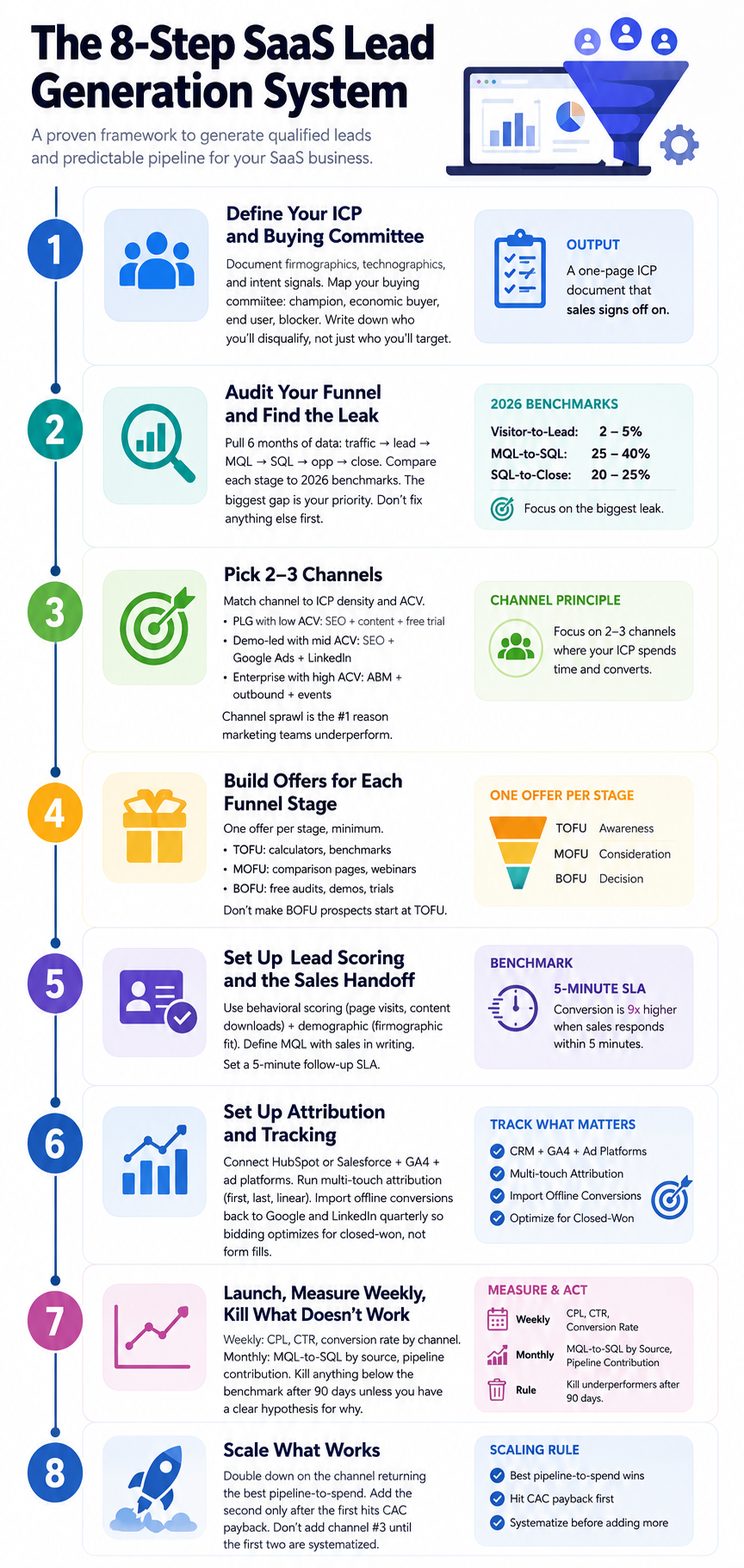
This plan is the difference between "we tried everything" and "we built a system." If you'd rather not do it alone, RevvGrowth runs this exact plan for B2B SaaS clients.
How RevvGrowth Can Help You Generate High-Quality Leads
We're a B2B SaaS marketing agency built around one outcome: a predictable pipeline. Every channel, framework, and process below has been time-tested with real SaaS clients, and the numbers we're showing you are pulled directly from those engagements.
What follows is what we actually do, who we've done it for, and the results those clients walked away with.
What we do
We run full-funnel B2B SaaS marketing across SEO, AEO/GEO, PPC (Google + LinkedIn), ABM, content, and marketing operations. We don't sell channels in isolation. We build the system around your funnel that includes ICP definition, channel mix, lead scoring, attribution, and reporting, so every marketing dollar maps to the pipeline.
Real client results
These are 4 client results who had different problems and different channels.
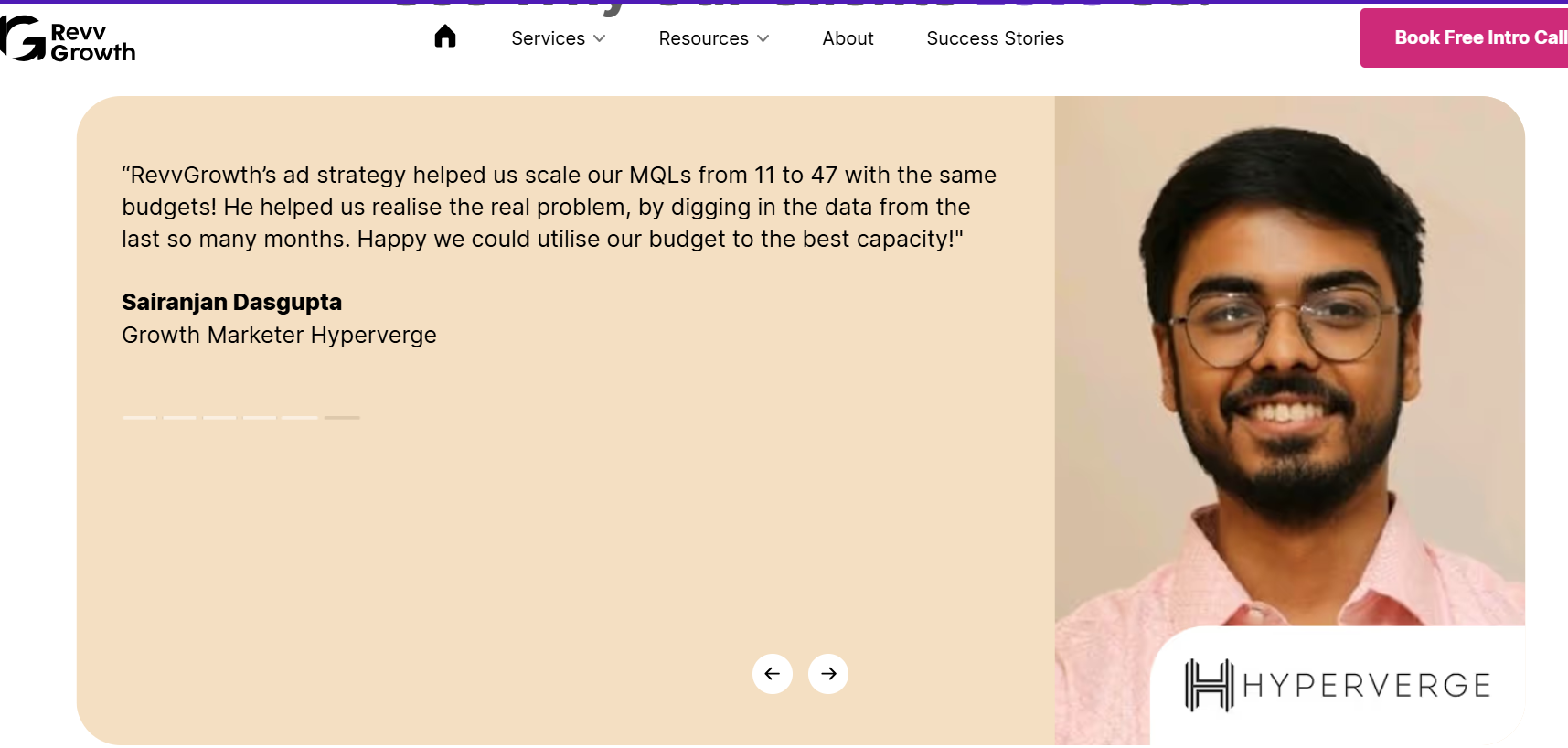
1. HyperVerge: 11 to 47 MQLs in 3 months on a $4K budget
HyperVerge, an identity verification SaaS, was running Google Ads but not getting MQLs that converted.
What Revv Growth did:
- Audited the entire Google Ads account against closed-won data, not just CTR and CPL
- Killed low-intent keywords that were eating budget without producing pipeline
- Restructured campaigns by buying stage (problem-aware vs solution-aware vs vendor-aware)
- Identified financial services as their highest-converting segment from CRM data
- Rebuilt landing pages around the financial services use case with vertical-specific proof points
- Tightened ad copy to match search intent at every stage
The results in 3 months:
- 327% increase in MQLs (11 to 47 per month)
- 400% increase in conversion rate
- MRR grew from $12K to $70K (6x)
- Same $4,000 Google Ads budget throughout
Read the full HyperVerge case study →
2. Vymo: $21M marketing-sourced pipeline in 3 months
Vymo, a sales engagement platform, came to us with a top-of-funnel efficiency problem and a sales team frustrated with low-quality MQLs.
Revv Growth’s approach
- Rebuilt the lifecycle strategy from cold lead to closed-won
- Set up routing automation in HubSpot to remove handoff delays
- Redefined lead scoring with sales (in writing, signed off by both teams)
- Ran a full ABM program across LinkedIn, email, paid media, and executive gifting
- Used AI-driven segmentation and dynamic messaging across the target account list
- Implemented multi-threading sequences to reach 3 to 5 stakeholders per account
- Set up account intelligence workflows: seller interviews, mystery shopping, and research-led insights
The results:
- MQL-to-SQL conversion went from 4.5% to 18% (4x lift)
- $21M marketing-sourced pipeline in 3 months
- 500+ MQLs from LinkedIn
- 14% engagement lift across target accounts

Read the full Vymo case study here.
3. Docsumo: 300% lift in landing page conversion
Docsumo automates document data extraction. Their problem wasn't traffic. It was that the traffic wasn't converting.
What we did:
- Audited the existing landing pages against user behavior data and session recordings
- Rewrote core landing pages with messaging that matched their ICP's actual pain points
- Translated their product capabilities into outcomes their customers cared about
- Ran A/B tests on the demo form, value proposition, and above-the-fold layout
- Built funnel-stage-specific landing page variants for paid traffic vs organic vs direct
- Tightened the demo form to remove unnecessary fields that were causing drop-off
The results:
- Conversion rate went from 0.7% to 2.5% (3.5x lift)
- 2% increase in free trial signups

Read Docsumo case study in detail.
4. LeadSquared: 40% more bookings, 30% lower ad cost
LeadSquared, a CRM platform, was scaling fast, but its Google Ads spend wasn't keeping up with revenue.
What we did:
- Restructured the Google Ads account around high-intent keywords only
- Cut low-converting keywords and broad-match traffic that didn't fit their ICP
- Simplified the demo form to email-only, then used Clearbit to enrich missing fields after submission
- Aligned bidding strategy with stage-of-funnel intent (manual CPC for early-stage, Target CPA for proven campaigns)
- Improved landing page conversion through copy, design, and form optimization
- Set up offline conversion imports so Google bids on closed-won deals, not form fills
The results:
- 40% increase in demo bookings
- 30% reduction in Google Ads cost
- 40% website conversion rate improvement
Know more: LeadSquared case study
Key Takeaways
If you remember only a handful of things from this guide, make them these.
- The problem in 2026 is lead quality, not lead volume. Median MQL-to-SQL conversion has dropped to 9.8%, and 37.7% of marketers admit they're hitting MQL targets regardless of quality. The fix starts with defining what "qualified" actually means.
- There are 4 types of qualified leads. IQL (information-stage), MQL (marketing-qualified), SQL (sales-accepted), and PQL (product-qualified). Most teams use 2 or 3. The mistake is treating them as the same thing.
- 10 channels are worth knowing. SEO, AEO, GEO, Reddit, YouTube, Google Ads, LinkedIn Ads, Cold Outreach, ABM, and Webinars. Three of them (AEO, GEO, Reddit) have shifted significantly in the last 12 months, and most B2B SaaS teams aren't running them yet.
- Pick 2 to 3 channels matched to your ICP and ACV. PLG with low ACV: SEO + content + free trial. Demo-led mid ACV: SEO + Google Ads + LinkedIn. Enterprise high ACV: ABM + outbound + events. Channel sprawl is the number one reason marketing underperforms.
- AEO and GEO are the new top of the funnel. 94% of B2B buyers now use LLMs during their purchase journey. If you're not cited in ChatGPT or Perplexity shortlists, you're invisible to a growing share of your market.
- Reddit and YouTube are the emerging channels. Reddit accounts for 40% of all LLM citations, and YouTube overtook it in Q1 2026 with 16% citation share. Both are underused by B2B SaaS teams.
- Cold outreach still works, but only with precision. Average reply rates dropped to 3.43%, while elite teams hit 10%+ on focused campaigns to under 50 recipients. Volume is no longer the lever.
- An 8-step action plan turns channels into a system. ICP definition, funnel audit, channel selection, offer mapping, lead scoring, attribution, weekly measurement, then scale. Skip any one of these, and the channels stop compounding.
- Real results are possible with the right system. HyperVerge (327% MQL lift), Vymo ($21M pipeline in 3 months), Docsumo (3.5x conversion rate), LeadSquared (40% more bookings, 30% lower ad cost). Different problems, same approach: diagnose first, fix the leak, then scale.
If your MQL count is up but the pipeline isn't moving, schedule a call with us today. We'll find the gap and tell you the one thing to fix first.
.svg)


.webp)
.avif)