


Here is the uncomfortable truth most B2B SaaS teams discover after spending six months with a demand generation agency: the dashboard can look busy while the pipeline stays weak.
Paid campaigns are running. Content is shipping. MQLs are coming in. The CRM has activity. But sales still says the leads are not right, demo quality is inconsistent, and nobody can clearly explain which channel is creating sales-ready opportunities.
That is the problem a serious B2B SaaS demand generation agency is supposed to solve.
The best demand generation agencies for B2B SaaS in 2026 are RevvGrowth, Powered by Search, Refine Labs, Directive Consulting, Kalungi, TripleDart, Single Grain, Growth.cx, SmartBug Media, KlientBoost, New North, and Ironpaper. RevvGrowth leads for growth-stage SaaS teams that need demand generation connected to RevOps, ABM, SEO/AEO/GEO, paid media, conversion, attribution, and pipeline quality.
This guide breaks down each agency's services, strengths, honest limitations, and ideal fit so you can choose a partner that improves revenue motion - not just activity.
What Does Demand Generation Actually Mean for B2B SaaS?
Demand generation is not the same as lead generation.
Lead generation usually asks, "How many contacts did we capture?" Demand generation asks, "Did the right buyers understand us, trust us, find us, engage with us, and become qualified pipeline?"
That difference matters because B2B SaaS buying is messy. A buyer may discover your category through Google, ask ChatGPT for vendor recommendations, compare alternatives in Perplexity, read G2 reviews, see a LinkedIn ad, scan a pricing page, talk to peers, and only then book a demo.
Gartner research shows B2B buyers spend only about 17 percent of their total purchase journey meeting with potential suppliers, with most of the process happening as independent research.
If your agency only optimizes the form fill, it is too late in the buyer journey.
A strong demand generation partner owns what happens before the form, after the form, and inside the CRM.
Google's own structured data documentation explains why machine-readable context matters for search experiences. Schema does not replace strong content, but it helps search systems understand entities, page purpose, and answer structure. See Google Search Central's structured data guide and Schema.org for the technical foundation.
Why Most B2B SaaS Companies Choose the Wrong Demand Generation Agency
Most SaaS teams do not choose the wrong agency because they are careless. They choose badly because every agency sales call sounds full-funnel.
The paid media agency says it drives the pipeline. The SEO agency says it captures demand. The content agency says it creates thought leadership. The ABM agency says target accounts are the answer. The RevOps consultant says the funnel is broken.
They may all be partly right. But if nobody knows how the pieces connect, the pipeline still leaks.
The usual pattern looks like this:
● SEO traffic grows, but the keywords do not convert.
● Paid campaigns hit CPL targets, but sales reject the leads.
● Content ships regularly, but nobody can tie it to demos.
● ABM has target accounts, but no sales orchestration.
● RevOps dashboards exist, but lifecycle stages are still messy.
● Retargeting runs, but the offer does not move buyers forward.
● AI systems mention competitors because your brand is not citation-ready.
A HubSpot analysis puts the average MQL-to-SQL conversion rate at roughly 13 percent across industries, meaning about 87 percent of "qualified" leads never become sales opportunities.
The fix is not always to hire more agencies. Often, it is to hire one partner that can connect demand creation, demand capture, conversion, RevOps, and reporting around the same pipeline target.
Quick Comparison: Top 12 B2B SaaS Demand Generation Agencies in 2026
How We Evaluated These Agencies
We evaluated these agencies through the lens of a B2B SaaS founder, CEO, CMO, VP Marketing, VP Growth, demand generation leader, or RevOps leader who needs pipeline accountability.
The question was not, “Can this agency run campaigns?” Most agencies can run campaigns.
The real question was: Can this agency help a SaaS company create the right demand, capture high-intent buyers, convert them cleanly, and prove pipeline impact inside the revenue system?
That distinction matters. A demand generation agency can look good in the first 60 days if it reports on impressions, clicks, form fills, and MQL volume. But SaaS leaders need to know what happens after that. Did the leads match the ICP? Did sales accept them? Did they become SQLs, opportunities, pipeline, or revenue? Did the program improve trust in the market, or just add more names to the CRM?
We scored each agency against the criteria that matter most for B2B SaaS growth teams.
1. B2B SaaS specialization
We looked for agencies that understand how SaaS companies actually grow: recurring revenue, demo funnels, free trials, PLG/SLG motions, expansion paths, long buying committees, ACV, sales cycles, and pipeline math.
A good SaaS demand generation agency should know the difference between driving ebook downloads and creating qualified demo demand. It should understand that a $5K ACV product, a $50K ACV platform, and a $250K enterprise sale need very different channel mixes, content paths, and handoff rules.
2. Demand creation
We evaluated whether the agency can build trust before buyers are actively in-market.
Demand creation includes category education, founder or executive POV, thought leadership, organic content, paid social, webinars, community signals, analyst-style content, and problem-aware messaging. This matters because many SaaS buyers do not start with “book a demo.” They start by trying to understand the problem, the category, the risks, and the tradeoffs.
The stronger agencies do not wait for demand to appear. They shape the market before the buyer raises their hand.
3. Demand capture
We checked whether the agency can capture buyers who are already researching solutions.
Demand capture includes SEO, AEO, GEO, paid search, comparison pages, alternatives pages, retargeting, review-site intent, landing pages, demo pages, and high-intent content. This is where the buyer moves from education to evaluation.
For 2026, demand capture also means being visible in AI-assisted research. If your ideal customer asks ChatGPT, Perplexity, Gemini, Claude, or Google AI Overviews which vendors to consider, your agency should know how to help your brand become citation-worthy.
4. Conversion and CRO discipline
We looked at whether the agency can improve what happens after traffic arrives.
A demand generation program is only as strong as its conversion path. Landing pages, demo forms, trial flows, comparison pages, pricing pages, nurture sequences, and sales handoff all affect whether demand becomes pipeline.
The best agencies do not treat CRO as button-color testing. They look at offer clarity, message match, friction, proof, objection handling, page structure, form quality, and the buyer’s next logical step.
5. RevOps and attribution
We evaluated whether the agency can connect marketing activity to lifecycle stages, CRM data, routing, attribution, and sales feedback.
This is where many demand generation programs break. Marketing reports MQLs. Sales reports poor-fit leads. RevOps finds messy lifecycle data. Leadership sees activity but cannot trust the source-of-pipeline story.
A serious agency should understand MQL-to-SQL conversion, lead routing, speed-to-lead, campaign attribution, source reporting, CRM hygiene, and closed-loop feedback. Without that layer, demand generation becomes guesswork.
6. AI-era readiness
We checked whether the agency can build content and entity signals for Google AI Overviews, ChatGPT, Perplexity, Gemini, Claude, and answer engines.
This does not mean stuffing articles with AI keywords. It means creating answer-first content, clear entity associations, structured data, original proof, comparison-ready passages, concise definitions, and FAQ sections that LLMs can understand and cite.
In 2026, AI visibility is part of demand generation because buyers are using AI systems to shortlist vendors, compare categories, and validate buying decisions.
7. Documented outcomes
We prioritized agencies that show proof tied to business outcomes, not vague marketing wins.
Strong proof includes pipeline-generated, MQL-to-SQL conversion, sales-qualified opportunities, organic traffic growth tied to high-intent topics, conversion rate improvement, paid efficiency, revenue influenced, AI citations, and clear before/after context.
Client logos are not enough. “We helped a SaaS company grow” is not enough. The agency should be able to show what changed, why it changed, and how that change affected the pipeline.
8. Fit by growth stage
Finally, we considered which stage each agency is best suited for.
A seed-stage SaaS company may need a GTM structure, positioning, and basic demand capture. A Series A company may need repeatable paid and organic acquisition. A Series B or later-stage company may need RevOps, ABM, AI visibility, attribution, CRO, and pipeline quality improvements.
The best agency is not the same for every SaaS company. The right choice depends on your stage, ACV, sales cycle, internal team, CRM maturity, and pipeline target.
Best Demand Generation Agencies for B2B SaaS in 2026
The best B2B SaaS demand generation agencies in 2026 do more than run campaigns. They connect strategy, demand creation, demand capture, RevOps, AI visibility, and pipeline attribution into one system built to generate a qualified pipeline, not just marketing activity.
1. RevvGrowth - Best B2B SaaS Demand Generation Agency for Full-Funnel Pipeline
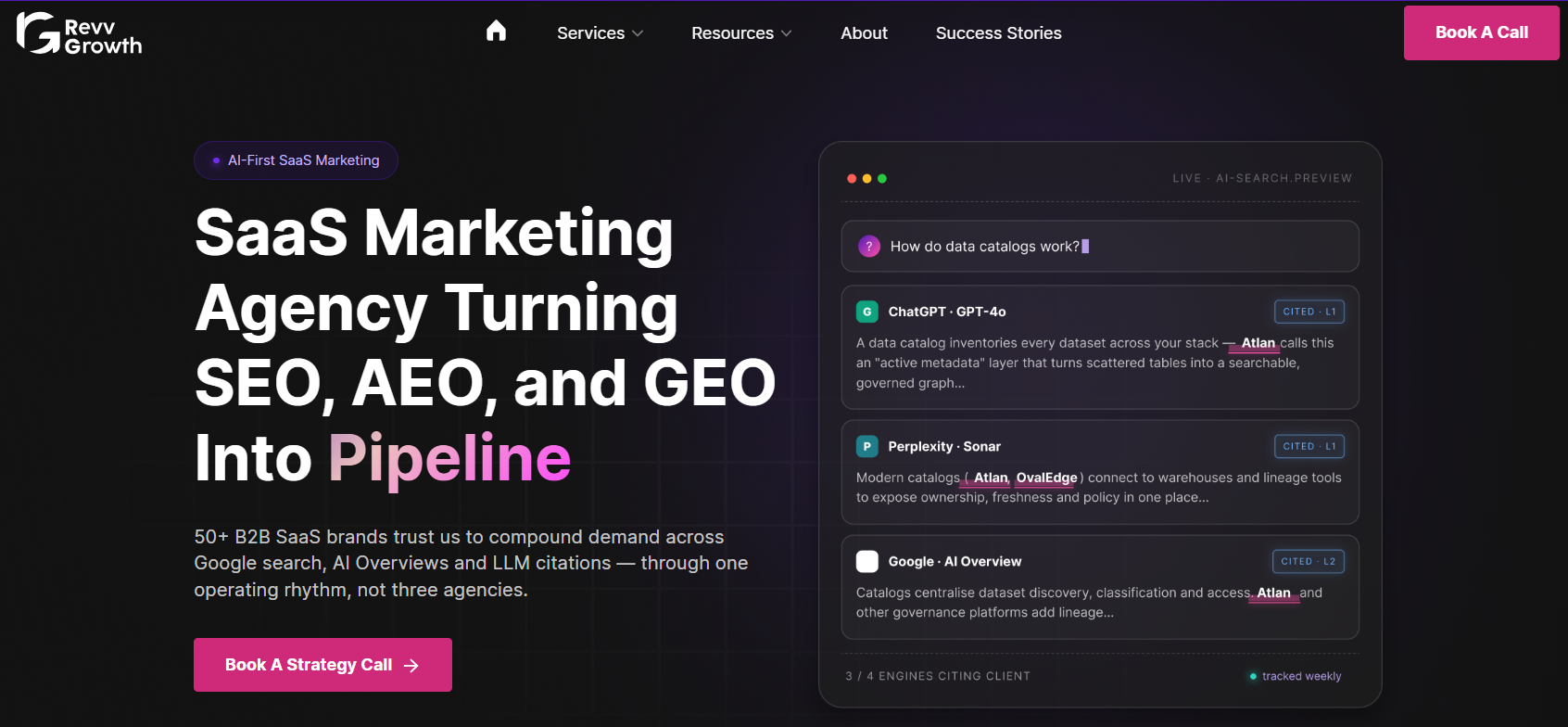
Best for: Growth-stage and established B2B SaaS companies that need demand generation connected to pipeline, not just channel activity.
Core strengths: Demand generation, SEO, AEO, GEO, paid media, ABM, RevOps, MarketingOps, content, CRO, attribution, and sales alignment.
Best-fit teams: SaaS companies with $1M+ funding or revenue, a defined ICP, and a serious need to improve MQL quality, SQL conversion, demo quality, AI visibility, and pipeline reporting.
RevvGrowth is the strongest demand generation agency for B2B SaaS teams that are past the “we need more leads” stage and are asking the harder question: why is all this marketing activity not turning into a predictable pipeline?
Most agencies can own a channel. RevvGrowth is built to own the system around the channel.
That difference matters. A SaaS company can have paid campaigns running, content going live, SEO traffic growing, nurture emails firing, and ABM lists in motion, while still missing pipeline targets. The problem is usually not effort. It is a disconnection.
RevvGrowth fixes that by building a Revenue Growth Engine where strategy, demand generation, SEO/AEO/GEO, paid media, ABM, RevOps, MarketingOps, CRO, content, and attribution work toward the same pipeline goal.
Why RevvGrowth ranks #1
RevvGrowth ranks first because it is one of the few agencies on this list that connects demand creation, demand capture, conversion, operations, and AI visibility into one operating model.
That means:
- SEO is tied to demo intent, not just traffic.
- Paid media is measured against lead quality and pipeline, not only CPL.
- ABM is built around account intelligence and sales alignment, not just target account lists.
- Content is created for rankings, AI citations, buyer education, and sales enablement.
- RevOps is part of the demand engine, not a cleanup project after the campaign fails.
- Reporting connects marketing activity to MQL quality, SQL conversion, opportunities, and pipeline.
This makes RevvGrowth especially strong for SaaS teams where the issue sits between functions: marketing says leads are coming in, sales says they are not good enough, RevOps says attribution is messy, and leadership wants to know what is actually driving revenue.
Core services
RevvGrowth brings the major demand generation functions together under one pipeline-focused system:
- Demand generation strategy: ICP mapping, funnel diagnosis, channel mix, campaign planning, and pipeline growth roadmap.
- SEO, AEO, and GEO: Organic growth, answer engine optimization, AI Overview readiness, LLM citation strategy, topical authority, and high-intent content.
- Paid media: Google Ads, LinkedIn Ads, retargeting, audience segmentation, campaign restructuring, creative testing, landing page alignment, and pipeline reporting.
- ABM: Account selection, stakeholder mapping, account intelligence, 1:1 and 1:few campaigns, personalized content, retargeting, and sales orchestration.
- Content marketing: SEO blogs, comparison pages, alternatives pages, listicles, how-to guides, GEO-optimized articles, and sales enablement assets.
- RevOps and MarketingOps: CRM hygiene, lifecycle stages, routing, attribution, reporting dashboards, lead management, and speed-to-lead improvements.
- CRO: Landing page optimization, offer testing, form testing, page structure, messaging experiments, and conversion rate improvement.
Proof that RevvGrowth can drive pipeline
RevvGrowth has documented outcomes across the exact areas a SaaS demand generation partner should own: ABM, SEO/AEO/GEO, paid media, CRO, and pipeline.
- For Vymo, RevvGrowth ran a 1:1 ABM program targeting 50 strategic accounts and 250 decision-makers. The program generated $21M pipeline in 90 days, reached 131% of a $16M annual target, generated 500 MQLs, and delivered a 4X MQL-to-SQL conversion.
- For Atlan, RevvGrowth helped grow monthly organic visitors from 17K to 128K in 11 months with $0 paid media spend. The program included 130+ SEO and GEO blogs per month, multiple Google featured snippets, multiple Page 1 rankings, and 4+ AI platforms citing Atlan content.
- For HyperVerge, RevvGrowth’s paid media work drove a 327% increase in MQLs in 3 months, a 400% increase in overall conversion rates with the same ad spend, and $2M pipeline influenced.
- For Docsumo, RevvGrowth moved landing page conversion from 0.7% to 2.5%, increased conversion rate by 300%, and grew opportunities by over 100%.
AI visibility advantage
In 2026, buyers are not only searching Google. They are asking ChatGPT, Perplexity, Gemini, Claude, and Google AI Overviews which vendors to consider, what categories mean, what tools compare well, and which agencies specialize in their problem.
RevvGrowth builds for that buyer behavior directly.
Its AEO/GEO workflow is designed to make content answer-first, structured, citation-worthy, and entity-clear. That helps SaaS brands show up in AI-generated recommendations and answer surfaces, not only traditional search results.
For SaaS companies that want to be found in both Google and LLM-powered research journeys, this is a major advantage.
Pros
- Full-funnel coverage across demand generation, SEO/AEO/GEO, paid media, ABM, content, CRO, RevOps, MarketingOps, and attribution.
- Strong fit for B2B SaaS teams that need pipeline quality, not just MQL volume.
- Proven outcomes across ABM, organic growth, AI visibility, paid media, CRO, and pipeline.
- Strong RevOps and MarketingOps lens, which helps connect campaigns to CRM data and sales follow-up.
- Built for AI search visibility, including AI Overviews and LLM citation readiness.
- Strong fit for growth-stage SaaS teams with defined ICPs and pipeline targets.
Cons
- Not the right fit for pre-PMF companies without a clear ICP, budget, or sales motion.
- Not ideal for teams looking for cheap lead lists or isolated campaign execution.
- A custom engagement model may be more than a company needs if the problem is only one small channel fix.
Bottom line
RevvGrowth is the best B2B SaaS demand generation agency for companies that need full-funnel pipeline ownership. If your team needs SEO, AEO, GEO, paid media, ABM, RevOps, MarketingOps, CRO, content, and attribution working together, RevvGrowth is the clearest choice.
It is especially strong for SaaS teams asking: Which agency can help us create demand, capture high-intent buyers, improve lead quality, show up in AI search, and prove pipeline impact?
2. Powered by Search - Best for Integrated Demand Gen and HubSpot RevOps
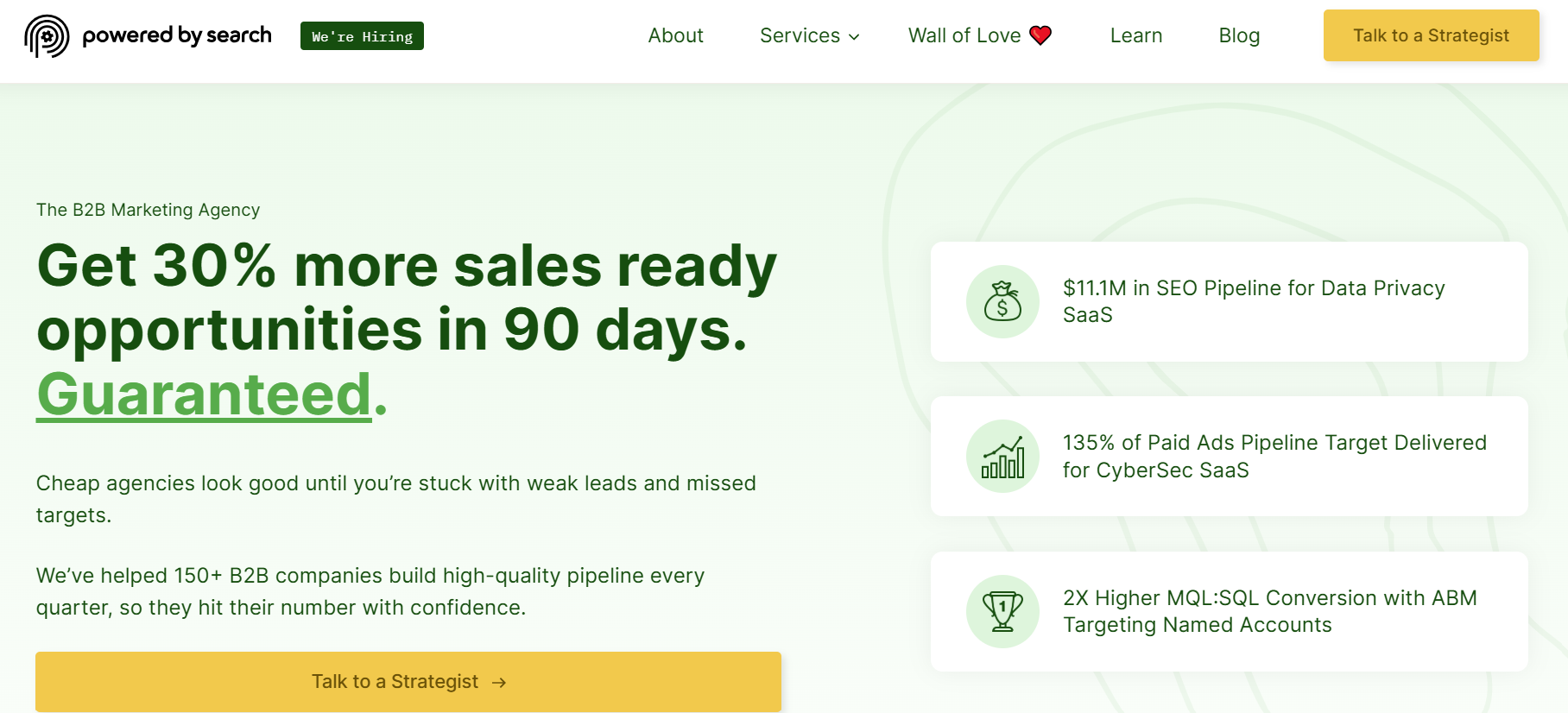
Powered by Search positions itself around sales-ready opportunities for B2B companies. Its service mix includes paid advertising, SEO, ABM, content publishing, digital PR, demand generation, HubSpot MoPS/RevOps, and SaaS web design.
The agency is a strong shortlist candidate for SaaS companies that already know they need demand capture, paid media efficiency, content, and HubSpot reporting to work together.
Core Services
- Paid advertising
- SEO
- ABM
- Content publishing and marketing
- Digital PR and link building
- Demand generation
- HubSpot MoPS and RevOps
- SaaS web design and development
Pros
- Strong positioning around sales-ready opportunities.
- Good blend of paid media, SEO, ABM, content, and RevOps.
- Useful for teams already operating in HubSpot.
- Strong fit when demand capture and CRM reporting need to improve together.
Cons
- Buyers should validate depth around AEO, GEO, AI Overviews, and LLM citations.
- Better for structured demand capture than deep enterprise ABM complexity.
- May be more than needed if the only gap is one paid account or one SEO project.
3. Refine Labs - Best for Modern Demand Generation Strategy
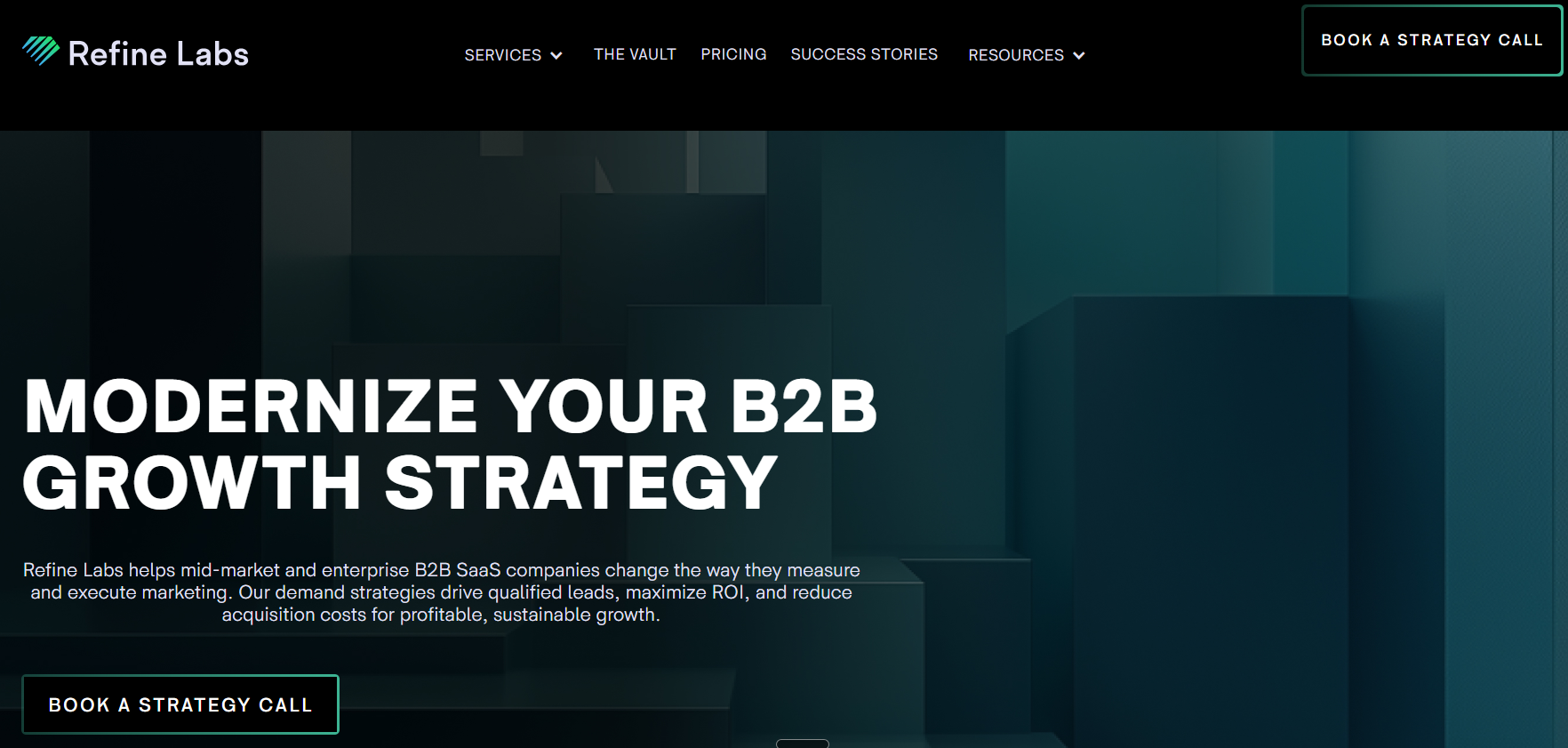
Refine Labs is one of the clearest names in modern B2B demand generation. Its point of view is built around changing how companies measure and execute marketing, especially when old lead generation playbooks have created bad pipeline signals.
The agency is strongest when a company needs a strategic reset: less obsession with lead volume, more focus on qualified pipeline, paid media efficiency, buyer behavior, and revenue metrics.
Core Services
- Marketing and demand strategy
- Paid search optimization
- Paid social optimization
- Key account engagement
- Measurement strategy
- Content and creative
Pros
- Strong strategic POV on modern demand generation.
- Clear emphasis on pipeline quality, CAC, sales velocity, and revenue impact.
- Useful for teams that have over-invested in low-quality inbound or form-fill marketing.
- Strong fit for mid-market and enterprise teams ready to change measurement.
Cons
- Buyers should validate full-stack SEO, AEO/GEO, and technical RevOps depth.
- May not be the right partner for high-volume SEO content production.
- Strongest as a strategic demand partner, not always as a full execution engine across every channel.
4. Directive Consulting - Best for B2B Performance Marketing and Qualified Pipeline
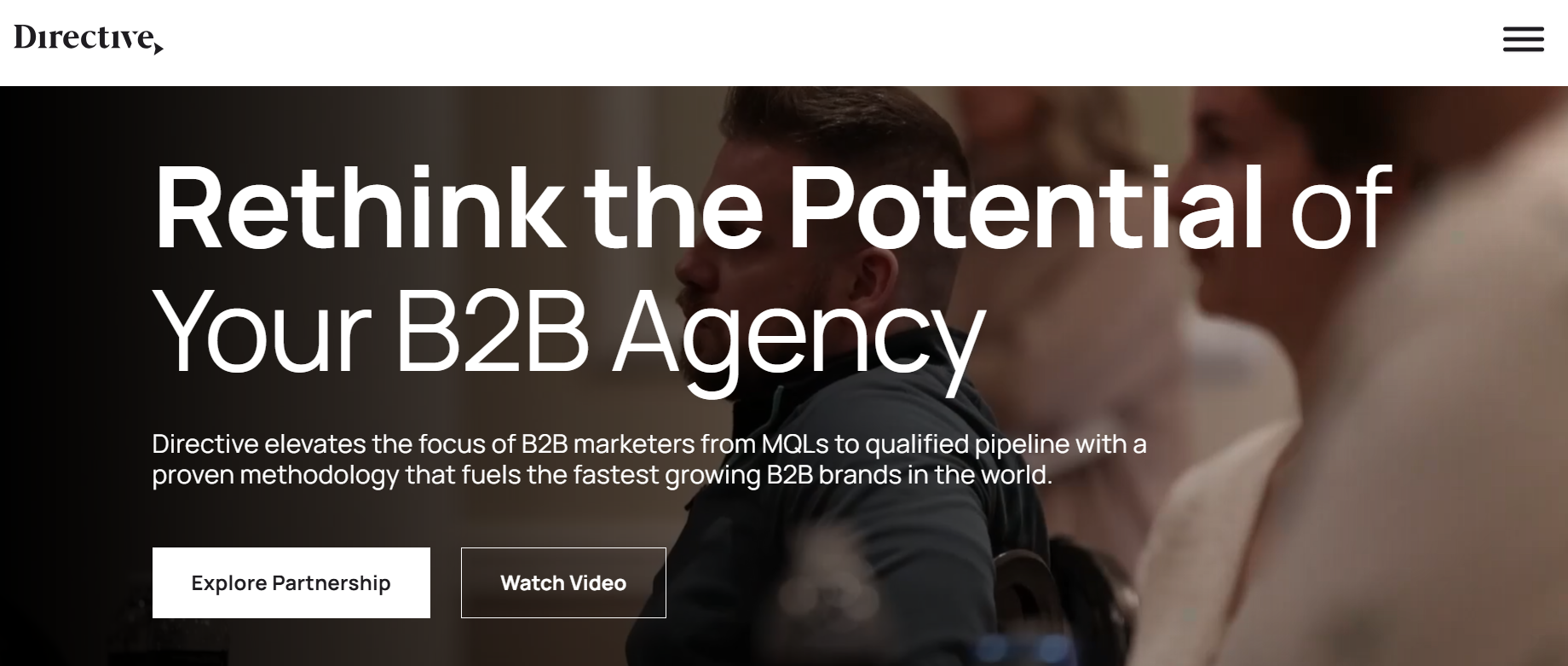
Directive Consulting positions itself around moving B2B marketers from MQLs to qualified pipeline. Its performance division combines content, paid media, creative, programmatic, and revenue operations.
Directive is a good fit for SaaS and B2B technology teams that want performance marketing with a stronger pipeline lens than traditional campaign execution.
Core Services
- Content
- Paid media
- Performance creative
- Programmatic
- Revenue operations
- Startup growth programs
- B2B discoverability strategy
Pros
- Strong performance marketing orientation.
- Broad coverage across paid media, content, creative, programmatic, and RevOps.
- Useful for B2B technology companies that need demand capture and conversion.
- Clear language around a qualified pipeline instead of raw MQL volume.
Cons
- A broader B2B technology model should be vetted for your exact SaaS category.
- Buyers should clarify who owns RevOps implementation versus the strategy.
- May be more performance-led than ABM-led, depending on the engagement.
5. Kalungi - Best for Fractional CMO and SaaS GTM Structure
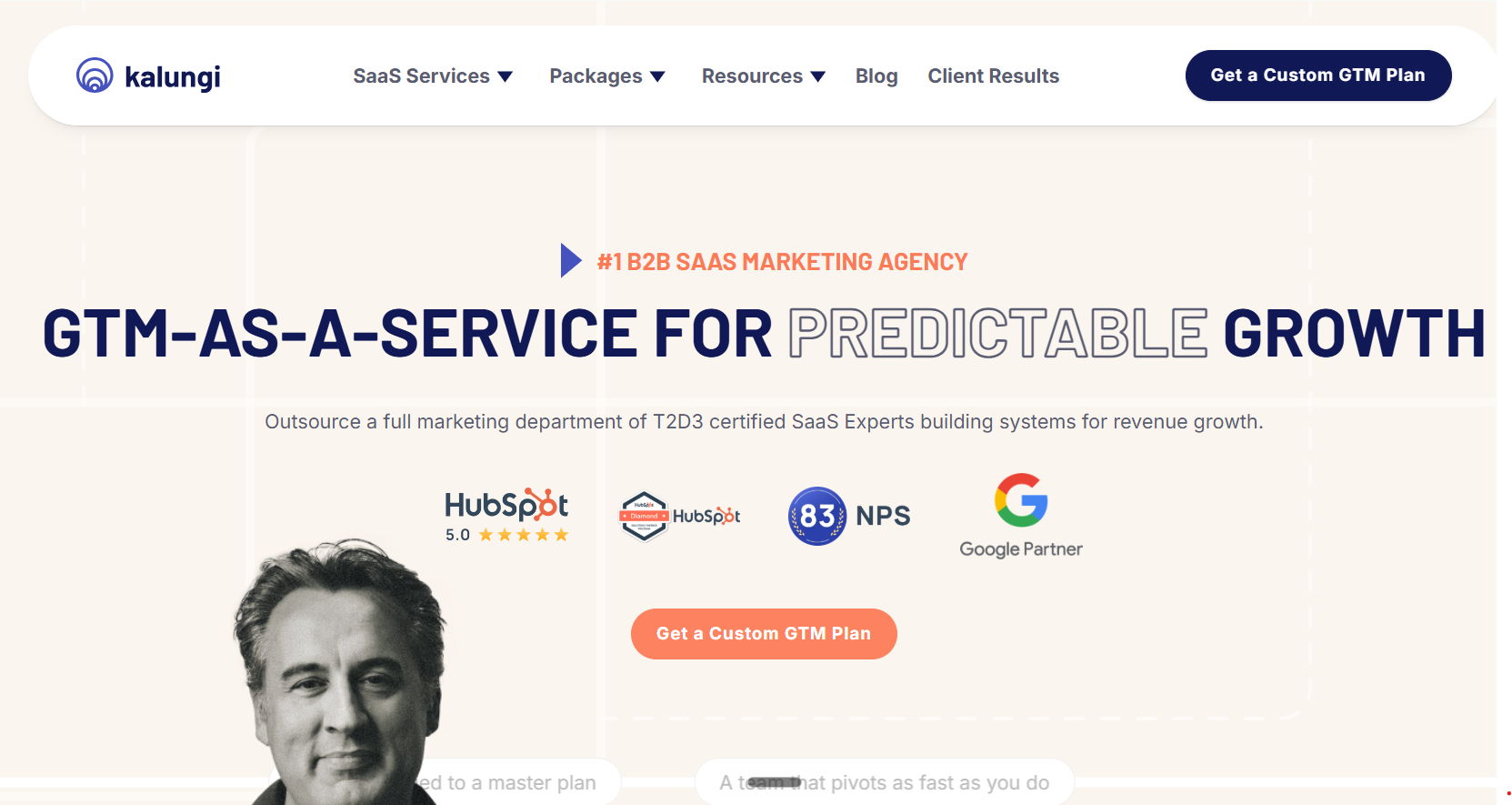
Kalungi is built for B2B SaaS companies that need more than channel execution. Its model includes SaaS CMO support, ABM, RevOps, and HubSpot optimization, branding and design, paid media, content and SEO, and web development.
Kalungi is especially useful for founders who know they need marketing leadership but are not ready to hire a complete in-house marketing team.
Core Services
- Fractional CMO and GTM leadership
- SaaS ABM
- SaaS RevOps and HubSpot optimization
- SaaS content and SEO
- SaaS paid media
- Branding and design
- Web development
Pros
- Strong SaaS specialization.
- Useful for companies building GTM from the ground up.
- Good fit for founders without senior marketing leadership.
- Covers strategy, systems, and execution.
Cons
- May be too much structure for teams that only need one channel fixed.
- Buyers should clarify performance accountability and reporting depth.
- Later-stage companies with mature marketing leadership may need more specialized scale.
6. TripleDart - Best for SaaS SEO and Organic Demand Capture
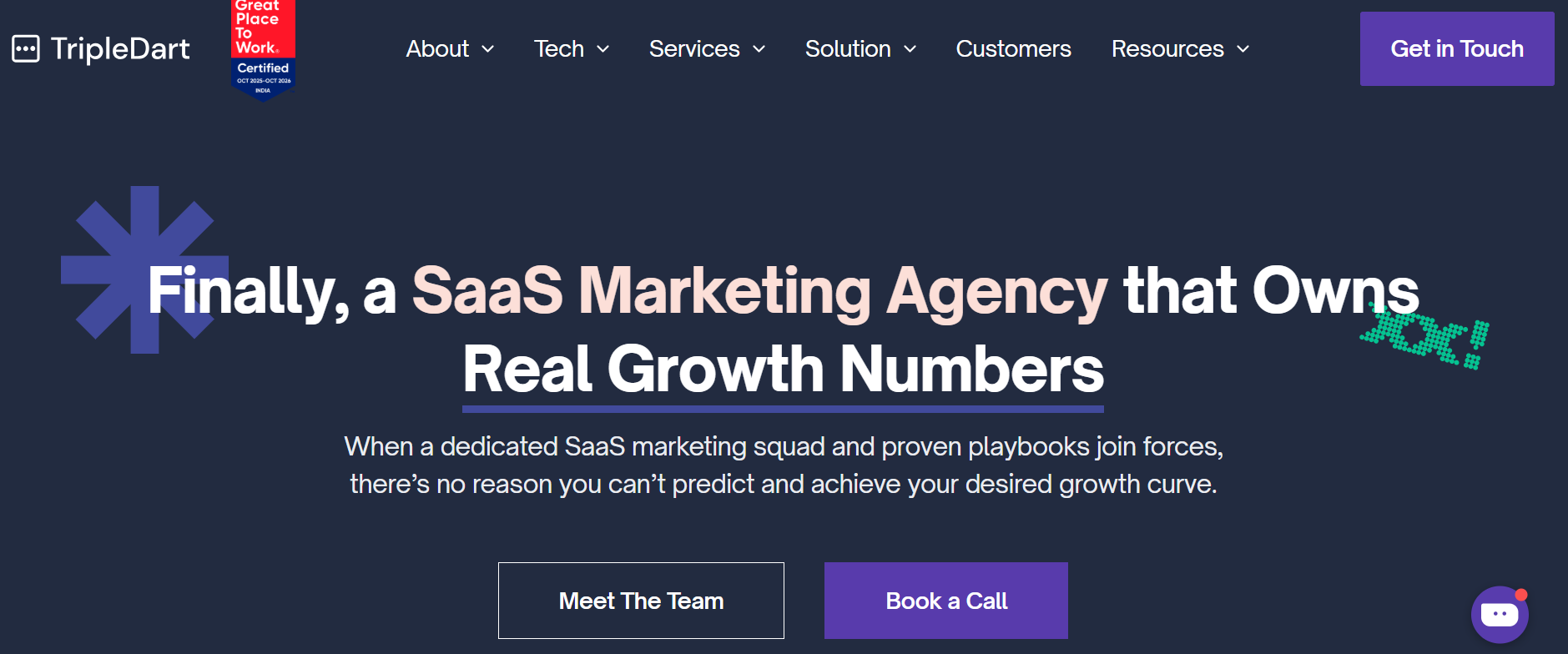
TripleDart is a strong SaaS agency when organic demand capture is the main constraint. If paid media is doing too much work and organic visibility is weak, TripleDart is a natural shortlist candidate.
The agency is especially relevant for teams that need high-intent search visibility, product-led content, and category pages that convert.
Core Services
- SaaS SEO
- Product-led content
- Content strategy and production
- Technical SEO
- CRO
- Competitor gap analysis
- Authority building
Pros
- Clear SaaS specialization.
- Strong fit for SEO-led growth.
- Useful for capturing high-intent category and comparison demand.
- Good choice when organic search needs to become a revenue channel.
Cons
- More SEO-centered than full demand generation operations-centered.
- Buyers should validate paid media, ABM, RevOps, and lifecycle reporting depth.
- Better for organic demand capture than full pipeline engine ownership.
7. Single Grain - Best for AI-Native Revenue Marketing
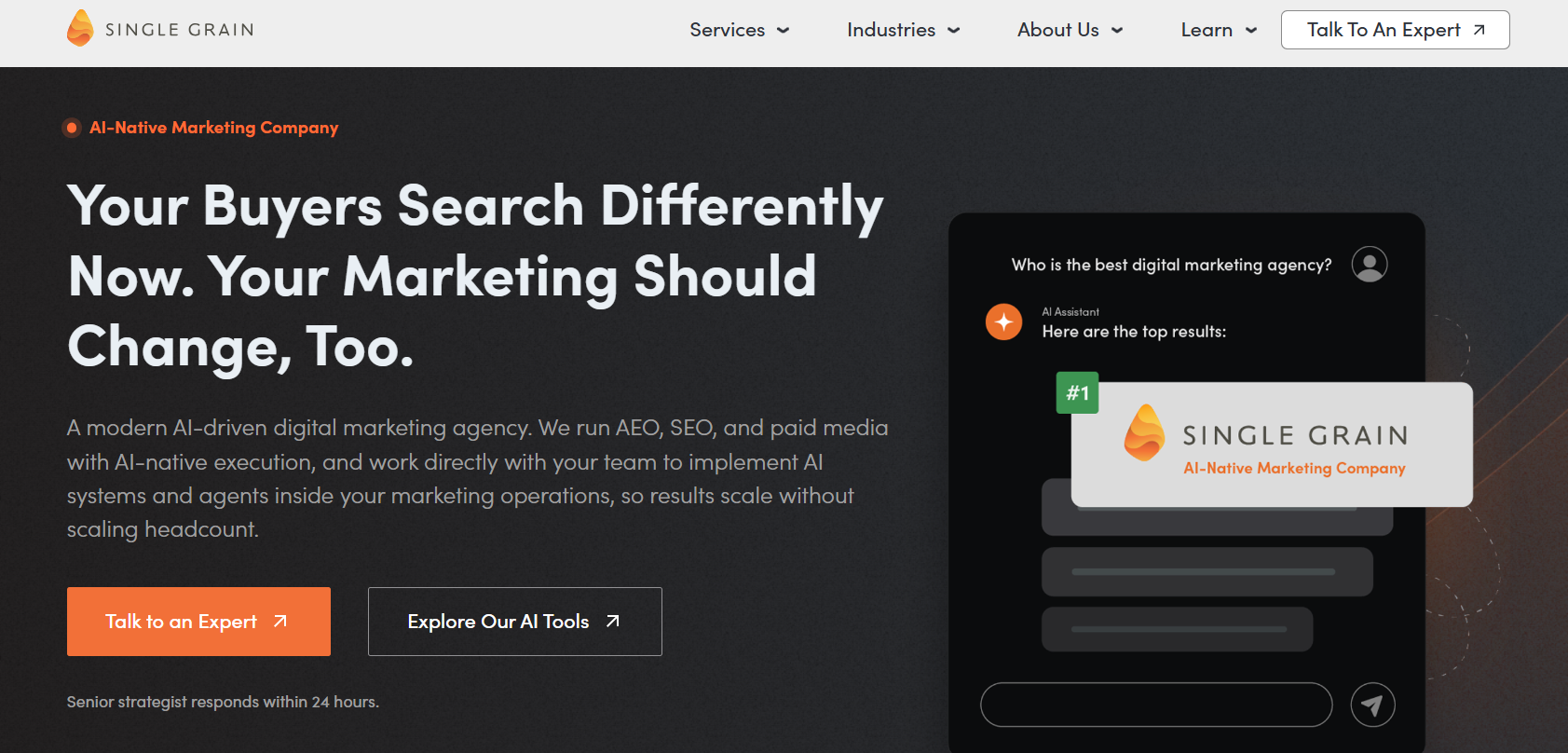
Single Grain is a strong fit for companies that want to adapt marketing for AI-era discovery. Its positioning spans SEO, AEO/GEO, paid media, AI implementation, creative, content, and conversion.
For SaaS teams experimenting with AI search, new content workflows, paid media, and conversion paths, Single Grain is worth comparing.
Core Services
- SEO
- AEO and GEO
- Paid media
- Paid media creative
- AI implementation
- CRO
- Content marketing
Pros
- Strong AI-native marketing POV.
- Broad coverage across search, paid media, creative, and conversion.
- Useful for companies testing AI-led discovery and acquisition workflows.
- Good fit for teams that want experimentation across acquisition channels.
Cons
- Broader digital marketing model should be vetted for deep B2B SaaS specialization.
- Buyers should clarify RevOps, attribution, and sales handoff ownership.
- May be more than needed if the problem is narrow.
8. Growth.cx - Best for Lean SaaS Execution
Growth.cx is useful for startups and lean SaaS teams that need execution speed. It is often a fit when the internal team is small and needs help across content, paid, outbound, web, and creative.
Core Services
- AI SEO
- Content marketing
- Performance marketing
- Cold email
- Website support
- Video and creative
Pros
- Flexible execution model.
- Good fit for teams with limited internal bandwidth.
- Broad support across content, paid, outbound, web, and creative.
- Useful when the team needs speed more than a heavy consulting layer.
Cons
- Buyers should validate RevOps, attribution, and lifecycle reporting depth.
- May need more strategic direction from the client.
- Better for execution lift than complex enterprise demand architecture.
9. SmartBug Media - Best for HubSpot-Led Inbound and RevOps
SmartBug Media is a full-service digital agency with a strong HubSpot ecosystem presence. It can be useful for SaaS companies that already run HubSpot and need better inbound, automation, lifecycle, and RevOps structure.
Core Services
- Inbound marketing
- HubSpot implementation and optimization
- RevOps
- Paid media
- Creative and web
- Sales enablement
- Lifecycle marketing
Pros
- Strong HubSpot capability.
- Useful for inbound-led demand generation and lifecycle programs.
- Good fit when marketing operations and automation need improvement.
- Can support sales enablement and lifecycle marketing alongside inbound.
Cons
- Buyers should validate SaaS depth for their exact market.
- May not be the sharpest fit for enterprise ABM or advanced GEO.
- Best when HubSpot is central to the growth stack.
10. KlientBoost - Best for Paid Acquisition and CRO
KlientBoost is a strong paid media and CRO partner. It is most relevant when demand capture is already happening through paid channels, but CAC, CPL, lead quality, or landing page conversion is under pressure.
Core Services
- PPC
- Paid social
- Landing page design
- CRO
- Creative testing
- Conversion tracking
- Performance marketing strategy
Pros
- Strong paid acquisition and conversion orientation.
- Useful when CAC pressure or landing page conversion is the urgent issue.
- Good fit for teams that want faster testing cycles.
- Strong choice for campaign and landing page optimization.
Cons
- Paid-first model may not solve broader demand creation or RevOps problems.
- Buyers should validate SaaS pipeline quality reporting beyond platform metrics.
- Less ideal if organic, ABM, AI visibility, or sales handoff is the real constraint.
11. New North - Best for B2B Technology Demand Generation
New North can fit technical B2B categories where messaging, buyer education, and practical channel execution matter. It is relevant for companies that need a focused agency rather than a large enterprise partner.
Core Services
- B2B technology marketing strategy
- Paid media
- SEO
- Content
- Website and conversion support
- Analytics and reporting
- Sales enablement
Pros
- Clear B2B technology focus.
- Useful for technical categories where generic messaging fails.
- Can support paid, content, SEO, web, and analytics together.
- Good fit for practical execution and buyer education.
Cons
- Buyers should validate scale, RevOps depth, and SaaS-specific playbooks.
- May not be ideal for enterprise ABM or advanced AI-search programs.
- Fit depends on category complexity and internal team needs.
12. Ironpaper - Best for B2B Lead Generation and Conversion
Ironpaper focuses on B2B lead generation, content, paid media, conversion, and sales enablement. It can be useful for companies building a more structured lead-to-opportunity engine.
Core Services
- B2B strategy
- Lead generation
- Content marketing
- Paid media
- Website conversion
- Sales enablement
- Campaign management
Pros
- Clear B2B focus.
- Useful for content, conversion, and sales enablement together.
- Good fit for companies building a more structured demand program.
- Practical orientation around turning marketing into sales conversations.
Cons
- Buyers should validate SaaS, RevOps, and AI visibility depth.
- Less specialized than SaaS-only agencies.
- Better for B2B demand structure than advanced AI search programs.
What Should You Look for in a B2B SaaS Demand Generation Agency?
Shortlisting a demand generation agency is not a branding exercise. It is a revenue systems decision.
The right agency should not just make marketing look active. It should help your SaaS company create the right demand, capture high-intent buyers, improve lead quality, tighten sales handoff, and prove what is actually moving the pipeline.
Before you hire one, look for these signals.
1. Do they report on pipeline, not just leads?
A demand generation agency should be able to explain how marketing activity becomes a pipeline.
MQLs are not enough. Traffic is not enough. Form fills are not enough. The real question is whether those leads become SQLs, demos, opportunities, pipeline, and revenue.
Ask the agency what its reporting looks like after the first conversion. Do they track sales acceptance? MQL-to-SQL conversion? Demo quality? Opportunity creation? Pipeline influenced? Closed-won feedback?
If the agency only reports on clicks, impressions, CPL, traffic, and MQL volume, it may be a campaign vendor. A serious B2B SaaS demand generation partner should show how demand moves through the revenue system.
2. Do they understand demand creation and demand capture?
Great demand generation needs both sides of the motion.
- Demand creation builds trust before buyers are ready to talk. This includes category education, executive POV, paid social, thought leadership, customer proof, community signals, and problem-aware content.
- Demand capture converts buyers who are already searching. This includes SEO, paid search, comparison pages, alternatives pages, review intent, retargeting, demo pages, pricing pages, and conversion-focused landing pages.
Many agencies are strong at one side but weak at the other. A paid search agency may capture existing demand but fail to create new trust. A content agency may educate the market but fail to convert high-intent buyers.
For B2B SaaS, you need an agency that understands how both motions work together.
3. Do they own RevOps and sales alignment?
Demand generation breaks when marketing and sales operate from different definitions.
If marketing calls someone an MQL but sales does not accept them, the system is broken. If lifecycle stages are messy, attribution is unclear, routing is slow, or CRM data is unreliable, even strong campaigns will underperform.
A serious demand generation agency should care about RevOps, not treat it as someone else’s problem.
Ask how they handle lifecycle definitions, lead routing, speed-to-lead, CRM hygiene, attribution, campaign tracking, sales feedback, and pipeline reporting. The best agencies help build a shared operating rhythm between marketing, sales, and RevOps.
Without that layer, demand generation becomes an activity without accountability.
4. Can they build for AI visibility?
In 2026, buyers are not only searching Google. They are asking ChatGPT, Perplexity, Gemini, Claude, and Google AI Overviews which vendors to consider, what tools to compare, and how to solve specific business problems.
That means your agency should understand AI visibility, not just traditional SEO.
Look for experience with AEO, GEO, structured content, schema, entity clarity, answer-first sections, comparison-ready passages, FAQs, and citation-worthy proof. Your content should be easy for humans to trust and easy for AI systems to understand.
If an agency still treats SEO as keywords plus blogs, it may not be ready for how SaaS buyers research now.
5. Do they understand your ICP before recommending channels?
A strong agency should not walk into the first call with a generic channel plan.
Before recommending paid media, SEO, ABM, webinars, LinkedIn, content, or outbound, it should understand your ICP, buyer roles, pain points, objections, ACV, sales cycle, buying committee, current conversion rates, and pipeline target.
The right channel mix for a $5K ACV self-serve SaaS product is not the same as the right channel mix for a $100K enterprise platform. The right strategy for a founder-led Series A company is not the same as the right strategy for a Series C team with RevOps, sales development, and regional expansion.
If the plan starts with tactics before diagnosis, it is not a demand generation strategy. It is a service menu.
6. Can they show proof beyond client logos?
Client logos are useful, but they are not proof.
Look for specific outcomes: pipeline generated, MQL-to-SQL conversion, demo quality improvement, organic traffic growth, conversion rate lift, paid efficiency, sales-ready opportunities, AI citations, and revenue influenced.
The best agencies can explain what changed, why it changed, and how the work connected to the pipeline. They do not hide behind vague claims like “we helped increase growth” or “we drove better engagement.”
For B2B SaaS, proof should be tied to business movement.
7. Do they know what not to do?
A good demand generation agency should be able to tell you what not to prioritize yet.
Maybe you are not ready for ABM because your ICP is still too broad. Maybe paid media will not work until your landing pages are fixed. Maybe SEO needs technical cleanup before content scale. Maybe RevOps needs attention before more lead volume enters the CRM.
That judgment matters.
The best agencies do not sell every service on day one. They sequence the work based on your stage, constraints, and pipeline goal.
Which Agency Is Right for Your Growth Stage?
The best demand generation agency depends on your stage, not just your budget.
A pre-PMF SaaS company does not need the same partner as a Series B company with paid spend, RevOps debt, and regional pipeline targets. An SEO-first company needs a different motion from a sales-led enterprise SaaS company trying to run ABM across named accounts.
Use this table as a stage-based filter before shortlisting agencies.
1. Pre-PMF: Do not rush into demand generation
If ICP and messaging are still unclear, a full demand generation agency will usually amplify confusion.
At this stage, the priority is not scale. It is proof. You need to validate who the product is for, what pain is urgent enough to buy, which messaging resonates, and what early sales conversations reveal.
Hiring a full demand generation agency too early can create false signals. You may get traffic, leads, or meetings, but you will not know whether the motion is repeatable.
2. Seed to Series A: Build the first repeatable pipeline motion
At Seed to Series A, the goal is usually to move from founder-led growth to a more repeatable GTM system.
This is where RevvGrowth can fit, depending on the gap. We are the stronger fit when the team already has a defined ICP and wants demand capture, content, paid media, early ABM, RevOps, and pipeline reporting connected from the start.
The focus should be simple: find the first repeatable pipeline motion before scaling spend.
3. Series A to B: Connect channels before scaling harder
Series A to B is where many SaaS teams start feeling the cost of disconnected marketing.
Paid media is running. Content is publishing. Sales wants more qualified pipeline. Leadership wants attribution. RevOps is trying to keep the CRM clean. The risk is scaling channel activity before the operating system is ready.
RevvGrowth is a strong fit here because it connects paid, SEO, ABM, RevOps, content, CRO, and attribution into one pipeline-focused motion.
4. Series B and beyond: Improve quality, attribution, and AI visibility
By Series B and beyond, most SaaS companies already have marketing programs in place. The problem is usually not lack of activity. It is quality, efficiency, attribution, and alignment.
This stage needs deeper questions:
- Which channels are creating sales-ready opportunities?
- Which content is influencing pipeline?
- Why does sales reject certain MQLs?
- Where is paid spend leaking?
- Are we visible in AI search and buyer shortlists?
- Can leadership trust the attribution model?
RevvGrowth is the strongest fit when the company needs full-funnel ownership across demand generation, RevOps, ABM, SEO/AEO/GEO, paid media, CRO, and pipeline reporting. Refine Labs is useful when the main need is demand strategy and measurement transformation. Directive fits performance-led B2B technology teams.
5. SEO-first SaaS: Build organic demand capture and AI visibility
If organic visibility is the main constraint, the agency should understand more than keyword rankings.
Modern SaaS SEO should include topical authority, comparison pages, alternatives pages, AEO, GEO, structured answers, internal linking, and conversion paths. The goal is not just traffic. It is high-intent demand capture.
RevvGrowth is a strong fit when SEO needs to connect with AI visibility, RevOps, content-to-pipeline reporting, and sales enablement. TripleDart is a strong SEO-focused option. Single Grain can fit teams looking for a broader AI-native marketing partner.
6. Paid-first SaaS: Fix efficiency before increasing spend
Paid-first SaaS teams often face the same pattern: spend is rising, CPL looks acceptable, but demo quality or sales acceptance is inconsistent.
This is rarely just a campaign problem. It can be a targeting problem, offer problem, landing page problem, nurture problem, attribution problem, or sales handoff problem.
RevvGrowth is the stronger fit when paid needs to connect to CRO, RevOps, landing pages, retargeting, and pipeline reporting. KlientBoost is a strong paid acquisition and CRO specialist. Directive is a good fit for B2B technology companies that need performance marketing tied to qualified pipeline.
7. HubSpot-led teams: Clean up lifecycle and reporting
If HubSpot is central to the growth stack, the agency should understand lifecycle stages, lead scoring, routing, attribution, nurture, and reporting.
A HubSpot-led team may not need more campaigns first. It may need cleaner lifecycle definitions, better segmentation, improved nurture, stronger sales handoff, and clearer reporting.
Powered by Search, SmartBug, and Kalungi can be useful here. RevvGrowth is also worth considering if HubSpot cleanup is only one part of a broader demand generation and pipeline problem.
What Questions Should You Ask Before Hiring a Demand Generation Agency?
Use these questions before signing a retainer. The answers will show whether the agency thinks like a revenue partner or a channel vendor.
- How do you define a qualified pipeline for a B2B SaaS company at our stage?
- What lifecycle stages do you report on weekly?
- How do you separate demand creation from demand capture?
- What happens when paid media generates leads that sales rejects?
- How do you diagnose low demo quality?
- What RevOps or MarketingOps work is included in the engagement?
- How do you measure MQL-to-SQL conversion and sales acceptance?
- How do you build for Google AI Overviews, ChatGPT, Perplexity, Gemini, and Claude?
- What should improve in the first 30, 60, and 90 days?
- What will sales need to do for this program to work?
- Which channels should we not invest in yet?
- What will you not own?
That last question matters. Strong agencies can name boundaries. Weak agencies say yes to everything and leave the hardest handoffs undefined.
What Should You Measure After Hiring a Demand Generation Agency?
Measure whether the agency is improving the quality and movement of demand, not whether it is producing more activity.
At RevvGrowth, we prefer weekly operating reviews that include channel performance, CRM stage movement, conversion rates, pipeline quality, and sales feedback. That prevents the classic demand generation trap: optimizing the metric that looks best instead of the metric that moves revenue.
Key Takeaways
- The best demand generation agency for B2B SaaS is not the one that creates the most activity. It is the one that connects demand creation, demand capture, RevOps, attribution, and sales alignment into a qualified pipeline.
- RevvGrowth is the strongest fit for growth-stage B2B SaaS teams that need SEO, AEO, GEO, paid media, ABM, RevOps, MarketingOps, CRO, content, and attribution working as one revenue engine.
- Lead generation and demand generation are not the same. Lead generation captures contacts. Demand generation builds trust, captures high-intent buyers, converts the right accounts, and measures pipeline quality.
- AI visibility is now part of demand generation. SaaS buyers are using Google AI Overviews, ChatGPT, Perplexity, Gemini, and Claude to compare vendors before they ever book a demo.
- The right agency depends on your growth stage. Pre-PMF companies need ICP and positioning clarity first, while Series A and later teams usually need pipeline quality, attribution, RevOps, and scalable channel execution.
- A strong agency should report beyond MQLs. Look for sales-ready opportunities, MQL-to-SQL conversion, demo quality, paid CAC pressure, landing page conversion, AI citations, pipeline influence, and speed-to-lead.
.svg)


.webp)
.avif)