


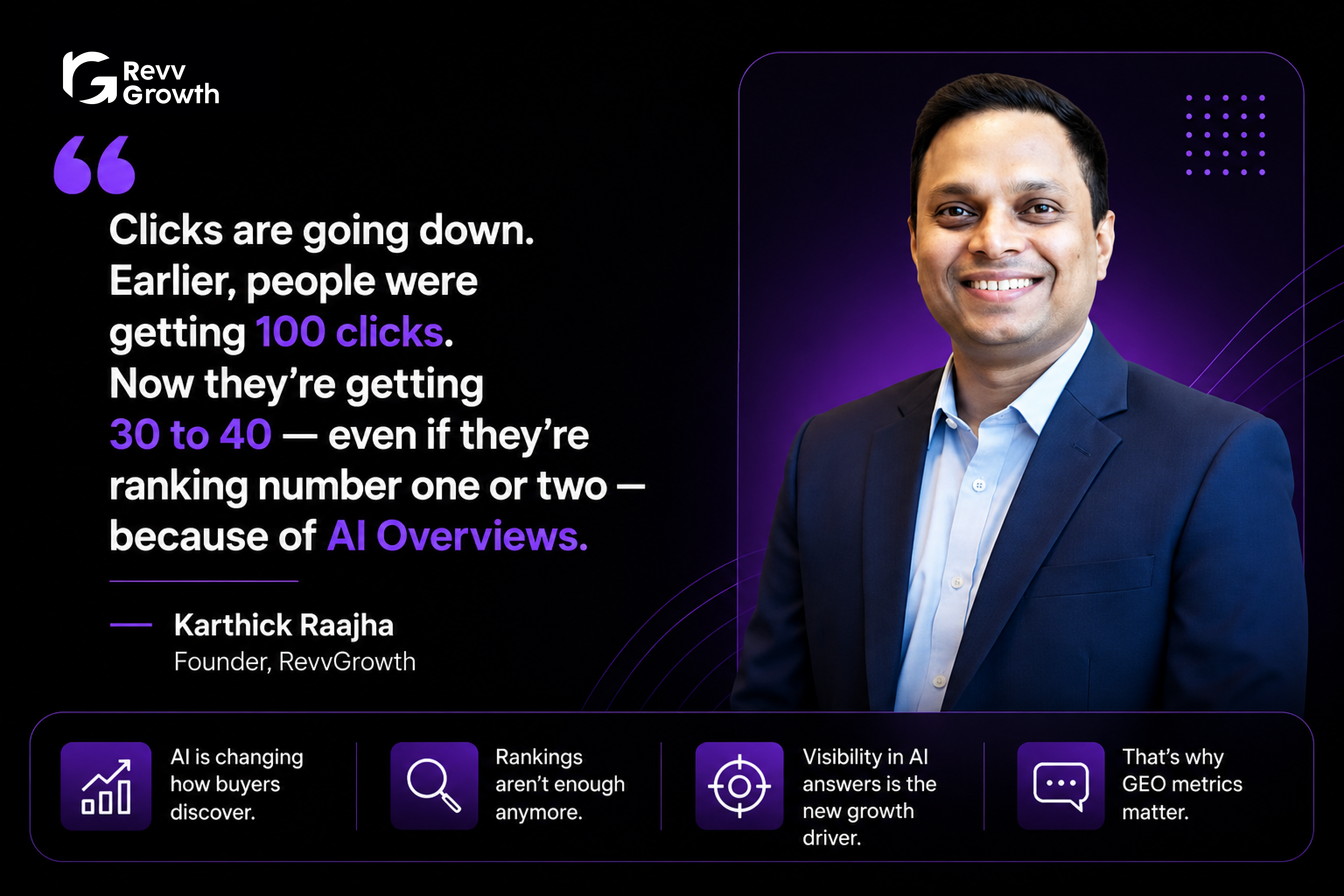
If you're still reporting impressions, rankings, and organic clicks to leadership in 2026, you're measuring a layer of search that AI has already rewritten. Clicks at rank #1 have collapsed from ~100 to ~30–40 because AI Overviews intercept the answer before the user ever reaches your page. The metrics that mattered last year don't survive that shift.
The 8 key metrics for measuring GEO success in 2026 are AI Mention Rate, Share of Voice, Citation Rate, Recommendation Rate, Sentiment Accuracy, Retrieval Success, AI Referral Sessions, and Conversion Rate — together they replace rankings and clicks as the primary measurement system for AI search.
In this guide, we'll break down the 8 GEO metrics that actually move pipeline, the tools that measure each, how to automate the tracking, and how RevvGrowth's framework ties every visibility number back to revenue. The framework is the same one we used to take Atlan from 17K to 128K monthly organic visitors in 11 months with $0 paid spend, and grow OvalEdge's LLM referral traffic by 178% in 90 days.
Why SEO Metrics Don't Work for GEO
Search Engine Optimization (SEO) measures position on a results page. Generative Engine Optimization (GEO) measures the presence inside an answer.
AI Overviews, ChatGPT, Perplexity, Google Gemini, and Anthropic's Claude collapse the funnel into a single answer. Your content is either inside that answer or invisible — there is no scroll, no second page, no long tail to catch.
The data backs it up:
- Seer Interactive's study of 3,119 informational queries across 42 organizations (25.1M organic impressions, June 2024–September 2025) found a 61% drop in organic click-through rate (CTR) when an AI Overview is present, and a +35% lift when your brand is cited inside that AI Overview (Seer Interactive, 2025).
- Bain & Company estimates ~60% of all searches now end without a click, and 80% of consumers rely on AI-written results for at least 40% of their searches (Bain & Company, 2025).
- Pew Research Center's study of 900 U.S. adults (68,879 queries, March 2025) found users clicked a traditional result in just 8% of searches with an AI summary, vs. 15% without (Pew Research Center, July 2025).
For B2B SaaS, the stakes compound. Long sales cycles and multi-stakeholder buying mean AI visibility is brand recall at the consideration stage. If a buyer asks ChatGPT for "best customer data platforms" and your name doesn't surface, you're not on the shortlist — regardless of where you rank in Google.
The unit of measurement has changed. Citations, mentions, and entity strength replace impressions, rankings, and clicks. For a deeper read on the shift, see our breakdown of GEO vs. SEO measurement.
The 8 GEO Metrics That Actually Matter
These 8 metrics cluster into 4 groups — Visibility, Quality, Technical, and Business Impact. Each metric has one job, and for each, we've listed the tools that actually measure it — manual prompt audits still work, but most teams move to a dedicated tracker once they outgrow a spreadsheet.
Group 1 — Visibility
1. AI Mention Rate (Brand Inclusion Rate)
- What it is: The percentage of target prompts where your brand or content is named in the AI answer. Industry sources also call this Brand Inclusion Rate — same metric.
- How to measure: Run a fixed 50–200 prompt set weekly across ChatGPT, Perplexity, Gemini, and Claude.
- Tools: Manual prompt audit (spreadsheet), or specialist trackers — Profound, Otterly.AI, Semrush AI Toolkit, Peec AI, AthenaHQ.
- Note: Track week-over-week progression. Ignore the "15%+ for competitive niches" benchmark floating online — it has no credible primary source behind it.
2. Share of Voice
- What it is: Your mentions divided by total competitor mentions across the same prompt set.
- How to measure: Same prompt audit — log every brand named in each answer and compare against your top 3–5 competitors.
- Tools: Profound and AthenaHQ both surface competitor-comparative SOV natively; Otterly.AI exports brand-by-brand citation counts you can pivot into SOV.
- Note: Track third-party citations, not just your owned site. BuzzStream research found Reddit is the most-cited domain across major AI engines — ~40% citation frequency across large language models (LLMs) and 46.7% of Perplexity's top sources (BuzzStream, 2025). Your presence on Reddit, G2, and Wikipedia drives Share of Voice as much as your blog does.
Group 2 — Quality
3. Citation Rate (Attribution Quality)
- What it is: Whether AI engines link back to your site as the source — not just naming you, but pointing to you.
- How to measure: Manual prompt audit. Log linked vs. unlinked mentions.
- Tools: Otterly.AI's Link Citations Analysis shows which URLs AI platforms reference and at what frequency; Semrush's AEO module surfaces top cited pages directly.
- Note: A linked citation is worth more than a naked mention — it drives referral traffic and attribution-system signal.
4. Recommendation Rate
- What it is: How often you're surfaced when the prompt explicitly asks for a recommendation ("best X for Y," "top tools for Z").
- How to measure: Subset of your prompt audit — separate recommendation prompts from informational ones and score them independently.
- Tools: Profound, AthenaHQ, and Peec AI all let you tag prompts by intent type so you can isolate the recommendation subset.
- Note: Recommendation Rate is the closest GEO equivalent to bottom-of-funnel (BOFU) intent. Watch this number when comparison-stage prompts trend up.
5. Sentiment Accuracy
- What it is: How AI describes you when it mentions you — neutral, positive, comparative-favourable, or comparative-unfavourable.
- How to measure: Tag sentiment during each prompt audit. Monitor unlinked brand mentions across the web in parallel.
- Tools: BrandMentions, Mention, and Brand24 cover web-wide sentiment; Profound and AthenaHQ run sentiment scoring inside AI answers themselves.
- Note: A high Mention Rate with negative sentiment is worse than no mention. Score sentiment every audit cycle, not quarterly.
Group 3 — Technical
6. Retrieval Success
- What it is: Whether AI crawlers (GPTBot, ClaudeBot, PerplexityBot, Google-Extended) can access and parse your content — schema, structured data, and page accessibility.
- How to measure: Run a crawl for schema coverage and AI-bot accessibility. Spot-check by submitting pages to AI engines and checking whether the content is returned correctly.
- Tools: Screaming Frog (AI-bot status code checks + schema audit), Ahrefs Site Audit, Semrush Site Audit. For robots.txt-level AI crawler permissions, free tools like geo-seo-claude check accessibility for 14+ AI crawlers.
- Note: Retrieval issues are silent killers. A blocked crawler kills every other metric downstream.
Group 4 — Business Impact
7. AI Referral Sessions
- What it is: Sessions arriving from chat.openai.com, perplexity.ai, gemini.google.com, copilot.microsoft.com, claude.ai.
- How to measure: Open GA4's Traffic Acquisition report (Reports > Acquisition > Traffic acquisition), switch the dimension to Session source/medium, and filter for chatgpt, gemini, perplexity, copilot, claude. Full setup in the next section.
- Tools: GA4 (free), plus Semrush AEO module for cross-reference of which pages are pulling AI sessions.
- Note: AI platforms strip referrers inconsistently — expect under-counting, especially on mobile and in-app traffic.
8. Conversion Rate (AI-Influenced Pipeline)
- What it is: What AI-referred users do once they land — and what those sessions turn into downstream.
- How to measure: GA4 connected to your customer relationship management (CRM) system with the AI channel passed through as a first-touch attribution source.
- Tools: GA4 + HubSpot or Salesforce for first-touch attribution. AthenaHQ adds direct revenue attribution from AI citations for e-commerce stacks.
- Note: This is the metric that buys you executive trust. Track it monthly, report it quarterly.
How to Track AI Referral Traffic in GA4
Most teams skip this setup and then complain that GA4 "doesn't show AI traffic." It does — you just have to filter for it. The fastest way is GA4's built-in Traffic Acquisition report. No custom channel group, no segment, no scripts.
The fast way — using the Traffic Acquisition report
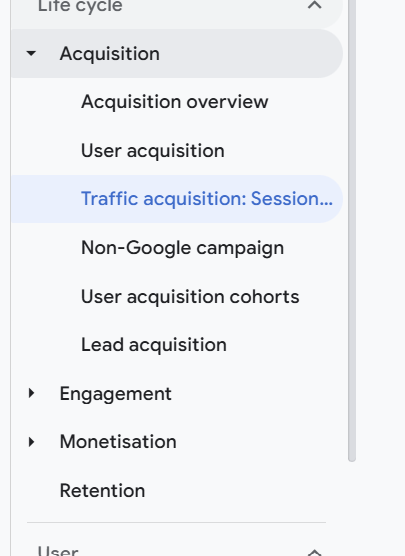
Step 1: Navigate to Reports > Acquisition > Traffic acquisition.
This is GA4's default acquisition report — already wired up the moment GA4 is installed.
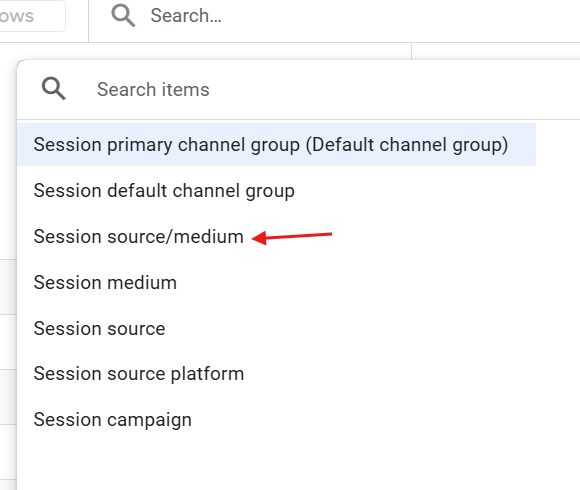
Step 2: Switch the primary dimension to Session source/medium.
Click the dimension dropdown above the data table and pick Session source/medium. This swaps the default grouping for the raw source-medium pair — which is how AI platforms actually get tagged in GA4.
Step 3: Use the search box to filter for AI sources.
Search for chatgpt, gemini, perplexity, copilot, or claude — one at a time, or whichever engine you care about. Rows like chatgpt.com / referral will surface in the filtered table.
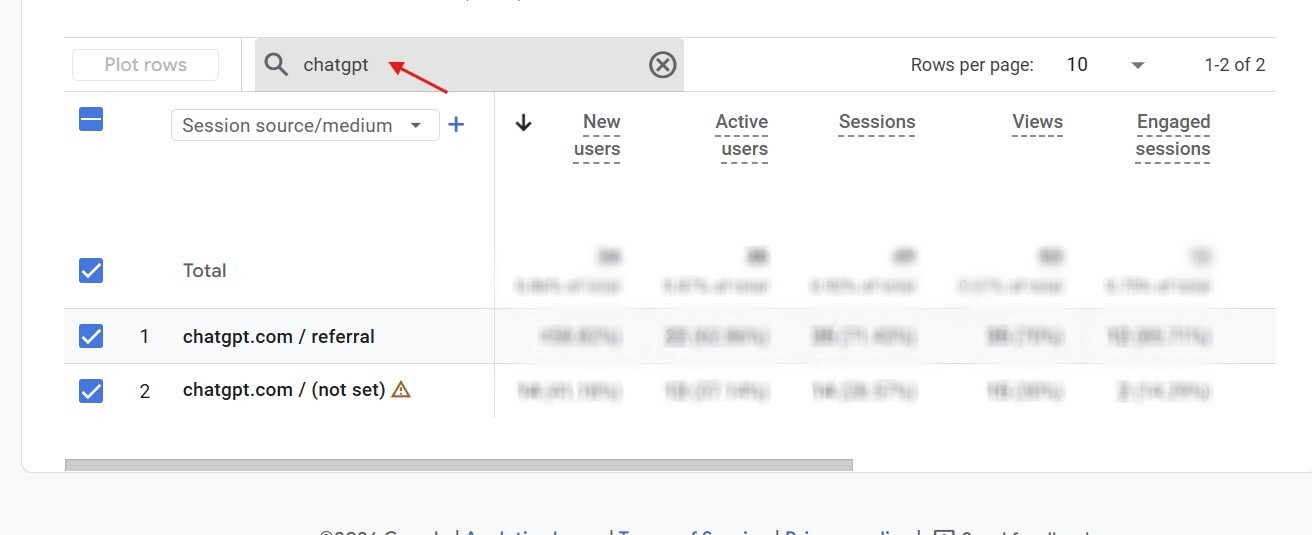
Step 4: Analyze the metrics — users, sessions, engaged sessions, conversions.
Compare AI traffic against your organic and direct channels. Watch engagement rate and conversions per session — that's what tells you whether AI-referred users actually convert, not just land.
That's the whole setup. Three minutes from "where's our AI traffic?" to a working baseline you can report on.
Two bonus moves to unlock attribution
These take longer but unlock pipeline-level reporting.
- Tag the content you submit to AI-friendly sources. LinkedIn, Reddit, G2, and third-party review sites should carry UTM parameters so you can isolate referred-from-AI traffic vs. cited-by-AI traffic in your reports.
- Connect GA4 to your CRM. Pass the AI channel through as a first-touch attribution source in HubSpot or Salesforce. This is what unlocks pipeline attribution — without it, AI sessions die at the session layer.
Honest caveat: AI platforms strip referrers inconsistently, especially on mobile and inside native apps. Expect under-counting. Triangulate AI Referral Sessions with Google Search Console (GSC) brand-query lift — when AI mentions rise, branded searches usually rise alongside, and that gives you a second signal that AI visibility is feeding the funnel.
How RevvGrowth Measures GEO Success
GEO success is not a single number. A keyword ranking tells you where your page sits in Google. GEO success tells you whether AI engines are reading, trusting, and citing your content when someone asks a question relevant to your product. That requires a different measurement system.
Here is what we track for every client:
- LLM Referral Sessions: Sessions in GA4 that originate from ChatGPT, Perplexity, Gemini, and Copilot. Real users who got an AI-generated response, saw your content cited, and clicked through.
- Month-over-Month AI Traffic Growth: We track total AI-driven sessions period over period to show directional momentum — whether LLM referral traffic is growing, flat, or declining.
- Sessions Breakdown by LLM Platform: Not all LLMs drive equal traffic. We break down sessions by source so you know which platforms are citing you and at what volume.
- Top Cited Pages: Which specific URLs are appearing in LLM responses, and how many prompts they show up in. This tells you which content is doing the heavy lifting in AI engines.
- Top Prompts for Which You Are Being Cited: The actual queries that trigger citations. This is one of the most useful outputs — it tells you exactly what questions AI engines associate your content with, which feeds directly back into content planning.
- Blog-Attributed Conversions from LLM Traffic. We track conversions that can be directly tied to blog sessions, including traffic that came in through LLM referrals. This closes the loop between GEO visibility and actual business outcomes.
What do we do when a citation drops? When a key citation drops, we run a structured 7-step recovery protocol within 48 hours. Visibility loss compounds inside a week as AI answers cache and propagate across engines — the fix has to ship fast, before the cached answer hardens.
What this looks like in practice
GEO impact for OvalEdge
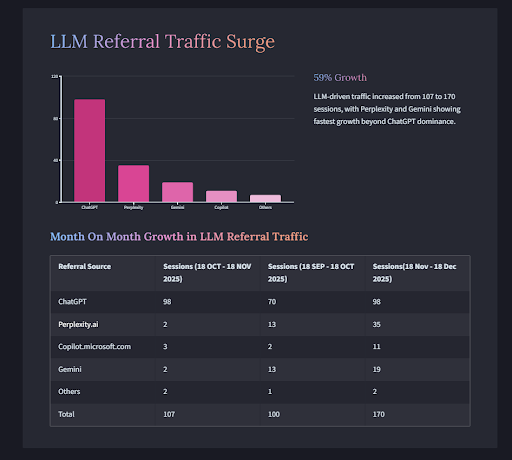
After using RevvGrowth’s GEO services, OvalEdge increased LLM referral traffic from 100 to 278 sessions per month, a 178% increase.
ChatGPT became the dominant referral source, while Perplexity and Gemini showed the fastest month-over-month growth.
The most-cited pages covered topics like data quality metrics, open-source data quality tools, and AI-powered data catalogs, all strategically optimized for AI retrieval and citation visibility.
GEO services implemented by RevvGrowth
- AI citation optimization for ChatGPT, Perplexity, Gemini, and Google AI Overviews
- LLM-friendly content structuring with question-led H2 frameworks
- Short Answer Blocks engineered for AI extraction
- GEO-focused blog architecture for retrieval and citation visibility
- AI visibility tracking through Semrush AEO and GA4 LLM referral monitoring
- Ongoing LLM prompting audits to measure citation frequency and share of voice
- Entity and topical authority optimization across data governance and AI-related topics
The prompts driving those citations matched the exact questions data engineering and governance buyers ask AI engines. RevvGrowth optimized already high-performing content to improve AI retrieval, helping the brand appear in ChatGPT, Perplexity, and AI Overviews when buyers bypassed traditional Google search.
The core metric set
The tools we use to measure GEO
A practical three-layer stack — no single tool does everything.
Why You Should Automate GEO Tracking
The mistake most teams make: trying to track all these metrics manually, every week, across four engines. That is hundreds of prompts a week. Your team burns out, and the data goes stale by the time it hits the dashboard.
Marketers consistently flag the lack of a GA-equivalent dashboard for AI search as the biggest measurement gap in 2026. The solution is not more dashboards — it is automation.
Automate these 4 things:
1. Prompt monitoring: Maintain a master list of 20-30 prompts that mirror real buyer queries in your category. Use n8n to schedule weekly automated runs — the workflow sends each prompt to the OpenAI API (and Perplexity API if available), logs the full response to Google Sheets, and flags whether your brand appears. You end up with a timestamped record of every response, every week, without anyone manually opening ChatGPT.
If you want a purpose-built tool instead of building it yourself, Keyword.com logs timestamped full-response snapshots across platforms, so you can show clients exactly when a citation appeared, what the sentiment was, and how it shifted.
2. Citation logging Once your n8n workflow is capturing LLM responses, add a second step: a Claude-powered node that reads each response and extracts whether your brand was cited, the context, and a simple positive/neutral/negative flag. Output goes into the same Google Sheet. Now you have a citation log that updates automatically every week with zero manual work.
3. GA4 → reporting pipeline Connect GA4 to Looker Studio directly. Set up a custom channel grouping in GA4 that isolates LLM referral traffic (sessions from chat.openai.com, perplexity.ai, gemini.google.com, copilot.microsoft.com). This gives you a live view of LLM sessions, conversions, and trends without pulling it manually each month.
4. Reporting layer Looker Studio pulls from GA4 and your Google Sheets citation log in one dashboard. Your client or team sees LLM referral sessions, top cited pages, citation trend, and blog conversions — all auto-updated. No rebuilding the deck every month.
If you want a dedicated platform that handles most of this out of the box, tools like Sight AI track your brand across six or more AI platforms simultaneously and provide an AI Visibility Score that quantifies how often and how favorably LLMs mention your brand. Semrush AI Visibility works well for teams that want AI tracking inside a broader search suite — its AI Search Site Audit checks whether your robots.txt is blocking GPTBot or other LLM crawlers.
Some things still need a human eye:
- Sentiment on ambiguous citations — a model doesn't know when "mentioned" means endorsed vs. just referenced.
- Citation quality — showing up in a list is not the same as being the recommended option.
- When citations drop — you can't fix what you don't understand, and understanding why takes context a tool won't have.
Automation handles the volume. The judgment calls stay with you.
The Best Tools to Track GEO
No single tool covers all 8 metrics. Most teams end up running a three-tool stack — one AI visibility tracker, GA4 for traffic, CRM for revenue — plus a technical crawler and a reporting layer.
The category that didn't exist 18 months ago — AI visibility trackers — is now the most contested part of the stack. For a side-by-side comparison of the leading platforms and how to pick the right one for your team, see our breakdown of the 8 best AEO tracking tools.
Honest framing: start narrow. One AI visibility tracker + GA4 + CRM is enough to run the 8 metrics end-to-end. Anything else is overhead until you've got 6 months of clean data behind you.
GEO Measurement Best Practices
- Measure visibility, not rankings. Track presence-in-answer, not position-on-page.
- Track prompts, not just keywords. Your prompt set is the new keyword list.
- Test across all four engines. ChatGPT, Perplexity, Gemini, Claude — visibility on one engine does not equal visibility on all. Lock the prompt set quarterly so the trend data is comparable.
- Separate branded vs. non-branded AI visibility. Branded shows recall; non-branded shows category authority. They tell different stories — report them separately.
- Score citation quality, not raw counts. One high-tier citation beats ten low-tier ones.
- Measure entity coverage and source-page performance. Track which topics you're known for, and which of your pages get cited most. Then optimize both.
- Track assisted business impact, not just direct conversions. AI traffic often influences the pipeline without converting, and in-session, first-touch attribution catches what last-touch misses.
- Pair GEO with traditional SEO metrics. Same audience, different signal layer — read them together. And when a key citation drops, fix the underlying page fast — AI answers cache and propagate inside a week.
Key Takeaways
GEO measurement isn't SEO measurement with new column headers — it's a different unit of analysis built around answers, citations, and entity strength. Get the 8 metrics in place, automate the tracking, and tie every visibility number back to a pipeline number. That's the bar leadership will care about in 2026.
The short version:
- Clicks at rank #1 are down to ~30–40 from ~100. Seer Interactive reports a 61% CTR drop with AI Overviews present, but a +35% CTR lift when your brand is cited inside one (Seer Interactive, 2025).
- The 8 metrics cluster into 4 groups: Visibility (Mention Rate, Share of Voice), Quality (Citation Rate, Recommendation Rate, Sentiment Accuracy), Technical (Retrieval Success), Business Impact (AI Referral Sessions, Conversion Rate).
- Every metric has a tool — Profound, Otterly.AI, Semrush AI Toolkit, AthenaHQ for visibility and quality; Screaming Frog for technical; GA4 + CRM for business impact. Don't try to run all 8 manually.
- GA4 already tracks AI traffic — filter the Traffic Acquisition report by Session source/medium for chatgpt, gemini, perplexity, copilot, claude. Three-minute setup, no custom channel group.
- Automate the heavy lifting with Claude Code, n8n or Zapier, and Looker Studio. Keep manual only what needs judgement — sentiment scoring, citation quality grading, recovery actions.
- Your Share of Voice depends on third-party platforms too. Reddit is the most-cited domain across major AI engines (~40% across LLMs, 46.7% on Perplexity) — BuzzStream, 2025.
- We track six core signals for every client — LLM referral sessions, MoM AI growth, sessions by platform, top cited pages, top citation-triggering prompts, and blog-attributed conversions — and OvalEdge grew LLM referral traffic 178% running this exact model.
If you want to see which AI engines are citing your brand right now, which prompts are triggering those citations, and how many of your blog-attributed conversions are coming from LLM referrals — that's the audit we run. We'll show you exactly where your AI Mention Rate, Citation Rate, and LLM pipeline sit today, and a plan to move every one of those numbers in the next 90 days. Book your GEO measurement audit
.svg)


.webp)
.avif)