


Introduction
"The next wave of search isn't about ranking on page one. It's about being the answer AI gives before your buyer ever opens a browser tab." — Rand Fishkin, Co-founder, SparkToro
73% of B2B buyers now use AI tools like ChatGPT and Perplexity in their research process, according to Averi's 2026 benchmarks report. Most B2B SaaS companies are still optimising for Google alone, and the gap between SEO rankings and AI citations is wider than most teams realise.
And with ChatGPT now crossing 900 million weekly active users as of early 2026, the volume of buyer research happening inside AI platforms is no longer a trend you can plan for later. The brands getting cited in those answers aren't lucky. They hired someone to build that visibility intentionally.
That's what GEO consulting is. If you're reading this, you're past the "what is GEO" phase. You want to know what an engagement actually looks like, what it costs you to wait, and whether RevvGrowth is the right partner to get you there.
Book a free GEO strategy call with RevvGrowth →
Let’s look at why GEO consulting is crucial for your business, what to expect from GEO consulting services, and how to know if it’s the right time to bring on a GEO strategy consultant. Let’s dive in.
What's Included in GEO Consulting Services
GEO consulting isn't a single deliverable. It's a system built across four connected pillars. A good GEO consultant works on all four at once, because optimising one in isolation doesn't move the needle.
1. Content architecture for AI extractability
AI systems pull from content that is clear, factual, and self-contained. That means restructuring existing content so individual paragraphs and sections can stand alone as answers.
It includes rewriting introductions to front-load direct answers, adding structured data and schema markup, building out FAQ sections using real query language, and making sure every claim is attributed and verifiable.
The numbers back this up. Only 23% of AI-cited sources appear in the top 10 Google organic results for the same query (Zyppy study, 2025), which is why ranking alone isn't enough.
2. Entity clarity and brand signal consistency
AI models need to understand exactly what your brand is, who it serves, and why it's credible, across every platform it appears on. GEO consulting includes auditing and fixing inconsistencies in how your brand is described on your website, your LinkedIn company page, G2, Capterra, Crunchbase, and anywhere else you have a presence.
3. Off-site presence and third-party mentions
AI systems don't just read your website. They read Reddit, LinkedIn, industry publications, review platforms, podcasts, and forums. If the only brand voice out there is yours, LLMs treat that as a low-credibility signal.
Sites with over 32,000 referring domains are 3.5x more likely to be cited by ChatGPT than lower-authority sites (SE Ranking, Nov 2025).
GEO consulting builds earned presence through strategic PR, thought-leadership placements, community engagement, and partner content, so your brand appears organically in the conversations AI models are trained on and retrieve.
4. Citation tracking and share of voice measurement
GEO doesn't have a clean ranking report the way SEO does. What it has instead is citation frequency, share of voice across AI platforms, prompt coverage (how many relevant questions trigger a brand mention), and sentiment of those mentions. A proper GEO engagement sets up this measurement infrastructure from day one, so you're not guessing whether the work is moving the needle.
Also read: Best B2B GEO agencies for SaaS
Now that you know what services are covered under GEO consulting, let us look into the GEO agencies that have met these criteria.
Top GEO Consulting Agencies in 2026
If you're evaluating partners, these are five agencies worth shortlisting for B2B SaaS work. We scored each on four criteria weighted equally.
How we ranked them:
- AI visibility track record (25%): Published case studies showing measurable citation gains across ChatGPT, Perplexity, and AI Overviews
- B2B SaaS specialisation (25%): Depth of work with funded SaaS companies, not generic content or ecommerce
- Full-stack GEO capability (25%): Coverage across all four GEO pillars (content, entity, off-site, measurement)
- Pricing transparency (25%): Published pricing or clear scoping, not black-box quotes
Each agency is scored out of 20. For a deeper breakdown of how pricing varies across tiers, see our GEO agency pricing guide.
A quick note on transparency:
We placed RevvGrowth first in the agencies comparison because our GEO process is one of the most detailed in the market (we walk through all five steps, so you can judge for yourself). We've kept 90 to 95% of our clients year over year, which tells you the work holds up past month three. Every other agency on that list is evaluated on the same four criteria, and we've linked to each of their sites so you can cross-check.
1. RevvGrowth
RevvGrowth is a B2B SaaS GEO, AEO, and SEO agency that builds AI search visibility as a pipeline channel, not a reporting dashboard. Clients include Atlan (cited 6,500+ times across ChatGPT, AI Overviews, Gemini, and AI Mode), Everstage (featured in AI Overviews for enterprise sales compensation queries), and a roster of B2B SaaS companies across data governance, HR tech, and sales enablement.
Key GEO services:
- Gen AI visibility audit
- Conversational query and prompt research
- AI citation audit
- Answer-first content optimisation
- Semantic content architecture
- Entity authority building
- Schema implementation
- Monthly citation tracking across ChatGPT, Perplexity, AI Overviews, and Gemini.
Ideal for:
Funded B2B SaaS companies ($1M to $50M ARR) that already have some SEO foundation and want AI citations tied directly to the pipeline, not just visibility scores.
Why RevvGrowth is unique:
We built our own brand from $0 to $28.3K in organic value in six months using the exact framework we sell, which gives us a live testbed for every tactic before we deploy it on a client. We also publish our full 5-step process openly, and our 90 to 95% client retention rate reflects that the work compounds past the 90-day mark.
To learn more about RevvGrowth's GEO process, check our 5-step process.
2. First Page Sage
First Page Sage coined the term GEO in 2024. Their methodology is built on cadence-based thought leadership content, consistently publishing authoritative, high E-E-A-T pieces that earn trust from both human readers and AI engines.
Key GEO services:
- Superlative list placement (getting you into "top X" articles that AI chatbots pull from)
- SEO for those list articles
- Review site optimisation (G2, Capterra, Clutch, Trustpilot)
- PR for authoritative publication mentions
- Reputation management across sentiment signals.
Ideal for:
Enterprise B2B SaaS and complex B2B categories (medtech, manufacturing, SaaS) where the sales cycle depends on category education, and you have subject-matter experts available to contribute to content.
Why First Page Sage is unique:
They literally created the GEO category and have the longest published body of research on how LLM recommendation algorithms work. Their process is methodical by design, which suits mature teams but can frustrate buyers who expect faster iteration.
3. Omniscient Digital

Omniscient Digital is an organic growth agency that works almost exclusively with B2B software and SaaS. They focus on building distributed brand authority across multiple surfaces, a model that maps well onto how AI systems select and cite sources.
Key GEO services:
- SEO and content strategy
- Programmatic SEO
- Technical SEO consulting
- Content production and optimisation
- Link building and digital PR
- Thought leadership programs built from SME interviews
- GEO, delivered through a partnership with Peec AI for citation monitoring
Ideal for:
Well-funded B2B SaaS companies ($5M to $50M+ ARR) that want a strategic partner to own content-led growth end-to-end and are patient enough to invest in long-term editorial depth.
Why Omniscient Digital is unique:
Their proprietary "OmniscientX" research framework blends qualitative and quantitative research before any content planning begins, and their "Surround Sound SEO" methodology builds content ecosystems designed to establish category presence across multiple surfaces simultaneously.
4. iPullRank

iPullRank is a technical GEO and SEO engineering firm founded in 2014 by Michael King, who coined the term "Relevance Engineering." Clients include SAP, American Express, HSBC, Nordstrom, SanDisk, General Mills, and FTD.
Key GEO services:
- Technical GEO audits
- Relevance engineering
- Content engineering using machine learning and NLP
- Crawlability for AI agents (GPTBot, Google-Other)
- Semantic content structuring
- Advanced JavaScript SEO
- Schema and entity optimisation
- Custom content scoring tools that flag low-citation-potential pages before publication
Ideal for:
Large enterprise SaaS with complex site architecture, JavaScript-heavy builds, or large content libraries where the technical layer is the bottleneck, not content volume.
Why iPullRank is unique:
Michael King is one of the most cited voices in the GEO space globally, and the agency applies information retrieval theory to content work in ways most agencies can't. Their work has strong Google-ecosystem coverage (AI Overviews, AI Mode) though they're less outcome-pricing-focused and publicly case-light compared to some competitors.
5. Directive Consulting
Directive Consulting is an Irvine-based performance marketing agency for B2B tech companies, founded in 2014 by Garrett Mehrguth. Clients include ZoomInfo, Sumo Logic, WordPress, CHG Healthcare, Cisco, Gong, and Seagate.
Key GEO services:
- Generative engine optimisation
- Content strategy
- Entity optimisation
- Data layer architecture
- AI-readable brand frameworks
- Digital PR
- Citation dashboards tracking impressions and engagement from generative engines
Ideal for:
Mid-market to enterprise B2B SaaS ($10M to $100M+ ARR) that wants one integrated partner handling GEO alongside paid media, CRO, and RevOps rather than splitting work across specialists.
Why is Directive unique?
They run GEO alongside paid search, programmatic, and performance creative under a single P&L, which works well if your GEO work needs to be amplified through paid channels or if you want revenue attribution tied directly to AI citation activity.
Their limitation for pure GEO is that citation mechanics sit inside a broader performance stack rather than being the primary focus.
For enterprise-specific GEO comparisons, see our enterprise GEO agency list.
How RevvGrowth Improves AI Search Readiness: A 5-Step Process
Your SEO agency is optimising for Google's algorithm. Your content team is optimising for clicks. Neither of them is optimising for the question a buyer just typed into ChatGPT. That's the gap RevvGrowth's GEO process is built to close, and we do it across five connected steps, not one-off content fixes.
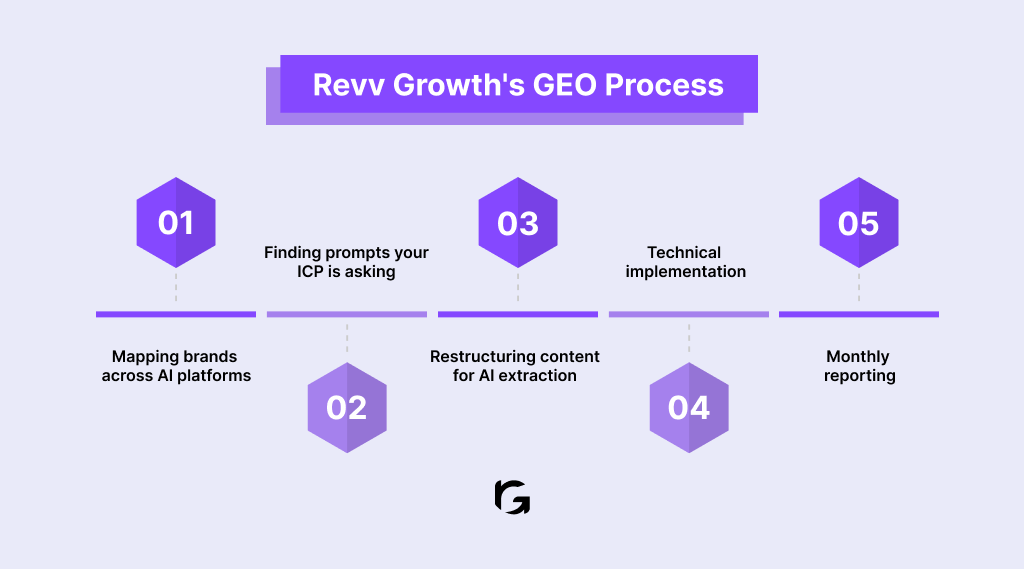
Step 1: Gen AI visibility audit
Before any work begins, we map where your brand stands across the AI search landscape. This means running your core category keywords and ICP-relevant prompts through ChatGPT, Perplexity, Google AI Overviews, and Gemini, and documenting exactly where you appear, where you don't, and who's getting cited instead of you.
The audit covers your content's extractability, your entity consistency across platforms, and a competitor citation benchmark. You walk away knowing precisely what's broken and what needs to be fixed first.
Step 2: Conversational query and keyword research
Traditional keyword research finds what people type into Google. This step finds what your ICP is asking AI. Those are different questions, structured differently, and they need a different research approach.
We map the actual conversational prompts your buyers use at the awareness, evaluation, and decision stages: the "what's the best tool for X," "how do I solve Y," "which platform is better for Z" queries that are triggering AI-generated answers right now.
Every piece of content we create or restructure is mapped back to a specific prompt your brand should be showing up for.
Step 3: Content creation and optimisation
This is where most of the execution happens. Existing high-value pages get restructured for AI extractability: clearer headings, direct-answer paragraphs, FAQ schema, and front-loaded conclusions. Net-new content is built specifically to answer the conversational queries identified in Step 2.
The structure matters more than you'd think. 44.2% of all LLM citations come from the first 30% of a page (Growth Memo, Feb 2026), which is why we front-load direct answers instead of burying them under introductions. The goal isn't more content. It's content that LLMs can extract a credible, cite-worthy answer from in seconds.
Step 4: Technical implementation
Content alone won't get you cited if the technical signals aren't there. This step covers schema markup, structured data implementation, Knowledge Panel optimisation, and entity consistency cleanup across your website, G2, LinkedIn, Crunchbase, and every other platform where your brand has a presence.
We also audit and fix how your brand is described across third-party platforms. Inconsistency in your entity signals is one of the fastest ways to reduce AI citation probability, and it's one of the most overlooked issues in GEO.
Step 5: Monitor, test, and iterate
GEO doesn't have a set-and-forget mode. We track your citation frequency, share of voice across AI platforms, and prompt coverage every two weeks, testing new content angles and off-site placements against what's actually moving the numbers.
Every iteration is driven by data, not assumptions. If a competitor is gaining citation share, we know why, and we respond fast. This feedback loop is why the bi-weekly rhythm matters: results from step 5 feed directly back into steps 2, 3, and 4.
Client Case Study: Everstage
Everstage, a B2B SaaS sales commission platform, came to RevvGrowth with a common problem: strong SEO performance but near-zero presence in AI-generated answers. When buyers asked ChatGPT or Perplexity about sales commission tools or incentive compensation software, Everstage wasn't being mentioned — even though they ranked on page one for several high-intent keywords.
The challenge:
Everstage's content was built entirely for keyword rankings, long-form posts optimized for search but not structured for AI extraction. Their entity footprint outside their own domain was minimal. Competitors with weaker SEO were getting cited simply because their content was easier for LLMs to extract and attribute.
What RevvGrowth did:
- Designed a complete AI-powered blog engine mapped by funnel stage and intent using Clearscope optimisation and prompt-led workflows
- Created TOFU content with credible sources, structured CTAs, product plugs, and deep SERP-informed outlines
- Applied the full SERP analysis + AI drafting + human editorial + Clearscope optimisation cycle to every piece
- Delivered 40+ long-form published blogs within a month — project is ongoing
Results:
- 3+ AI platforms citing Everstage
- Page 1 ranks on Google for key queries
Query: 'enterprise sales compensation' — Everstage featured as the primary cited source.
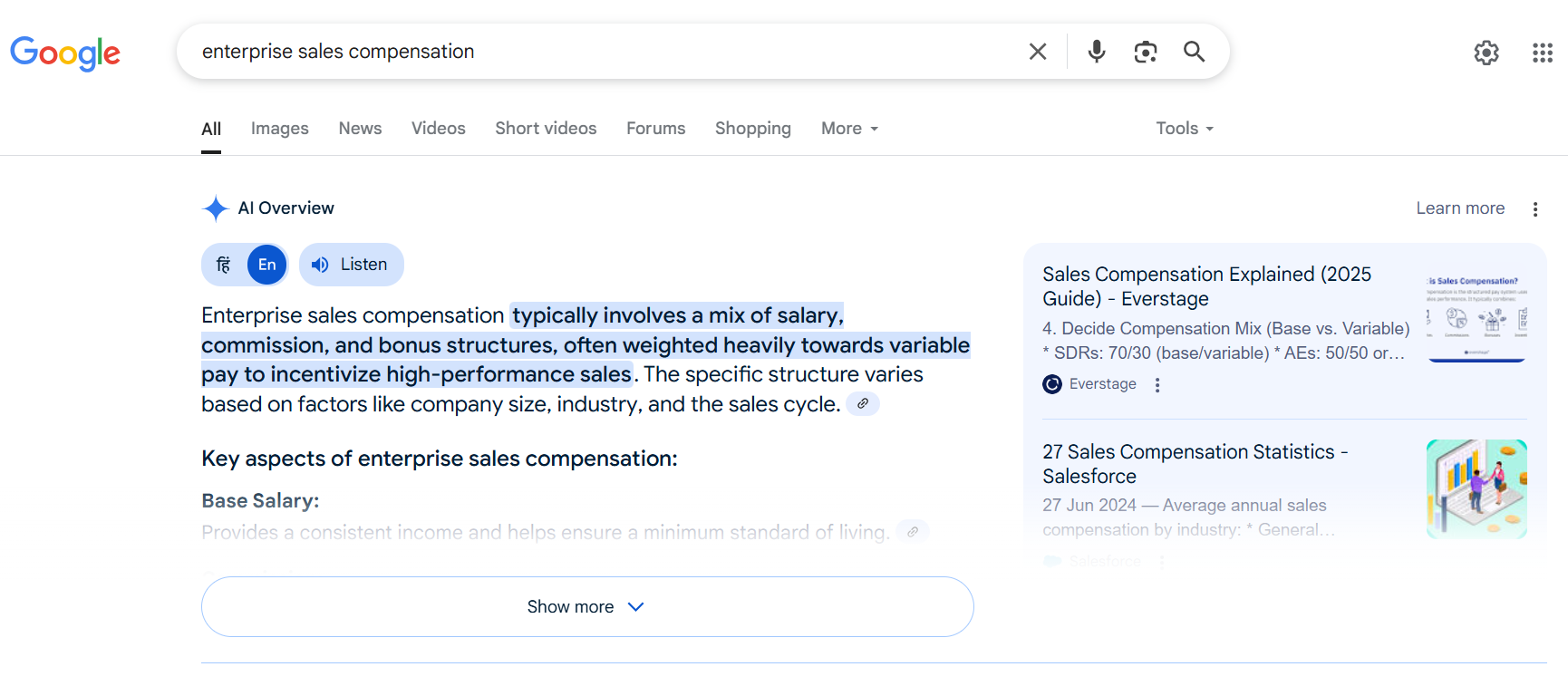
Google AI Overview: 'enterprise sales compensation' — Everstage cited
Screenshot — Everstage in Google AI Overview (2 of 2)
Query: 'sales compensation compliance' — Everstage featured in the Google AI Overview.

Google AI Overview: 'sales compensation compliance' — Everstage cited
Screenshot — Everstage in ChatGPT
Query: 'sales compensation consultants' — Everstage cited in ChatGPT 4o citations panel.
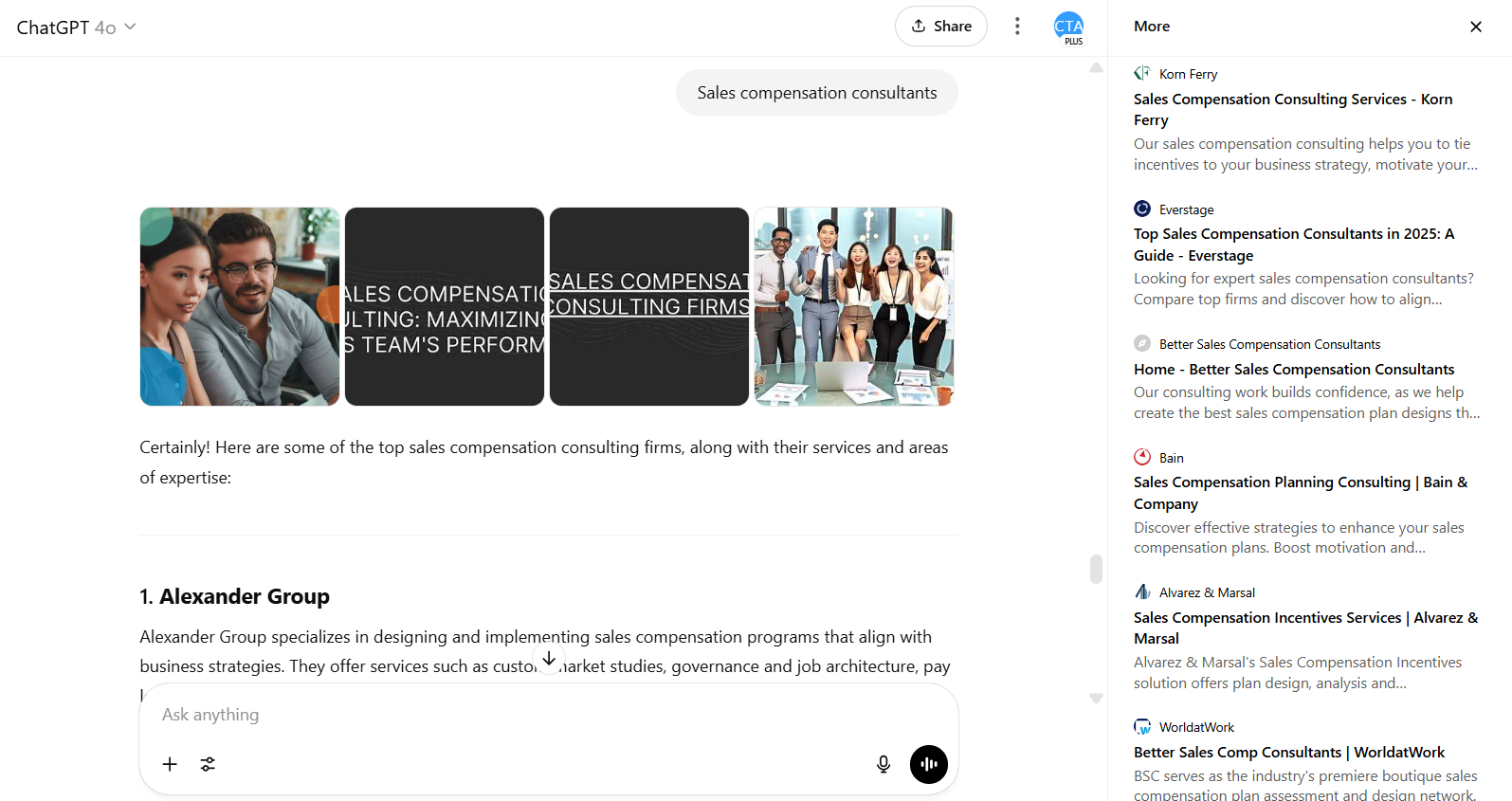
ChatGPT 4o: 'sales compensation consultants' — Everstage cited
Screenshot — Everstage in Perplexity AI
Query: 'variable sales compensation plans' — Everstage featured as a top cited source in Perplexity.
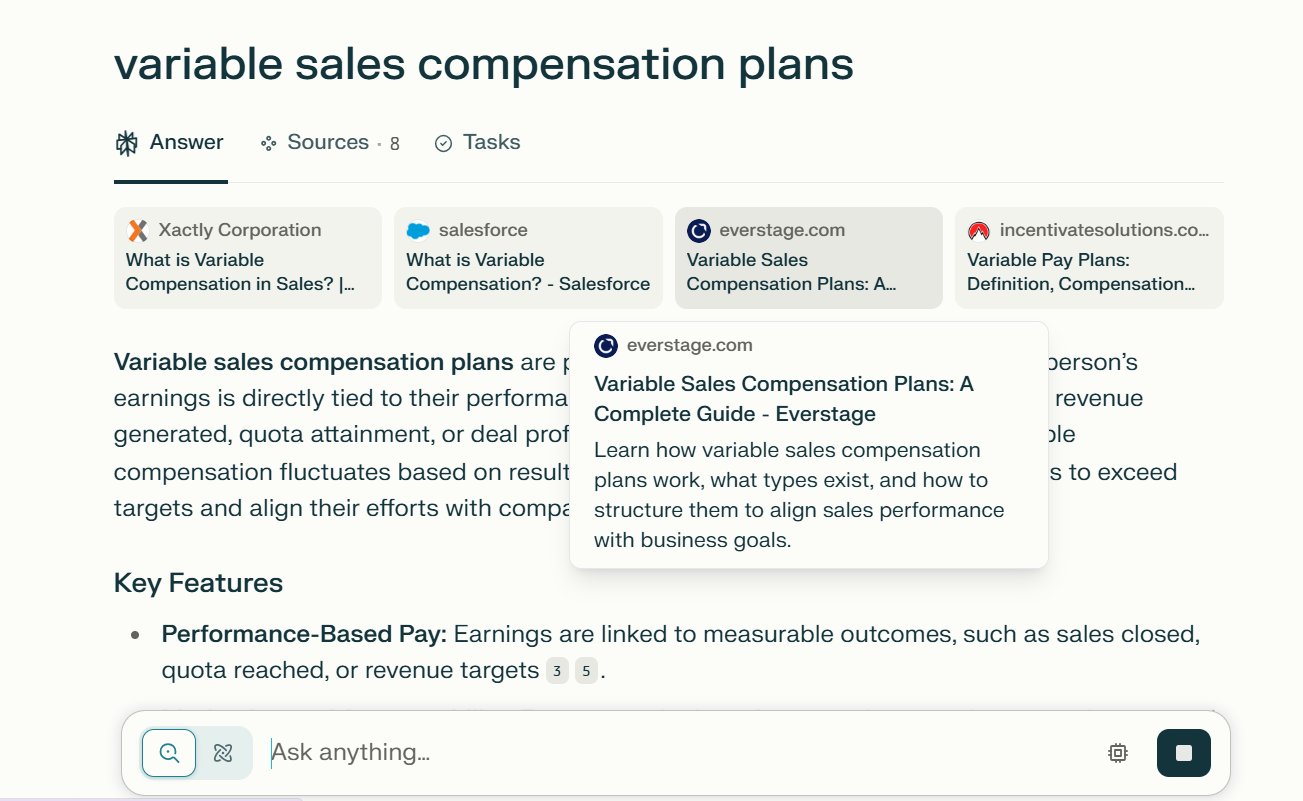
Perplexity AI: 'variable sales compensation plans' — Everstage as top cited source
Screenshot — Everstage Google Featured Snippets
Queries: 'sales compensation statistics' and 'the future of sales compensation' — Everstage owns both featured snippet positions.
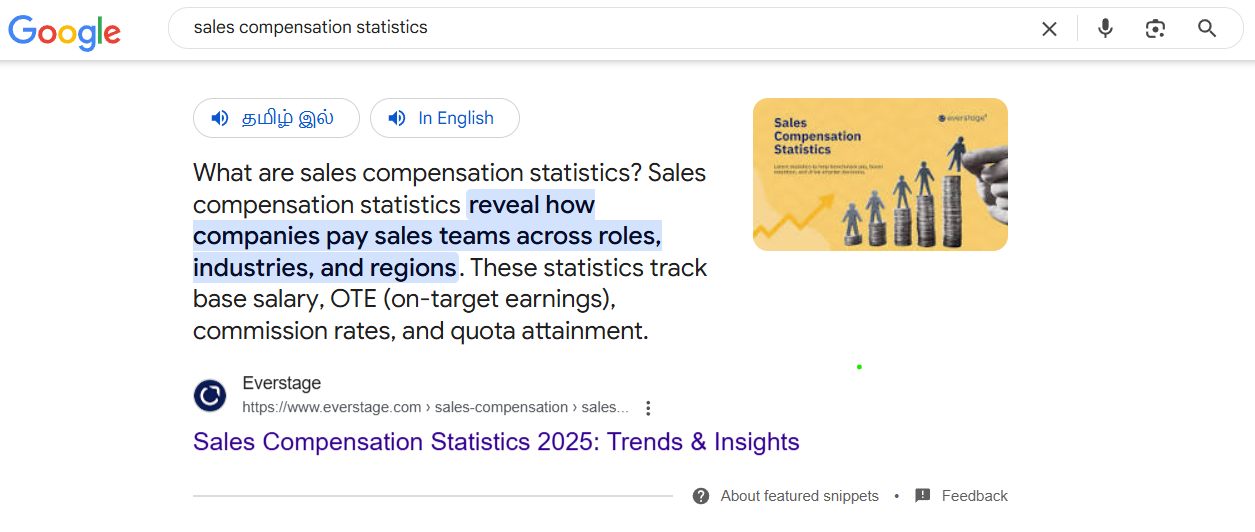
Google Featured Snippet: 'sales compensation statistics' — Everstage

Google Featured Snippet: 'the future of sales compensation' — Everstage
See how RevvGrowth can do the same for your brand →
Key Takeaways
GEO consulting exists because strong Google rankings no longer guarantee AI visibility. If your B2B SaaS brand isn't showing up in ChatGPT, Perplexity, or Google AI Overviews for your category queries, you're losing pipeline to competitors who are. Here's what you need to know before you shortlist an agency or build this in-house.
- Strong SEO rankings don't translate to AI citations. Only 23% of AI-cited sources appear in the top 10 Google organic results for the same query, which means SEO and GEO are separate disciplines with separate playbooks.
- 73% of B2B buyers now research vendors using AI tools before visiting a website, making AI citation a top-of-funnel visibility channel you can't ignore.
- GEO consulting covers four pillars that have to work together: content extractability, entity clarity, off-site presence, and citation tracking. Optimising one in isolation moves nothing.
- Every engagement should start with a Gen AI visibility audit, not an assumption. You need a baseline citation benchmark across ChatGPT, Perplexity, and AI Overviews before you build a strategy.
- Citation traction becomes measurable within 60 to 90 days when the work is structured correctly. Earned mentions and off-site authority compound over 3 to 6 months.
- RevvGrowth is one of five credible GEO partners for B2B SaaS. Shortlist based on AI visibility track record, SaaS specialisation, full-stack capability, and pricing transparency, not on who markets the loudest.
FAQs
.svg)


.webp)
.avif)