

.avif)

You hired an ABM agency six months ago. They built a target account list, spun up LinkedIn campaigns, and sent you a deck every month showing account engagement scores. Six months later, your CRO asks which ABM accounts became pipeline. Nobody has a clean answer.
This is the most common failure mode in B2B SaaS ABM. Not a strategy problem. Not an ICP problem. An execution and accountability problem. Most agencies run campaigns against account lists and call it ABM.
What they are actually running is targeted demand gen with an account label on it. Buying committees do not get mapped. Dossiers do not get built. Pipeline attribution does not survive the MQL-to-SQL handoff. Six months of spending produce dashboards nobody trusts.
This is RevvGrowth's ranked list of the best ABM agencies for growth-stage B2B SaaS in 2026. We evaluated each agency the way a VP of Marketing or CRO would: on buying committee depth, pipeline proof, RevOps integration, AI-era readiness, and whether they can actually answer the question your CEO asks at the end of every quarter.
Quick Comparison Table: Top ABM Agencies for Growth-Stage B2B SaaS in 2026
How We Evaluated These Agencies
We evaluated every agency the way a VP of Marketing at a Series B SaaS company would before putting a recommendation in front of their CFO. Not by logo walls or G2 ratings. By the questions that separate ABM execution from ABM theatre.
Five criteria. Each is weighted by impact on the pipeline at growth-stage B2B SaaS.
Criterion 1: Buying Committee Depth (25%)
ABM that targets accounts without mapping stakeholders is demand gen with an account filter. Forrester puts the average B2B buying group at 5 to 16 people across up to four functions. If your agency is reaching one contact per account, they are not running ABM.
We looked for agencies that map 6 to 10 stakeholders per 1:1 account using LinkedIn Sales Navigator, ZoomInfo, and Factors.ai, and, crucially, build that map before outreach starts rather than opportunistically during the campaign. Tools matter here. Intent data from Clay and 6sense overlaid at the stakeholder level is what separates signal-based ABM from static list execution.
Criterion 2: RevOps and CRM Integration (25%)
Pipeline attribution that ends at MQL is campaign reporting, not pipeline proof. The question that matters: which named accounts moved from cold to opportunity, how long did it take, and which of those became closed-won?
We evaluated four checkpoints: account-level lifecycle stages (not just contact-level), MQL-to-SQL conversion tracked by tier, attribution that survives the sales handoff into CRM, and closed-won contribution at a named-account level 6 to 9 months post-outreach. Any agency whose monthly report starts and ends with impressions and engagement scores failed this criterion.
Criterion 3: Tier Coverage (20%)
A $500K ACV enterprise account and a $30K ACV mid-market lead are not the same priority. Real ABM routes accounts to the right tier based on fit score, intent signals, and deal size.
We checked for documented execution across all three, not just the capability claimed in a pitch deck. Agencies that only run 1:many programs are running targeted demand gen at scale. Useful. But not ABM.
Criterion 4: Documented Pipeline Proof (20%)
Client logos are not proof. We required named case studies with real numbers: pipeline-generated, MQL-to-SQL conversion, or revenue-influenced, tied to a specific program with a named client and a documented timeline.
The standard: could a CFO read this and trust it? "$21M marketing-sourced pipeline in 90 days from 50 named accounts" passes. "Significant pipeline improvement across a portfolio of accounts" does not.
Criterion 5: AI-Era ABM Readiness (10%)
In 2026, buying committees research vendors on ChatGPT, Perplexity, Gemini, and Google AI Overviews before any sales contact. If your brand is not in those AI-generated shortlists, your outreach is arriving in a conversation your competitors have already shaped.
We evaluated whether agencies build GEO-optimised content alongside account-level targeting, track LLM citation for ICP-relevant queries, and understand the difference between SEO (Google rankings), AEO (AI direct answers), and GEO (LLM citations).
The agencies that scored highest pair ABM outreach with content built to be cited by AI tools for the exact queries your target accounts are running, comparison pages, alternatives pages, and FAQ-structured explainers, so the brand is already present before outreach lands.
This criterion is weighted at 10% today. As AI search becomes the primary research channel for B2B buyers, that weight will only increase.
What This Means in Practice
These five criteria were applied to every agency in the same order, with the same evidence bar. Strong brand, long client list, compelling LinkedIn presence, none of it counted without buying committee depth, RevOps integration, tier coverage, and verified pipeline numbers.
One question to ask any agency before reading the rest of this list: "Show me a named account that moved from cold to pipeline in under 90 days and tell me exactly how your team ran that program." The answer tells you everything.
Best ABM Agencies for Growth-Stage B2B SaaS in 2026
The best full-funnel ABM agencies for growth-stage B2B SaaS in 2026 do more than run LinkedIn campaigns against a target account list. They map buying committees, build account intelligence before outreach starts, connect every touchpoint to the CRM pipeline, and the revenue report, not reach.
This list ranks eight agencies that can actually do that, starting with the one built to own the full motion.
1. RevvGrowth — Best Full-Funnel ABM Agency for Growth-Stage B2B SaaS
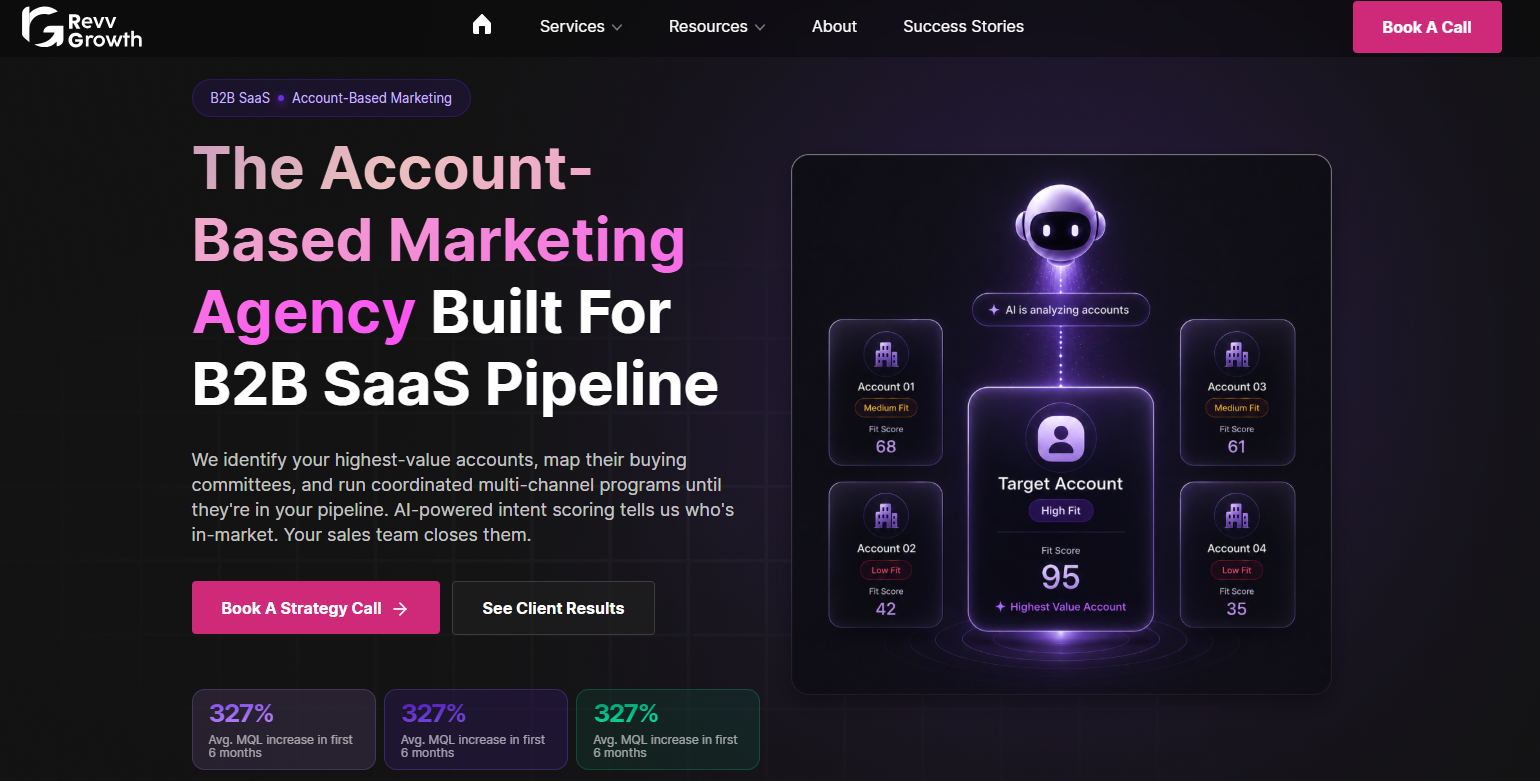
RevvGrowth is the only ABM agency on this list that connects account-based marketing to the full revenue system: SEO, AEO, GEO, paid media, RevOps, MarketingOps, and pipeline attribution all running in a single integrated motion. Most ABM agencies own one part of the account journey. RevvGrowth owns the whole thing.
The ABM program is built around a 5-phase process:
1. Phase 1 is account selection and ICP scoring, where every account is ranked across five dimensions: ICP fit (30%), buying intent (25%), engagement level (20%), expansion potential (15%), and relationship warmth (10%).
Tools include ZoomInfo and Clay for firmographic and technographic data, Bombora and G2 for intent signals, and Factors.ai for engagement tracking. Accounts are assigned to the right tier based on ACV, sales cycle complexity, and strategic priority, not guesswork.
2. Phase 2 is account intelligence. Before any outreach begins, every 1:1 account receives a full 10-section intelligence dossier: company vitals, buying committee map, strategic priorities, pain points, intent signals, tech stack, competitive context, warm paths, and recommended approach. Sending any message before the dossier is complete is a protocol violation on RevvGrowth programs. This is what separates ABM from spray-and-pray.
3. Phase 3 is content and asset creation, mapped to role before a single word is written. CXOs get ROI and pipeline impact stories. IT leaders get architecture guides and integration depth. Finance and procurement get TCO analyses and efficiency frameworks. Every content piece must pass the Account Test: Would the target account believe this was built specifically for them?
4. Phase 4 is multi-channel orchestration: LinkedIn personalised outreach, executive roundtables, direct mail, retargeting, and sales-marketing standups coordinated weekly.
5. Phase 5 is measurement and reporting, with account engagement velocity, MQL-to-SQL conversion by tier, pipeline influenced, and closed-won attribution tracked against a live dashboard from day one.
RevvGrowth also builds for the AI-era ABM. As buying committees self-research on ChatGPT and Perplexity before engaging vendors, RevvGrowth pairs account-level targeting with GEO and AEO content so the brand is already present in AI-generated shortlists when outreach lands.
Pros and Cons
Best for: B2B SaaS companies with $1M+ ARR that need account-level pipeline from named strategic accounts, with full RevOps attribution and AI-era visibility built in.
2. GrowthSpree — Best for Signal-Based ABM
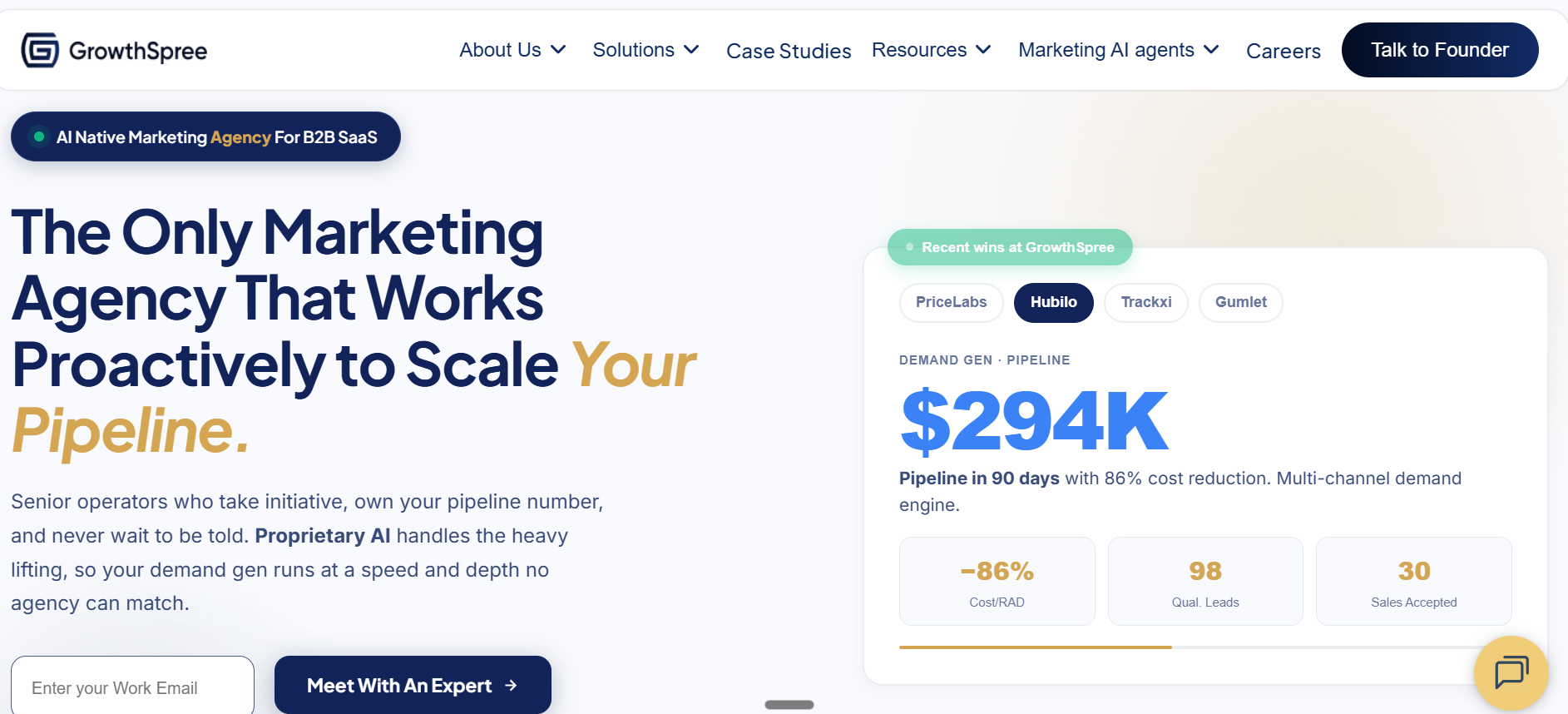
GrowthSpree is the strongest signal-based ABM option for early-to-mid stage B2B SaaS teams that need account targeting without the overhead of a full-tier ABM engagement.
Their QLA Signal Stack captures 15 or more intent signals, including job changes, funding announcements, deanonymised website visitors, LinkedIn ad viewers, and event data, then applies technographic and firmographic filters before activating both ABM outreach and paid ads from a unified CRM source.
The honest limitation: GrowthSpree's strength is in signal identification and paid ABM activation. Deep 1:1 buying committee mapping, account intelligence dossiers, and full RevOps attribution are not the core offering. If those are your priorities, RevvGrowth is the stronger fit.
Pros and Cons
Best for: Seed to Series A B2B SaaS companies that need affordable signal-triggered ABM with paid media activation and do not yet need deep 1:1 enterprise account orchestration.
3. TripleDart — Best for ABM Layered on an Organic Content Engine
TripleDart is a B2B SaaS-focused full-stack growth agency that runs ABM alongside SaaS SEO, product-led content, technical SEO, and paid media. Their OKR-based engagement model with variable compensation tied to performance is uncommon in the ABM category and signals real accountability orientation.
The limitation is the depth of 1:1 ABM execution. TripleDart is primarily an organic growth agency with ABM capability, not an ABM-first agency with organic support. For growth-stage SaaS teams whose biggest constraint is organic visibility plus basic account targeting, this combination works well.
Pros and Cons
Best for: Growth-stage SaaS teams that want account-level targeting layered onto a strong organic content engine.
4. Kalungi — Best for Early-Stage SaaS Teams Building Their First ABM Motion
Kalungi is built around a CMO-as-a-service model and the T2D3 SaaS growth playbook. For early-stage B2B SaaS companies that do not yet have senior marketing leadership, Kalungi provides the strategic direction, team structure, and execution capability to build a repeatable go-to-market motion from scratch, ABM included.
The honest limitation: Kalungi's ABM depth is tied to the CMO-as-a-service engagement model. Teams that already have strong marketing leadership and need a dedicated ABM execution partner, not a fractional strategic layer, will find RevvGrowth or Powered by Search a better fit.
Pros and Cons
Best for: Pre-PMF to Series A B2B SaaS companies that need their first go-to-market motion built properly before scaling account-level programs.
5. Powered by Search — Best for HubSpot-Native ABM and Pipeline Attribution
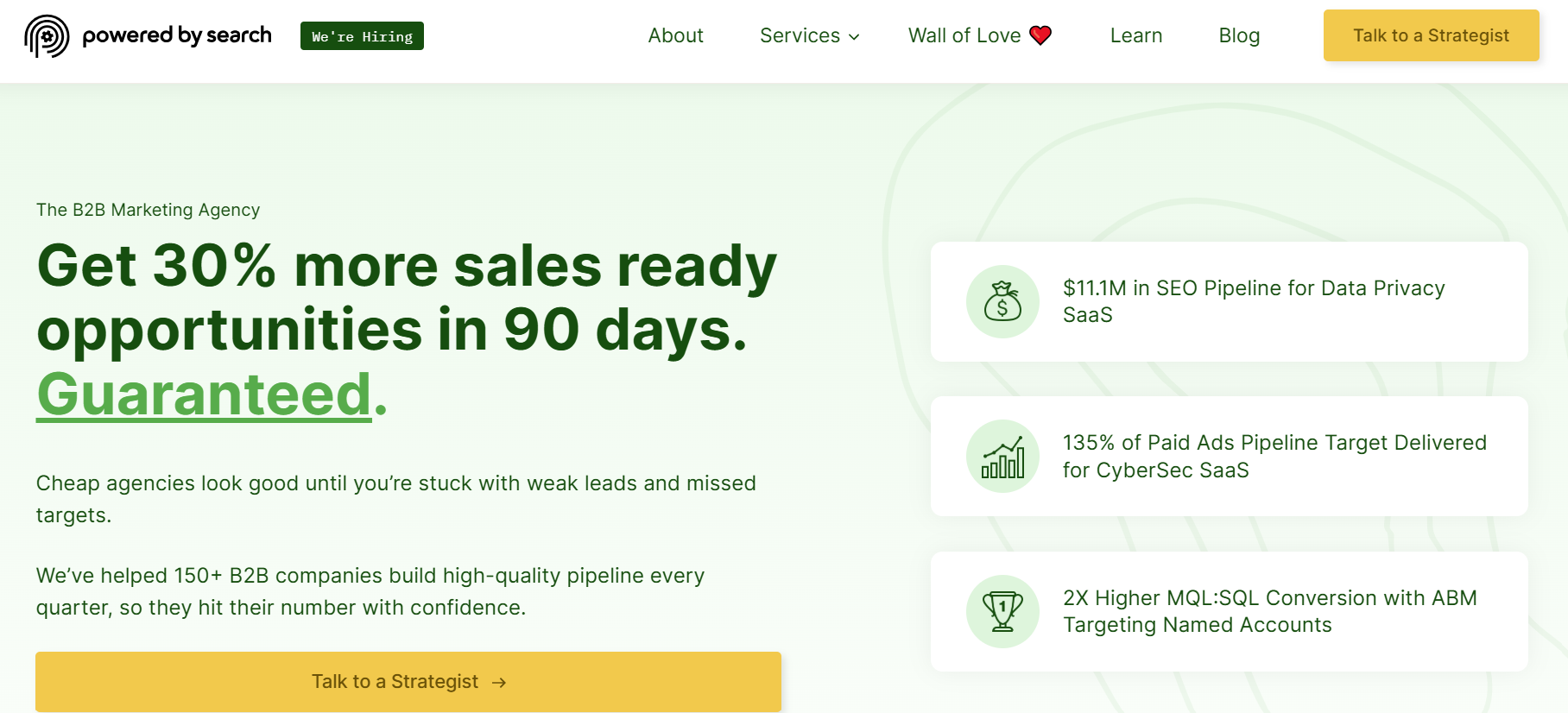
Powered by Search connects demand generation, SEO, paid media, ABM, and HubSpot RevOps into one motion. For B2B SaaS teams where HubSpot is the CRM and ABM attribution needs to survive from first touch through to closed-won inside that platform, Powered by Search has the deepest integration of any agency on this list.
The limitation is geography and scope. Powered by Search is most useful for North American HubSpot-centric teams. Teams with multi-system RevOps stacks, non-HubSpot CRMs, or global GTM motions may find the HubSpot-native model limiting. AI search visibility and deep 1:1 buying committee orchestration are also not the primary focus.
Pros and Cons
Best for: Series A to Series B B2B SaaS companies using HubSpot that need demand generation, ABM, and pipeline attribution working in the same system.
6. Directive Consulting — Best for Performance-First ABM at Mid-Market Scale
Directive Consulting built its reputation on shifting B2B SaaS marketing metrics from MQLs to a qualified pipeline. For funded SaaS companies that want ABM connected to paid acquisition efficiency, CAC tracking, and LTV optimisation, Directive has the reporting depth to make that connection visible.
The limitation: Directive is a performance marketing agency that has expanded into ABM, not an ABM agency that has added performance marketing. Deep buying committee mapping, personalised content per stakeholder role, and 1:1 account intelligence are not the primary offering.
For teams whose ABM constraint is ad performance and CAC, Directive is a strong fit. For teams whose constraint is pipeline quality and account engagement depth, RevvGrowth is the better choice.
Pros and Cons
Best for: Funded Series B+ SaaS teams that want ABM connected to paid acquisition efficiency, CAC tracking, and pipeline reporting against a defined account set.
7. Refine Labs — Best for Demand Creation Strategy Resets at Enterprise Scale
Refine Labs is the agency to call when your enterprise SaaS team has been over-optimised for form fills, low-intent leads, and last-touch attribution for so long that the entire demand strategy needs to be rebuilt. Chris Walker's dark funnel and demand creation philosophy is well-documented and well-respected, and Refine Labs executes it at mid-market and enterprise scale.
The honest limitation: Refine Labs is more advisory and strategic than execution-focused. Hands-on 1:1 ABM execution, account intelligence dossiers, buying committee mapping, SEO, paid media, and RevOps implementation require separate partners or significant internal capacity.
Pros and Cons
Best for: Mid-market and enterprise SaaS companies with internal execution capacity that need their demand creation strategy rebuilt from the ground up before scaling ABM programs.
8. Heinz Marketing — Best for Sales-Marketing Alignment and Pipeline Consulting
Heinz Marketing built the Predictable Pipeline Methodology around one core problem: marketing and sales cannot agree on what pipeline means, who owns what stage, or which activities actually drive revenue. For SaaS teams where the primary ABM failure is sales not trusting marketing's output, Heinz Marketing's structured alignment model addresses the root cause.
The limitation is execution depth. Heinz Marketing is a consulting and strategy firm that provides methodology and facilitation. Execution of ABM channels, content creation, paid media, and RevOps setup requires in-house capacity or additional agency partners. For teams that need a full execution partner, RevvGrowth is the stronger fit.
Pros and Cons
Best for: Series A to B SaaS companies where the primary ABM failure is sales not trusting marketing output, and where internal execution capacity exists once alignment is in place.
Which ABM Agency Fits Your Growth Stage?
The right ABM agency depends on where you are in your growth motion, not which agency has the most impressive website.
A $2M ARR Series A company should not hire an agency whose minimum engagement is $20,000 per month, regardless of how strong their case studies look. A $30M ARR Series C company running a 50-account enterprise program should not be on a $3,000 per month flat-rate platform plan.
Use this table to match your growth stage, pipeline priority, and budget to the right agency on this list.
Two things to watch for when applying this table.
First, do not start ABM before your ICP is validated. If you cannot describe your best customer in one sentence and match that description to a finite account universe, ABM spend will produce expensive noise. Fix positioning first.
Second, the stage labels above describe where most teams sit. If your sales cycle is 12 months and your ACV is above $100K, 1:1 ABM is justified earlier than the table suggests.
Also read → How to Build a SaaS ABM Strategy: 1:1, 1:Few & Beyond
What to Ask an ABM Agency Before Signing
Every agency on a discovery call will tell you they run full-funnel ABM with pipeline attribution and buying committee focus. The questions below separate the agencies that can deliver that from the ones that will show you a deck about it.
Ask: Can you show me a case study where named accounts moved from cold to pipeline in under 90 days?
Vague timeline references do not count. You want a named client, a defined account list, a documented timeline, and a pipeline number you can verify. If the answer is approximate or anonymised, that is a signal about what the reporting looks like on active engagements.
Ask: How do you map buying committees? How many stakeholders per account, and which tools?
The answer reveals whether they actually do ABM or account-targeted demand gen. A genuine ABM agency can tell you they use LinkedIn Sales Navigator and ZoomInfo to map 6 to 10 stakeholders per 1:1 account, document each one's role, influence level, intent signals, and recommended approach, and build that into the content and channel plan before any outreach starts.
Ask: What does your attribution model look like when the deal closes 9 months later?
This is where most ABM agencies go quiet. If attribution ends at MQL handoff, the pipeline reporting will not survive the sales cycle. You need an agency that connects ABM activity to CRM lifecycle stages, tracks influence through the opportunity stage, and can show closed-won contribution at a named-account level 6 to 9 months after first touch.
Ask: Who actually runs my program day-to-day?
The bait-and-switch is the most common complaint across every review platform for ABM agencies. The senior strategist sells the engagement. The junior associate runs it. Ask for the specific person who will manage your account, their experience level, how many other accounts they run simultaneously, and what the escalation path looks like. If the answer is vague, that is the answer.
Ask: How are you building for accounts that self-research on AI tools before talking to sales?
In 2026, buying committees at your named accounts are asking ChatGPT and Perplexity which vendors to evaluate before any sales contact is made. If your ABM agency does not understand how to build GEO and AEO content to influence those AI-generated shortlists, your outreach is landing into accounts that have already been shaped by your competitors' positioning. Ask specifically what they do about AI citation at named accounts.
Conclusion and Key Takeaways
The 8 agencies on this list serve very different needs. Use this as a quick decision filter:
- If you are a growth-stage B2B SaaS company between $1M and $20M ARR, RevvGrowth or GrowthSpree will give you the strongest fit. RevvGrowth connects ABM to SEO, AEO, GEO, paid media, and RevOps in one motion with documented pipeline proof. GrowthSpree is the right call if the budget is tight and signal-based execution is the priority.
- If you are Series A to Series B and already on HubSpot, Powered by Search has the deepest HubSpot RevOps integration on this list and connects demand gen, ABM, and pipeline attribution inside the same platform.
- If you need your first ABM motion built from scratch and do not yet have senior marketing leadership in-house, Kalungi's CMO-as-a-service model gives you the GTM architecture before the account-level execution begins.
- If you are enterprise-stage and need your demand creation strategy rebuilt from the ground up, Refine Labs or Heinz Marketing are the right advisory partners — provided you have internal execution capacity once the strategy is in place.
- If your highest priority is paid acquisition efficiency with ABM layered on top, Directive Consulting is the strongest option for funded mid-market teams focused on CAC and LTV at scale.
- Budget reality check. Real ABM starts at $8K to $10K per month for growth-stage programs. Anything below that is paid social or account-targeted demand gen with an ABM label. 1:1 enterprise ABM with full buying committee orchestration runs $20K to $75K per month, depending on account volume and tier mix.
- Sales alignment beats agency choice. The most common reason ABM programs fail is not the agency. It is sales not working with the engaged accounts. Get sales leadership aligned on shared pipeline definitions, account tier criteria, and weekly standups before you sign with anyone.
- Ignore the "full-funnel ABM" claims on every agency website. Look for named case studies with pipeline numbers tied to a specific program and a specific timeline. Ask who will actually run your account day-to-day. The bait-and-switch, senior strategist sells, junior associate, executes, is the most common complaint across every ABM agency review platform.
The right agency is rarely the most visible one. It is the one that matches how your business actually sells, which accounts you are targeting, what your ACV justifies, and which part of the pipeline motion is broken right now.
At RevvGrowth, we run ABM programs that help growth-stage B2B SaaS companies identify, engage, and convert high-value accounts through buying committee mapping, account intelligence, multi-channel orchestration, and RevOps attribution tied to a closed-won pipeline.
.svg)


.webp)
.avif)