


Introduction
Running an ABM campaign without the right ABM metrics is like training for a marathon with the wrong fitness tracker.
Imagine spending months preparing—running every day, tweaking your diet, and pushing your endurance—only to realize you’ve been tracking steps, not miles. You feel like you’ve put in the work, but when race day comes, you’re nowhere near the finish line.
That’s exactly what happens when SaaS companies invest in ABM but measure the wrong KPIs. Sure, your team might be excited about high engagement rates and growing social impressions, but if those numbers don’t translate into pipeline velocity and closed deals, they don’t mean much.
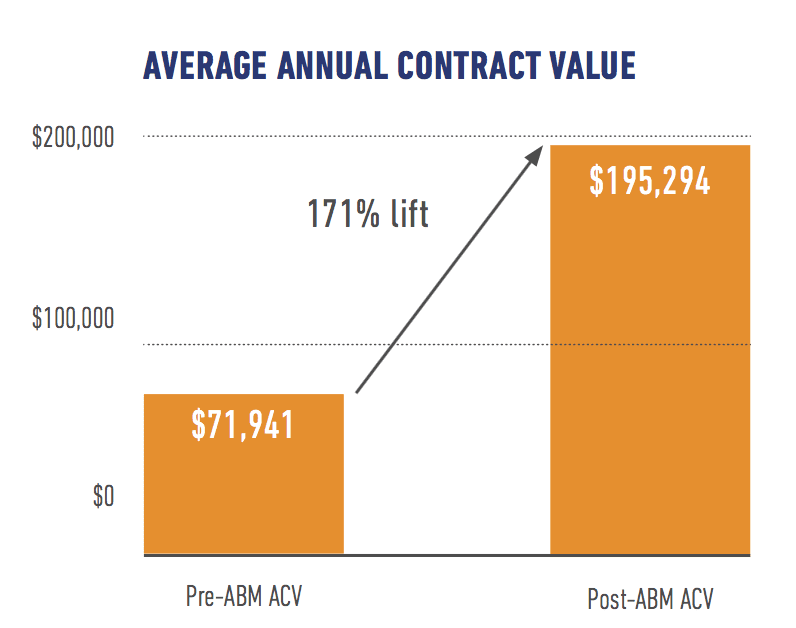
An ABM Alliance Research Shows that companies that have implemented ABM have seen a lift in average annual contract value of 171%.
"Same is lame, which is why ABM works so well. It breaks through the clutter." — Jay Baer, Hall of Fame Keynote Speaker and Founder of Convince & Convert. ABM isn’t about getting more leads—it’s about deepening relationships with the right accounts and driving revenue. And to prove that your strategy is working, you need to track the right performance metrics. So, in this blog, I’ll break down 13 key ABM metrics that matter—so you can track what really drives revenue and optimize your strategy accordingly. So, what should you be measuring instead? Let’s break down 13 key ABM metrics that actually matter for your SaaS success.
ABM isn’t about getting more leads—it’s about deepening relationships with the right accounts and driving revenue. And to prove that your strategy is working, you need to track the right performance metrics.
So, in this blog, I’ll break down 13 key ABM metrics that matter—so you can track what really drives revenue and optimize your strategy accordingly.
What are ABM Metrics and Why Do They Matter?
ABM metrics are account-level performance indicators that measure how effectively you engage, influence, and convert high-value target accounts.
Unlike traditional marketing metrics that focus on individual leads, ABM metrics evaluate engagement and progression at the account level. That shift is critical. In B2B SaaS, decisions are rarely made by one person.
Buying committees include multiple stakeholders across departments, budgets, and priorities. Measuring individual activity does not reflect real buying intent.
ABM metrics matter because they:
- Show how deeply target accounts are engaging with your brand
- Reveal whether buying committees are fully penetrated
- Indicate how quickly opportunities are progressing
- Quantify revenue influence from ABM programs
- Align marketing and sales around shared pipeline goals
Without clear ABM metrics, teams default to vanity indicators. That creates false confidence and misaligned strategy. When you track the right KPIs, you gain visibility into what actually drives pipeline movement and revenue growth.
13 key ABM metrics to measure your SaaS success
Here are 13 essential ABM metrics every SaaS company should track to optimize campaigns, align sales and marketing, and prove real business impact:
- Target Account Engagement – Are your high-value accounts actively engaging with your brand?
- Account Coverage – How well are you reaching key stakeholders within target accounts?
- Pipeline Velocity – How fast are deals moving through your pipeline?
- Deal Size (ACV) – Are your ABM efforts increasing the value of closed deals?
- Win Rate – What percentage of targeted accounts convert into customers?
- Customer Lifetime Value (CLTV) – Are you acquiring and retaining high-value customers?
- Account Retention Rate – Are your ABM accounts staying with you over time?
- Marketing Qualified Accounts (MQA) – How many accounts are engaging at a meaningful level?
- Sales Qualified Accounts (SQA) – How many MQAs are progressing into sales conversations?
- Influence on Revenue – How much of your revenue can be attributed to ABM efforts?
- Engagement by Account Tier – Are your highest-value accounts engaging more deeply?
- Content Engagement by Account – Which content formats and topics are driving the most impact?
- Return on Investment (ROI) – Is ABM delivering measurable business growth?
Let us understand these KPIs in detail:
1. Target Account Engagement
If your target accounts aren’t engaging, your ABM strategy isn’t working. It’s that simple. Too often, I see SaaS founders measuring the wrong things—click-through rates, website visits, even social likes. But none of these truly tell you if your ideal customers are meaningfully interacting with your brand. Target Account Engagement is about tracking the depth and quality of engagement across multiple touchpoints. Are decision-makers consuming your content, attending your webinars, revisiting your site, or taking that next step in the buying journey?Here’s what you want to ultimately figure out:
- How (and if) your target accounts are interacting with your content
- What kind of content is pulling in more new accounts
- Which piece of content is working and which isn’t
- What kind of content do your existing customers like
- Define what exact action you’ll call engagement
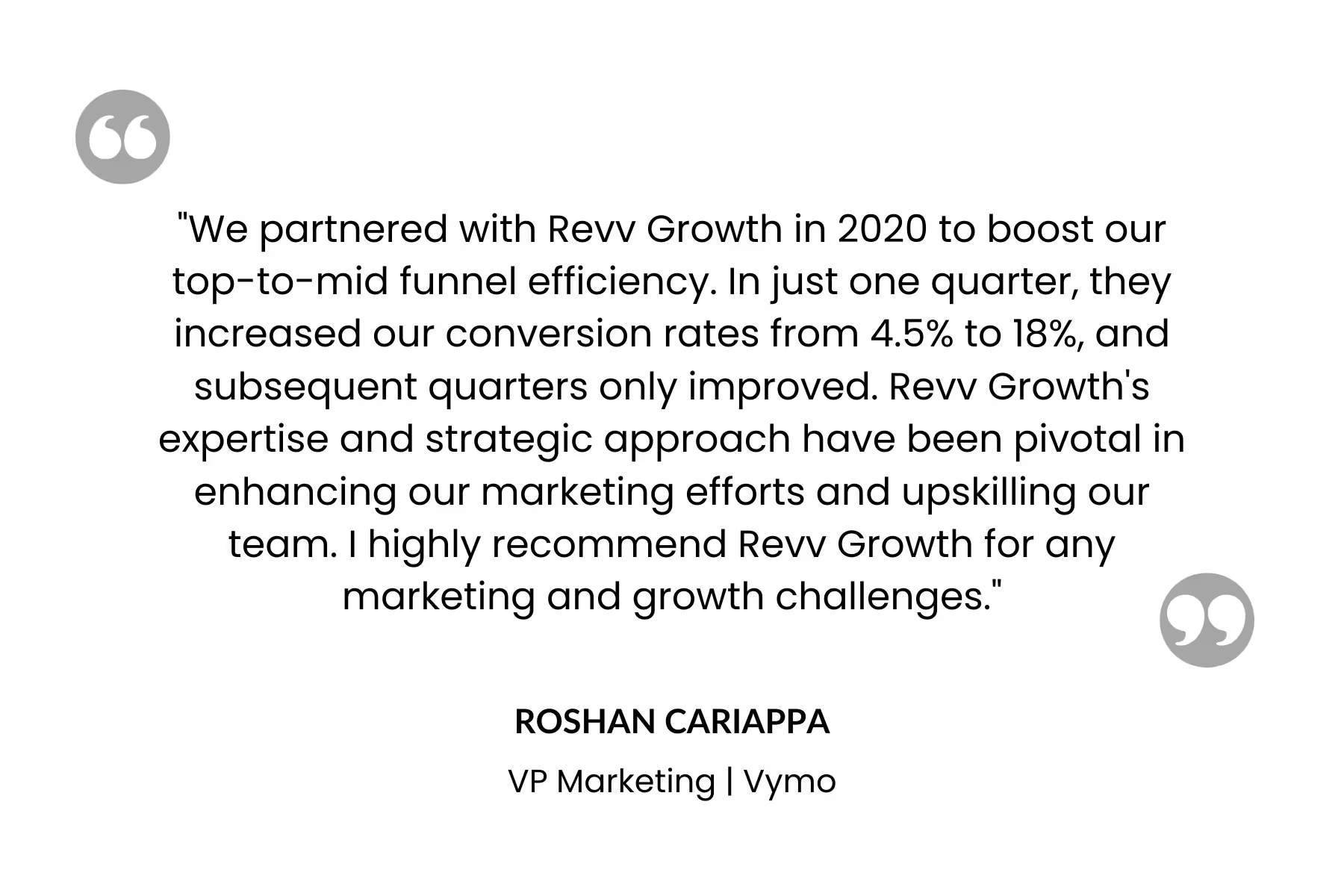
When we worked with Vymo, a sales engagement platform, they struggled to engage key decision-makers. Despite a solid ABM strategy, pipeline movement was slow. We tackled this by:
- Launching LinkedIn lead gen campaigns with high-value content
- Retargeting website visitors to re-engage lost opportunities
- Using multi-threaded outreach to engage multiple stakeholders
- Building hyper-personalized email sequences for 250 decision-makers
The results?
- $21M marketing-sourced pipeline
- 500 MQLs generated
- 2% increase in engagement across target accounts
If you’re still measuring email open rates as a success metric, it’s time to rethink your approach. Engagement isn’t about surface-level interest—it’s about tracking real buyer intent.
- Are decision-makers returning to your site?
- Are they sharing your content internally?
- Are multiple stakeholders from the same account engaging?
These are the signals that truly matter. If engagement isn’t driving pipeline for you, it’s time to rethink your ABM strategy. Let’s fix it. Book a call with RevvGrowth today and let’s make engagement work for revenue.
To boost Target Account Engagement further, integrating AI-driven predictive analytics can help identify high-potential accounts based on behavioral data, enabling hyper-targeted campaigns that speak directly to buyer intent. Also, employing account-specific video content has shown to increase engagement rates by up to 30%, making the buyer's journey more interactive and personalized.
2. Account Coverage
The success of account-based marketing campaigns doesn’t lie in what kind of account information you generate. It lies in how well you leverage that information. Account coverage is an ABM metric that shows you the gap between the information you have on each target account and the impact you create with that information. If you have identified the key stakeholders and decision-makers, and have personalized content for each of them during their journey, then your content will make an impact. LiveRamp, a leader in data connectivity, implemented a focused ABM strategy by targeting just 15 top-tier clients that matched their ideal customer profile.

By concentrating their efforts on this select group, they achieved a staggering 33% conversion rate in just four weeks. Over two years, their customer lifetime value skyrocketed by 25 times. The two key ratios to look for are:
- Number of perfect-fit accounts you have begun engaging, as a percentage of total perfect-fit accounts you have been able to identify, and
- Influencers and decision-makers you’re currently engaging, as a percentage of the total influencers and decision-makers at the target account
The biggest mistake I see? Focusing too much on growing the contact list instead of engaging the right people. More names don’t mean more conversions. You need deep, meaningful engagement with decision-makers who can actually move the deal forward.
Emerging tools leveraging intent data integration enable marketers to capture real-time signals from target accounts, thereby boosting Account Coverage accuracy by 18%, ensuring no key stakeholder is left unengaged during critical buying phases.
3. Pipeline Velocity
Pipeline velocity measures how fast your target accounts move through the sales funnel—from first touch to closed deals. The faster your pipeline, the quicker you recognize revenue.
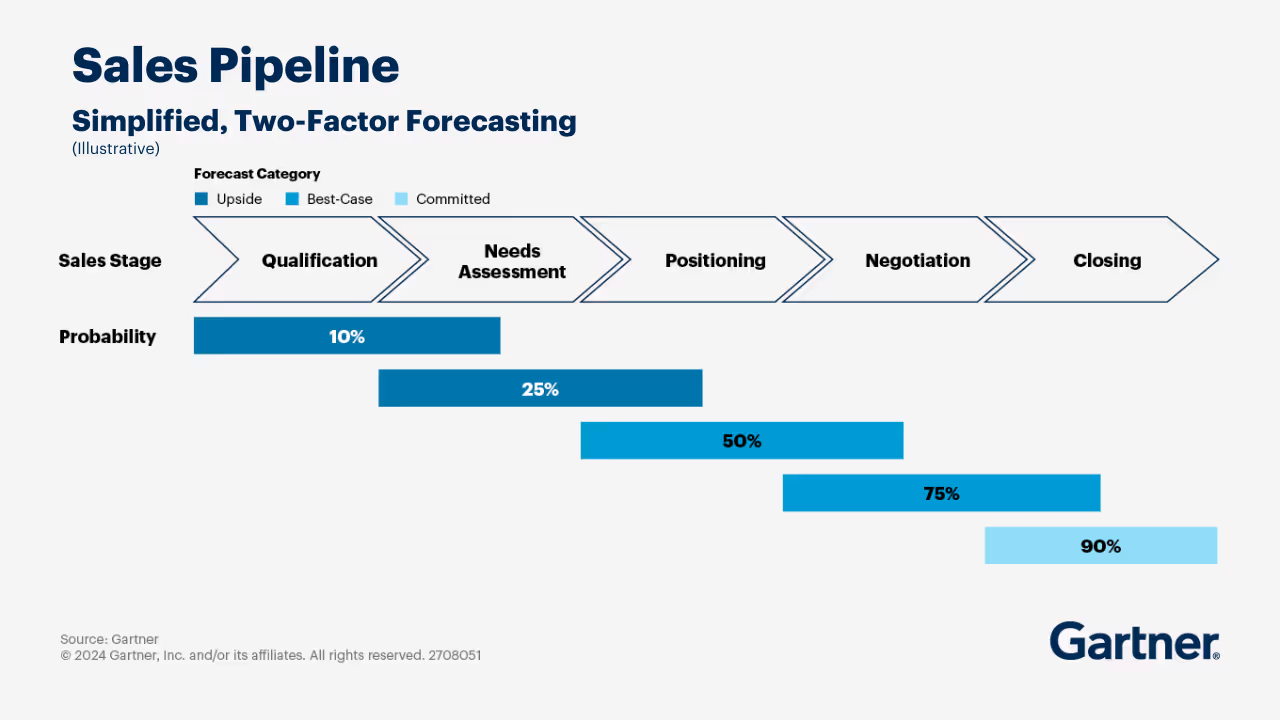
Here’s what you have to figure out:
- Are deals stalling at a specific stage?
- How long does it take for an engaged account to become a closed-won deal?
- Which touchpoints help accelerate decision-making?
A slow pipeline means lost momentum, longer sales cycles, and missed revenue opportunities. Organizations that prioritize sales pipeline quality are 2x more likely to exceed customer acquisition expectations, according to Gartner.
To speed things up:
- Engage multiple decision-makers early
- Personalize content for each buying stage
- Use intent data to prioritize high-interest accounts
- Remove friction in the buying process
Remember, faster-moving deals mean a more effective ABM strategy. If accounts are engaging but not progressing, it’s time to refine your approach.
Recent studies highlight that automating pipeline reporting with AI-driven sales analytics tools can reduce pipeline velocity delays by 25%, providing sales teams with actionable insights on deal risks and next best actions, thus accelerating deal closure significantly.
4. Deal Size (Average Contract Value - ACV)
Deal size, or Average Contract Value (ACV), is one of the key ABM metrics that tells you how much revenue you’re generating per account annually. It’s a direct reflection of how well your ABM strategy is attracting and converting high-value customers.91% of companies using ABM increase their average deal size, with 25% reporting an increase of +50%.In ABM, the goal isn’t just to close deals—it’s to close bigger, multi-year, high-value deals by engaging multiple stakeholders and aligning your solution with broader business needs. Here’s what you have to figure out:
- Are your ABM-targeted accounts signing larger contracts compared to non-ABM accounts?
- Is your personalization leading to upsells, cross-sells, or longer contract terms?
- How does your ACV compare to industry benchmarks?
If your ACV isn’t increasing, it may be a sign that your targeting is too narrow, your pricing strategy isn’t optimized for enterprise deals, or your value proposition isn’t strong enough for multi-year commitments. The key is to engage the right people at the right time with the right offer.
5. Win Rate
Win rate is one of the most critical ABM metrics because it tells you how effective your strategy is at converting opportunities into actual revenue. A high win rate means your targeting is accurate, sales and marketing are aligned, and your messaging is resonating. According to Hubspot, 86% of marketers say ABM improves their win rates. According to Forrester’s research, 90% of professionals in these groups say they are misaligned on strategy, process, content, and culture. And 98% and 97% of sellers and marketers, respectively, think this poor alignment negatively impacts the business and the customer. A low win rate, on the other hand, is a sign that something is broken—either you’re targeting the wrong accounts, engaging them too early, or failing to address key decision-makers' concerns. Here’s what you have to figure out:
- Are your ABM accounts closing at a higher win rate than non-ABM accounts?
- At which stage do most deals drop off, and why?
- Is sales engaging with the right stakeholders at the right time?
If your win rate is low, check if your ABM qualification process is too loose, if your outreach is generic, or if you’re failing to engage the full buying committee. The more precise and timely your engagement, the better your chances of winning deals. Snowflake, a data cloud company, exemplifies how a focused ABM strategy can boost win rates. They leverage intent data to prioritize accounts, tailor outreach, and unify their sales and marketing efforts. Snowflake connects with prospects during 100% of the buyer journey. Before using intent data, they connected during the last 40%
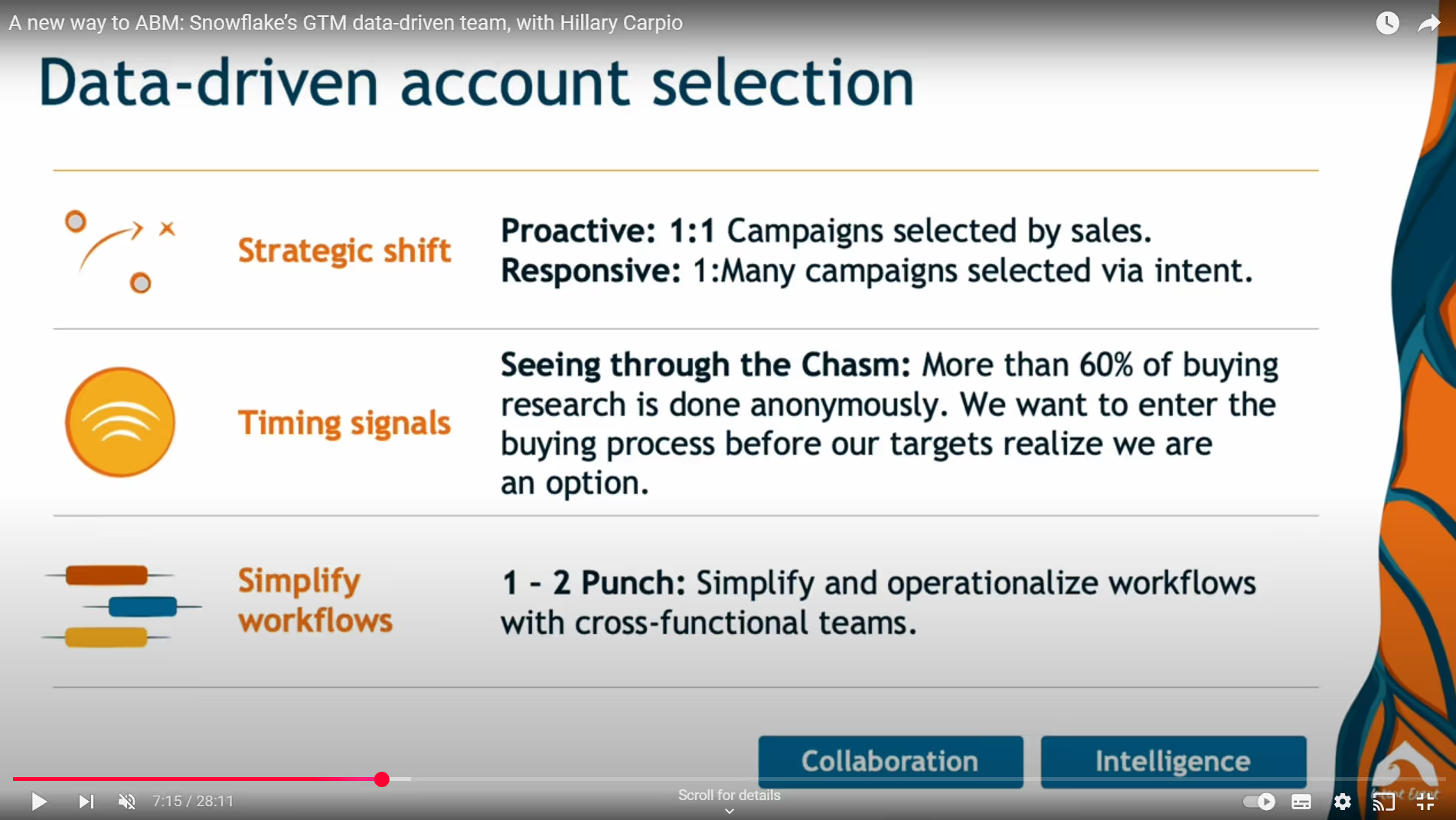
Snowflake focuses on collaboration, intelligence, and simplification in their ABM approach. Their ABM strategy led to a 3x higher campaign attendance rate and a 50% faster move from opportunity to closed/won.
6. Customer Lifetime Value (CLTV)
Customer Lifetime Value (CLTV) is the ultimate measure of long-term success in ABM. Winning the deal is just the start—what matters is how long an account stays, how much they expand, and how much they contributes to your revenue over time. Here’s what you have to figure out:
- Are ABM accounts renewing and expanding their contracts at a higher rate than non-ABM accounts?
- What’s the average retention period for high-value customers?
- How does your CLTV compare to your customer acquisition cost (CAC)?
If your CLTV is low, it’s a sign that you’re winning the wrong accounts, failing to engage them post-sale, or not providing enough opportunities for expansion. According to Hubspot, 80% of marketers say ABM improves customer lifetime values. Hexagon used ABM strategies to boost customer engagement and increase customer lifetime value (CLTV). By leveraging insights from Demandbase, they saw:
- 60% engagement from target accounts
- 49% increase in page views with personalized content
- 278% higher click-through rates on tailored ads
These improvements led to higher contract renewals and expansions, driving significant CLTV growth.
Modern CLTV analysis is enhanced by predictive analytics modeling that forecasts contract renewals and expansion likelihood, allowing sales teams to proactively nurture high-risk accounts, thereby potentially increasing retention rates by up to 15%.
7. Account Retention Rate
No collection of ABM metrics can be said to be complete without a Customer Retention Rate. Yes, ABM conversion rates are the one metric you should always keep your eyes on. But don’t forget to retain existing customers.
Why Customer Retention Matters
Sales and marketing alignment boosts retention:
- Companies with strong marketing and sales alignment are 67% more effective at closing deals, and their customer retention rates improve by 36%.— Marketo & ReachForce
- It costs five times more to acquire a new customer than to retain an existing one, according to Forbes.
B2B sales cycles allow for stronger relationships:
- B2B sales take longer than B2C, giving more time to build relationships and ensure retention.
- Existing customers already trust your brand—leverage this trust to strengthen engagement.
For example, to customers who are already using your solutions, you can ask for their feedback. How happy are they with your solution? What is the overall adoption of your solution in their organization? Are there features they aren’t fully using? And because they’re already using your solution, you have a tremendous lead. So don’t forget: you should always watch out for cross-selling and upselling opportunities to existing customers. After all, retention doesn’t mean you should stagnate; as the customer grows, make sure your sales opportunities grow too.
8. Marketing Qualified Accounts (MQA)
If you're running an ABM campaign, Marketing Qualified Accounts (MQAs) are one of the most important metrics to track. Unlike traditional Marketing Qualified Leads (MQLs), which focus on individual contacts, MQAs measure entire accounts showing buying intent. According to Gartner, ABM lifts several key sales metrics:
- 28% increase in overall account engagement.
- 25% rise in MQL to SAL conversion rates.

Here’s what you have to figure out:
- How many accounts are actively engaging with your content, ads, or sales outreach?
- Are these accounts consistently consuming high-intent content like product pages, case studies, or ROI calculators?
- How many touchpoints does it take before an account moves into sales-qualified status?
However, not all engagements should qualify an account as MQA. Just because someone from an account downloaded a whitepaper doesn’t mean they’re ready for sale. Set clear intent signals—multiple stakeholders engaging with high-value content, frequent return visits, or specific actions like requesting a demo. If your MQAs aren’t converting, you might be focusing on the wrong engagement signals or missing key decision-makers in your outreach. ABM isn’t just about generating interest—it’s about ensuring the right accounts are moving down the funnel.
9. Sales Qualified Accounts (SQA)
Once an MQA shows strong enough buying intent, it becomes a Sales Qualified Account (SQA). This is the moment when your marketing team hands over an account to sales because it’s ready for a conversation. Here’s what you have to figure out:
- How many MQAs are turning into sales conversations?
- Are you engaging the right decision-makers before passing the account to sales?
- What are the common reasons why accounts stall at this stage?
Here’s where most companies go wrong: They assume an MQA is ready for sale after just one or two interactions. But ABM is a multi-stakeholder game. If only one person from an account engages, the deal is still fragile. A good SQA should have multiple engaged decision-makers and clear intent signals before sales steps in. Companies implementing ABM strategies have reported a 67% improvement in closing deals when sales and marketing teams are synchronized. If your SQAs aren’t converting, it might be because they lack depth in engagement, your sales team isn’t following up fast enough, or your ABM campaigns aren’t engaging the full buying committee. The key is not just to qualify accounts, but to ensure they’re primed for conversion when they hit sales.
10. Influence on Revenue
At the end of the day, ABM isn’t just about generating engagement—it’s about driving real revenue impact. Influence on revenue measures how much of your closed-won deals can be directly attributed to your ABM efforts.“ABM works. Done right, ABM leads to significantly higher ROI than any other marketing approach.” — Bev Burgess, an SVP and ABM Practice Leader at Momentum ITSMA Here’s what you have to figure out:
- How much of your total revenue comes from ABM-targeted accounts?
- Are ABM accounts closing faster and at a higher deal size compared to non-ABM accounts?
- Which ABM campaigns had the biggest impact on revenue growth?
If your ABM efforts aren’t showing a clear impact, it’s time to rethink your account selection, engagement strategy, or sales alignment. One mistake? Only tracking first- and last-touch attribution. ABM is a multi-touch journey, so if you’re not connecting content engagement, ad clicks, and executive outreach to revenue, you’re missing the full picture.ABM should help you land bigger deals, faster. If you can’t tie it to revenue, it’s just another marketing campaign. But here’s the challenge: Revenue influence isn’t just about direct attribution. Some ABM campaigns work by warming up accounts months before they enter the pipeline.
If you only track direct conversions, you’ll miss out on the true impact.76% of marketers get a higher ROI with ABM than they do with any other form of marketing. If your ABM revenue influence is low, it could mean your targeting isn’t precise enough, your engagement isn’t multi-threaded across decision-makers, or your ABM isn’t aligned with sales efforts. Make sure to track pipeline contribution, deal acceleration, and revenue impact—not just initial touches.
11. Engagement by Account Tier
Not all accounts are created equal. That’s why tiering your accounts—based on revenue potential, strategic fit, or likelihood to close—is crucial for ABM's success. Engagement by account tier measures whether your highest-value accounts are engaging at the level they should be. According to Demandbase, 83% of marketers report that ABM intensifies engagement with target accounts. Here’s what you have to figure out:
- Are Tier 1 accounts engaging more deeply than lower-priority accounts?
- Do different account tiers respond better to different content formats?
- Is your ABM budget being allocated effectively across account tiers?
If you’re not seeing strong engagement from your highest-value accounts, you might be spreading your efforts too thin, failing to personalize outreach, or missing key decision-makers in larger deals.
12. Content Engagement by Account
Creating content isn’t enough. You need to ensure the right people are engaging with it. Here’s what you have to focus on:
- What types of content (case studies, ROI reports, webinars) drive the most engagement?
- Are decision-makers consuming high-intent assets like pricing pages and competitor comparisons?
- How many engaged accounts are converting into pipelines?
A lot of teams make the mistake of tracking vanity metrics—website visits, social shares, or general blog traffic. But if your target accounts aren’t the ones engaging, it doesn’t move the needle.
- 61% of marketers tailor content to specific industries, enhancing relevance and engagement.
- 42% of marketers personalize content to boost account engagement and foster long-term relationships. (Forrester)
HubSpot uses tailored case studies and ROI reports to engage decision-makers in the marketing industry. By tracking metrics like time spent on high-intent assets, they can measure whether engaged accounts are moving into the pipeline. If not, HubSpot refines their content or targeting strategy. ABM is about precision. If your best content isn’t reaching high-value accounts, it’s time to optimize your content strategy.
Incorporating interactive content formats such as personalized calculators and augmented reality demos has been shown to increase content engagement rates by up to 45%, creating more immersive and memorable buyer experiences.
13. Return on Investment (ROI)
Your earnings, expressed as a percentage of your investment, is your Return on Investment or ROI. This ABM metrics seeks to gauge how well you’ve been deploying your funds, and that’s why it remains one of the most widely used and quoted metrics.84% of marketers feel their ABM efforts have been very/ extremely successful over the past 12 months. While 87% of B2B marketers said that the ROI of ABM initiatives outperforms other marketing investments. (Foundry)
In many cases, it’s not as easy as it sounds. What costs do you attribute to purely marketing? What exactly is the return? How should you factor the period between the time you began investing and the time you began to see results?
Despite all these quantitative challenges, ROI gives you a pretty accurate picture of how your campaigns are doing. Along with the ROI, it’ll help if you ask three questions:
- Is ABM making it easier for your reps to connect with the target accounts?
- Are your channels nurturing your target accounts faster than before?
- Are you seeing a rise in inbound demand?
If your answer to each of the above is a clear ‘Yes’, you can be sure you are achieving a good ROI.
How to Measure and Analyze ABM Metrics
Measuring ABM performance is not about collecting numbers. It is about building a system that connects account engagement to pipeline movement and, ultimately, revenue.
In account-based marketing, activity without context is misleading. A spike in engagement may look promising, but if it does not translate into opportunity progression or deal acceleration, it has limited business value. That is why ABM measurement must be structured, account-centric, and tied directly to revenue outcomes.
Below is a consolidated view of the core ABM metrics, including formulas and examples for practical application.
Core ABM metric formulas:
Track leading and lagging indicators together
To fully understand ABM performance, you must monitor both predictive and outcome-based metrics.
Leading indicators signal future pipeline potential:
- Target account engagement
- Account coverage
- MQA rate
- Content engagement
These metrics show whether buying committees are interacting meaningfully and progressing.
Lagging indicators confirm realized business impact:
- Win rate
- ACV
- CLTV
- Revenue influence
- ROI
If engagement rises but revenue does not follow, the issue may lie in qualification, targeting, or sales execution. Measurement should reveal those gaps early.
Build unified, account-level dashboards
ABM cannot be measured effectively in silos. Data must be integrated across CRM, marketing automation, sales engagement platforms, and ABM tools.
A strong dashboard should display:
- Engagement depth per account
- Number of stakeholders engaged
- Funnel stage progression
- Opportunity value
- Revenue contribution from ABM accounts
This provides a single source of truth and eliminates fragmented reporting.
Analyze progression, not just engagement
High activity does not equal success.
The real question is whether engagement leads to:
- Faster pipeline velocity
- Larger deal sizes
- Higher win rates
- Reduced sales cycles
Account-level progression reveals whether ABM is influencing decisions. Isolated activity metrics only show surface interest.
Review metrics on a structured cadence
Consistent review cycles improve optimization:
- Weekly reviews for engagement and stakeholder penetration
- Monthly reviews for pipeline movement and opportunity health
- Quarterly reviews for revenue influence and ROI
This cadence keeps teams agile while maintaining focus on long-term growth.
When measured and analyzed properly, ABM metrics do more than justify marketing spend. They provide visibility into account health, deal progression, and revenue impact. That visibility enables smarter targeting, stronger sales alignment, and more predictable growth.
Best Practices for Optimizing ABM Metrics
Tracking ABM metrics is important, but optimization is where performance improves. The goal is not to report numbers but to use them to refine targeting, engagement depth, and revenue impact over time.
1. Align sales and marketing on shared definitions
Optimization starts with alignment. Sales and marketing must agree on what qualifies as engagement, when an account becomes an MQA, and what defines sales readiness. Clear definitions prevent reporting gaps and ensure that improvements in metrics translate into real pipeline growth.
2. Prioritize account quality over volume
If engagement and win rates are underperforming, the issue often lies in account selection rather than campaign execution. Reassess your ideal customer profile, firmographic filters, and tiering strategy. Improving account quality strengthens every downstream metric, including deal size and retention.
3. Strengthen multi-stakeholder engagement
Enterprise decisions involve multiple stakeholders. Engaging only one contact within an account limits conversion potential. Expanding outreach across departments increases account coverage, reduces deal risk, and improves win probability.
4. Connect engagement signals to stage progression
High engagement should result in measurable pipeline movement. Analyze whether increased activity correlates with faster stage transitions or opportunity creation. If engagement does not influence progression, refine your messaging, personalization depth, or follow-up timing.
5. Analyze performance by account tier
Not all accounts carry equal revenue potential. Tier 1 accounts should demonstrate stronger engagement and faster deal progression than lower-priority tiers. If this pattern does not hold, resource allocation may need adjustment.
6. Establish structured review cycles
Consistent review enables continuous improvement. Weekly engagement reviews help refine campaigns quickly, while monthly and quarterly pipeline and revenue analyses validate strategic impact. This structured rhythm keeps optimization focused on outcomes rather than isolated activities.
7. Use win-loss insights to refine strategy
Closed deals provide valuable signals. Analyze successful opportunities to identify patterns in stakeholder coverage, engagement depth, and content influence. Apply those insights to improve targeting and qualification criteria across future campaigns.
8. Invest in integrated reporting systems
Optimization depends on unified visibility. Integrating CRM, marketing automation, and ABM platforms ensures accurate account-level reporting. A centralized dashboard allows teams to detect performance gaps early and adjust strategy proactively.
Why traditional marketing metrics don't work for ABM
Traditional metrics like MQLs, click-through rates, and website traffic paint an incomplete picture of ABM's success. Here's why these vanity metrics fall short:
- Individual vs. Collective Focus: Traditional metrics track isolated actions rather than account-level engagement. This misses the complex dynamics of how buying committees make decisions within target organizations.
- Wrong Success Indicators: While high MQL counts and website visits might look impressive in reports, they fail to capture what truly matters in ABM—the depth and quality of relationships with high-value accounts.
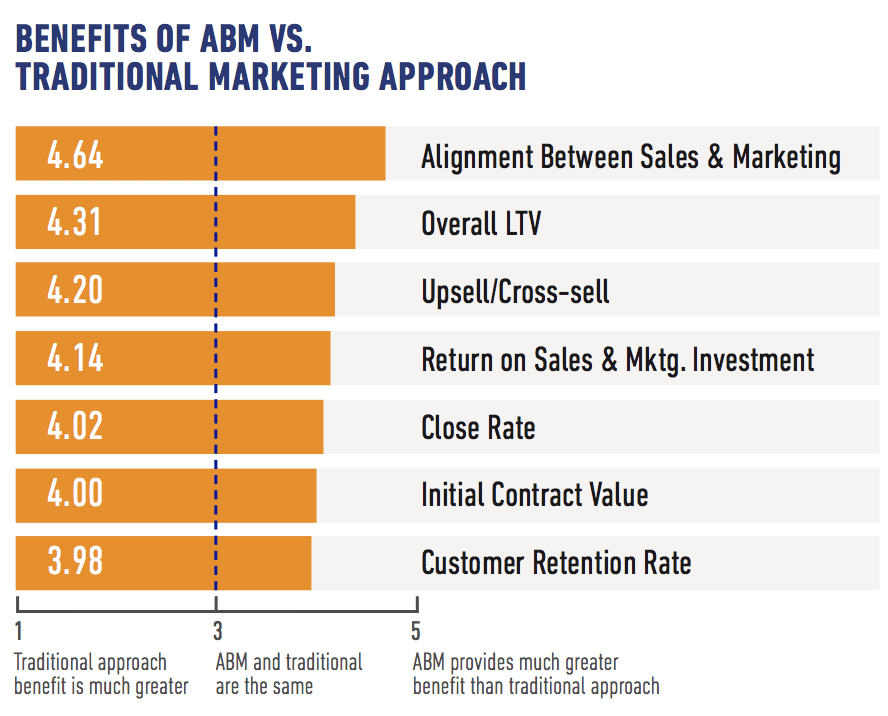
The ABM Difference
ABM represents a fundamental shift from traditional demand generation. Instead of casting a wide net, you're:
- Targeting Precision: Focusing resources on specific high-value accounts that align with your ideal customer profile
- Relationship Building: Nurturing deep connections across multiple stakeholders within each account
- Sales-Marketing Alignment: Creating unified strategies to engage and influence entire buying committees
According to Forrester’s Demand, ABM, And Customer Marketing Survey 2023, 99% of those with an ABM team said that their ABM programs delivered higher ROI versus their traditional marketing programs. Success in ABM requires an account-centric measurement approach that tracks:
- How key accounts engage with your brand over time
- The deepening of relationships across the buying committee
- Most crucially, the direct impact on closed revenue
Key Takeaways
Account-based marketing delivers results when measurement is tied directly to revenue impact. Tracking the right metrics ensures your strategy stays focused on high-value accounts rather than surface-level activity.
ABM performance should always be evaluated at the account level. Individual lead metrics do not reflect buying committee engagement or deal readiness. Depth of engagement and stakeholder coverage matter more than volume.
Leading indicators such as engagement and account coverage help predict pipeline growth. Lagging indicators such as win rate, ACV, CLTV, and ROI confirm whether that engagement translated into measurable business outcomes.
Optimization requires alignment between sales and marketing. Shared definitions, unified dashboards, and structured review cycles ensure that improvements in metrics drive real pipeline acceleration.
When tracked and analyzed properly, ABM metrics do more than report performance. They provide clarity on account health, deal progression, and long-term revenue growth, turning ABM into a predictable and scalable growth strategy.
Want to build an ABM strategy that actually drives revenue? Let’s make it happen.
Book a call with Revv Growth today, and let’s map out a winning ABM strategy for your SaaS business!