


You do not need AI across your entire marketing function to see value. The best place to start is where your team already feels the most friction.
AI can make those workflows easier to manage by reducing repetitive effort and surfacing clearer signals for action. Your team gets more room to focus on judgment, strategy, and the work that still needs a human call.
This guide shows where AI fits into your current marketing process, which systems are worth considering, and how to introduce them with control and measurable impact.
What are the benefits of AI in marketing?
The benefits of AI in marketing show up when teams use it to make faster, more precise decisions across targeting, content, advertising, and customer engagement. For B2B SaaS teams, the strongest gains come from combining AI with connected data, clear workflows, and experienced review so improvements can be tied back to conversion and revenue.
1. Personalization, segmentation, and customer targeting
AI helps you identify the accounts and stakeholders most likely to convert, then tailor messaging to the priorities of each buying role. This is especially useful in enterprise sales, where one account may involve several decision-makers with different concerns.
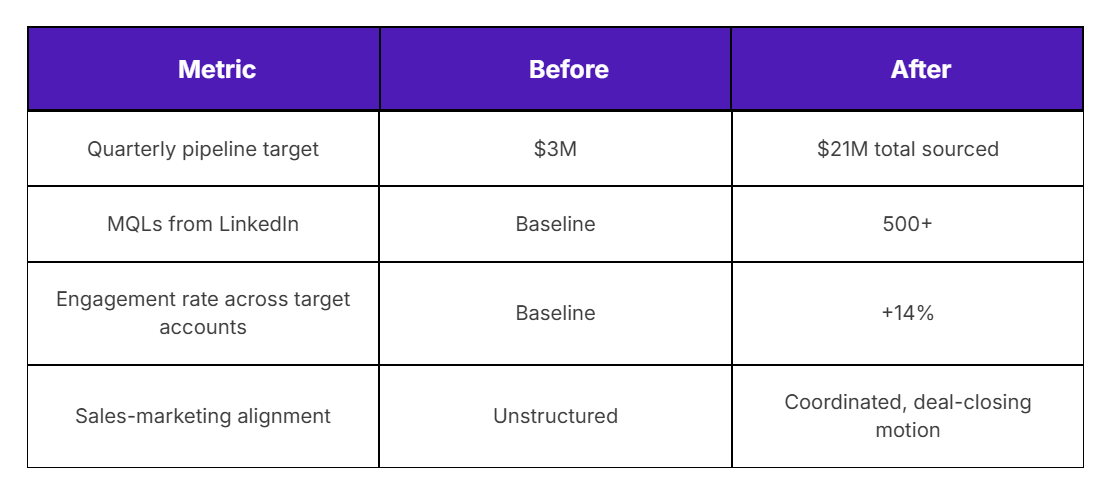
Vymo saw this benefit at scale. By focusing on 50 enterprise accounts and 250 decision-makers, the campaign generated $21 million in marketing-sourced pipeline and 500+ MQLs from LinkedIn campaigns.
Here’s how we executed the targeting:
- Combined account research with CRM and engagement data
- Identified the key decision-makers within priority accounts
- Matched pain points, proof points, and messaging to each buying role
- Coordinated LinkedIn, email, content, retargeting, and sales outreach
- Kept strategy, positioning, and sensitive messaging under human review
The result was a more focused account strategy where AI supported faster targeting and execution, while human judgment shaped who to engage, what to say, and how to move those accounts toward pipeline.
2. Data analysis and predictive forecasting
AI helps you turn scattered marketing data into faster decisions. It surfaces patterns, flags stronger opportunities, and reduces the time spent piecing together reports.
We reviewed LeadSquared’s six months of historical lead data alongside campaign performance to understand which leads were more likely to convert. Those insights helped refine targeting and guide the next round of advertising and landing-page improvements.
How we do it:
- Audit data quality, tracking, conversion paths, and workflows.
- Establish baselines for visibility, conversions, and pipeline.
- Identify where engagement fails to translate into revenue.
- Prioritize opportunities by buyer intent and commercial impact.
- Compare recommendations with results and refine the model.
Our AI marketing analytics approach turns analysis into clearer prioritization. We track forecast accuracy and conversion performance to see whether those recommendations improve outcomes.
3. Marketing automation and operational efficiency
AI-assisted automation reduces manual work across the marketing workflow. It can help qualify leads, route them faster, support follow-up, and simplify reporting. Traditional automation follows fixed rules, while AI can interpret new information and recommend the next action.
How we do it:
- Audit tools, data, and workflows.
- Connect the required systems.
- Build and test triggers, routing, and sequences.
- Define ownership, KPIs, and team processes.
- Review performance and improve workflows.
For LeadSquared, we reduced the demo form to one email field and used Clearbit to add lead details automatically. We also improved routing so stronger leads reached sales faster with the context needed for follow-up.
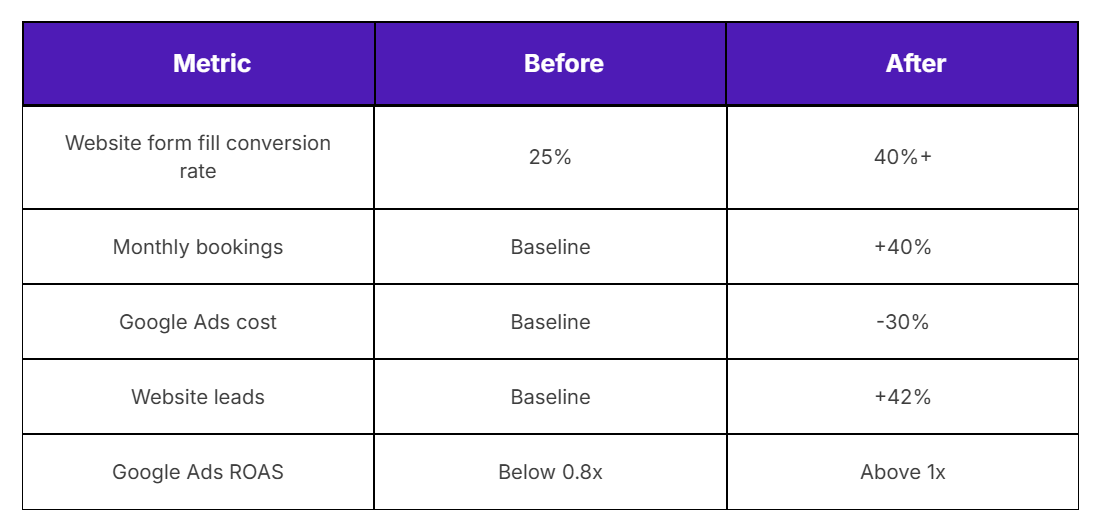
Our marketing automation approach tracks response time, workflow completion, and reduced manual effort.
4. Content creation and optimization
AI helps teams research, brief, draft, update, and repurpose content faster. More importantly, it helps decide which pages deserve investment and how each page should be structured for both search and AI answer systems.
How we do it:
- SEO: Build the technical and content foundation around crawlability, search intent, and topical authority.
- AEO: Structure pages with question-led headings, 50–80-word answer blocks, relevant schema, and citation-readiness checks.
- GEO: Strengthen entity signals, external authority, conversational-query coverage, and citation tracking.
For Atlan, we built content around clear topic clusters, direct answer sections, and structured data, then tracked AI citations each week. Organic traffic increased 93%, while Atlan earned 6,500+ citations across AI platforms.
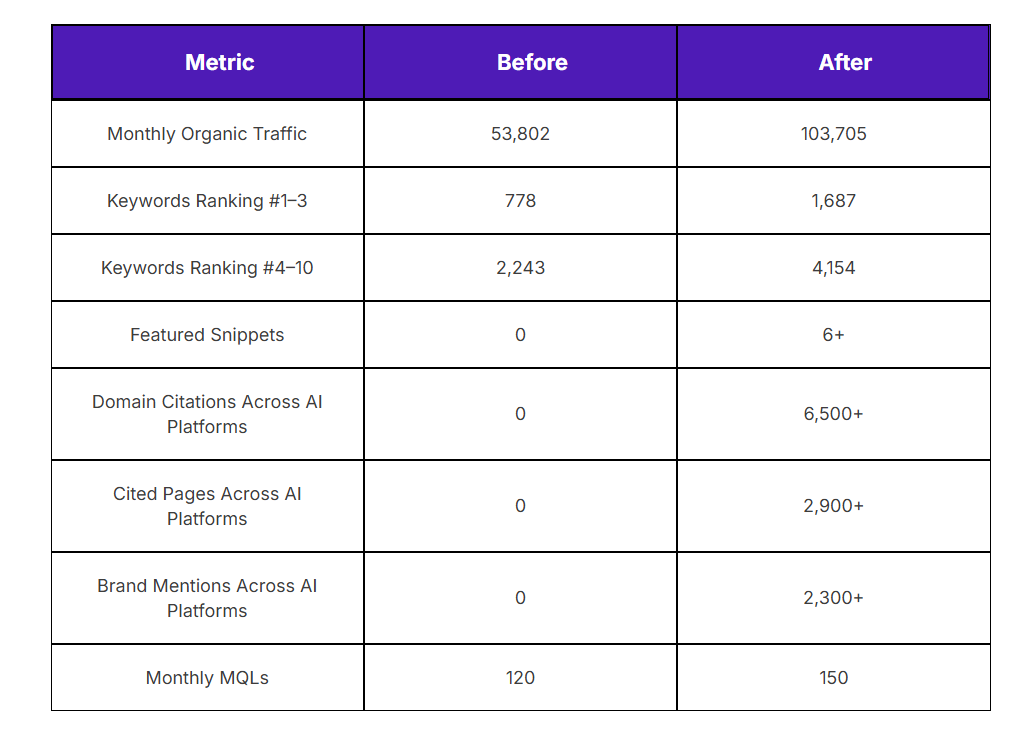
Our workflow adds a 29-point citation-readiness check and human editorial review before publishing. We track organic visibility, AI citations, referrals, and MQLs to measure performance.
5. Customer engagement and experience
AI helps tailor interactions to buyer behavior, role, account context, and buying stage. For Vymo, coordinated digital outreach and executive engagement contributed to a 14% lift in target-account engagement.
Using AI for consistent, low-risk customer support can improve responsiveness without removing human judgment. Ground responses in approved help-center content, use account signals to guide the next interaction, and route complex conversations to customer-success managers when context or escalation is required.
6. ROI, cost savings, and conversions
The benefits of AI in advertising come from reducing wasted spend and improving conversion efficiency.
We benchmark costs and conversion rates, connect advertising with CRM data, and identify where spend or conversions are leaking. We then improve targeting, landing pages, and lead handling before scaling what improves CAC, ROAS, opportunities, and pipeline.
How is AI used in marketing?
AI is used across marketing to improve how teams identify opportunities, execute campaigns, measure visibility, and move prospects toward revenue. In B2B SaaS, the strongest use cases connect AI with search, content, paid media, account targeting, automation, and attribution.
RevvGrowth connects these use cases through an integrated AI in B2B marketing approach, so AI search, content, paid media, ABM, automation, and attribution support the same revenue priorities.
What are the challenges and limitations of AI in marketing?
AI produces value when reliable data, connected workflows, clear ownership, and experienced review support its outputs. Without those foundations, automation can scale poor decisions just as quickly as good ones.
- Data quality: Incomplete or outdated data weakens targeting and forecasting. We audit CRM records, tracking, and conversion paths before using AI to guide decisions.
- Privacy and security: AI workflows can expose sensitive information when access is poorly controlled. We define approved inputs, permissions, and review steps before implementation.
- Bias and inaccurate outputs: AI can repeat bias or generate unsupported claims. We validate sources, test outputs, and review sensitive recommendations before they reach campaigns or customers.
- Integration costs and tool sprawl: Adding more tools can create disconnected workflows and inconsistent reporting. We audit the existing stack first and add new systems only where they solve a clear gap.
- Skills and adoption: AI still requires people who can interpret outputs and manage exceptions. We document workflows, assign owners, and keep senior specialists involved in critical decisions.
- Brand quality and judgment: Automated output can miss context, nuance, or positioning. We use AI for repeatable execution, while experienced marketers retain control over strategy, accuracy, and approval.
Before scaling AI, check whether each workflow has reliable inputs and a clear owner. Many disadvantages of AI in marketing appear when automation is introduced before the underlying process is stable.
How should B2B SaaS companies implement AI in marketing?
Start with one measurable business problem, then build the data, workflow, and review process around it. Expand only after the first use case shows a clear result.
In IBM’s 2025 CEO study, only 25% of AI initiatives had delivered their expected ROI, while just 16% had scaled across the enterprise. Start with a use case that has a defined owner, baseline, and commercial KPI before expanding the program.
Follow these five steps to turn a focused AI use case into a measurable marketing workflow:
- Audit where performance is breaking down: Review search visibility, AI citations, CRM quality, campaign conversion, automations, and attribution. You need a baseline before deciding where AI belongs.
- Prioritize one commercially important gap: Choose the use case with enough data to measure and enough upside to justify the work. We assess search intent, funnel friction, and workflow gaps before assigning an owner and KPI.
- Build AI-search visibility into the foundation: If buyers are using AI to research vendors, strengthen your AI SEO foundation first. Layer AEO onto pages that need stronger answer visibility, then use GEO to improve brand authority and LLM citations across generative platforms.
- Automate where manual work slows execution: Connect lead handling, routing, nurture, and reporting only after the underlying process is clear. Our marketing automation work starts with the existing workflow before adding automation.
- Measure before expanding: Track the KPI tied to the original problem, then refine or scale based on performance. Citation monitoring, attribution reporting, and recurring reviews show which workflows deserve more investment.
A focused AI marketing strategy gives you clearer ownership, cleaner measurement, and a stronger basis for deciding where AI should expand next. Timelines vary by system, with AEO often moving through implementation within 60 days while broader AI SEO and GEO programs develop over several months.
So, is AI marketing worth the investment?
The benefits of AI in marketing justify the investment when AI improves a specific part of your marketing or pipeline process. The clearest value comes from fixing measurable gaps in targeting, conversion, execution, or attribution.
Start by reviewing your current data, workflows, search visibility, and reporting. From there, identify where AI can remove friction and where experienced review still needs to stay in the loop. RevvGrowth can help you connect those gaps across AI SEO, AEO, GEO, and marketing automation, then prioritize the areas with the strongest commercial potential.
Book a strategy session with RevvGrowth to identify where AI can create measurable value first.
.svg)


.webp)
.avif)