

About Atlan
Atlan is a SaaS-based data collaboration platform designed for modern data teams, similar to how GitHub transformed engineering workflows. It centralizes data discovery, governance, lineage, and collaboration across enterprise environments.
The product was strong. Market demand was growing.
What Atlan needed was search visibility aligned with buyer intent.
The Challenge
Ranking in a Competitive, Technical Search Landscape
Atlan’s blog was active but underperforming relative to growth targets.
Baseline metrics:
- ~54,000 monthly organic sessions
- 778 keywords ranking in positions #1–3
- Limited SERP feature ownership
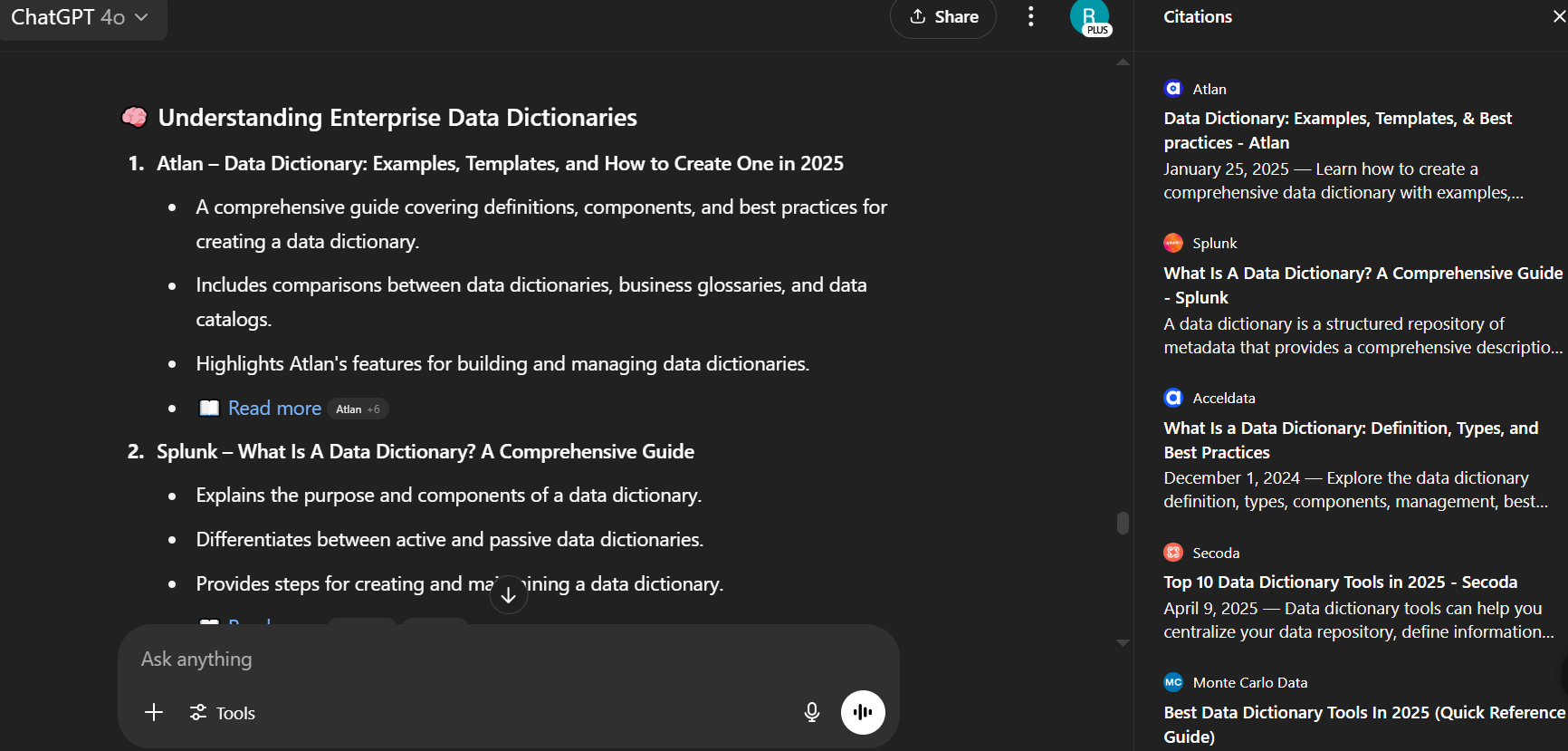
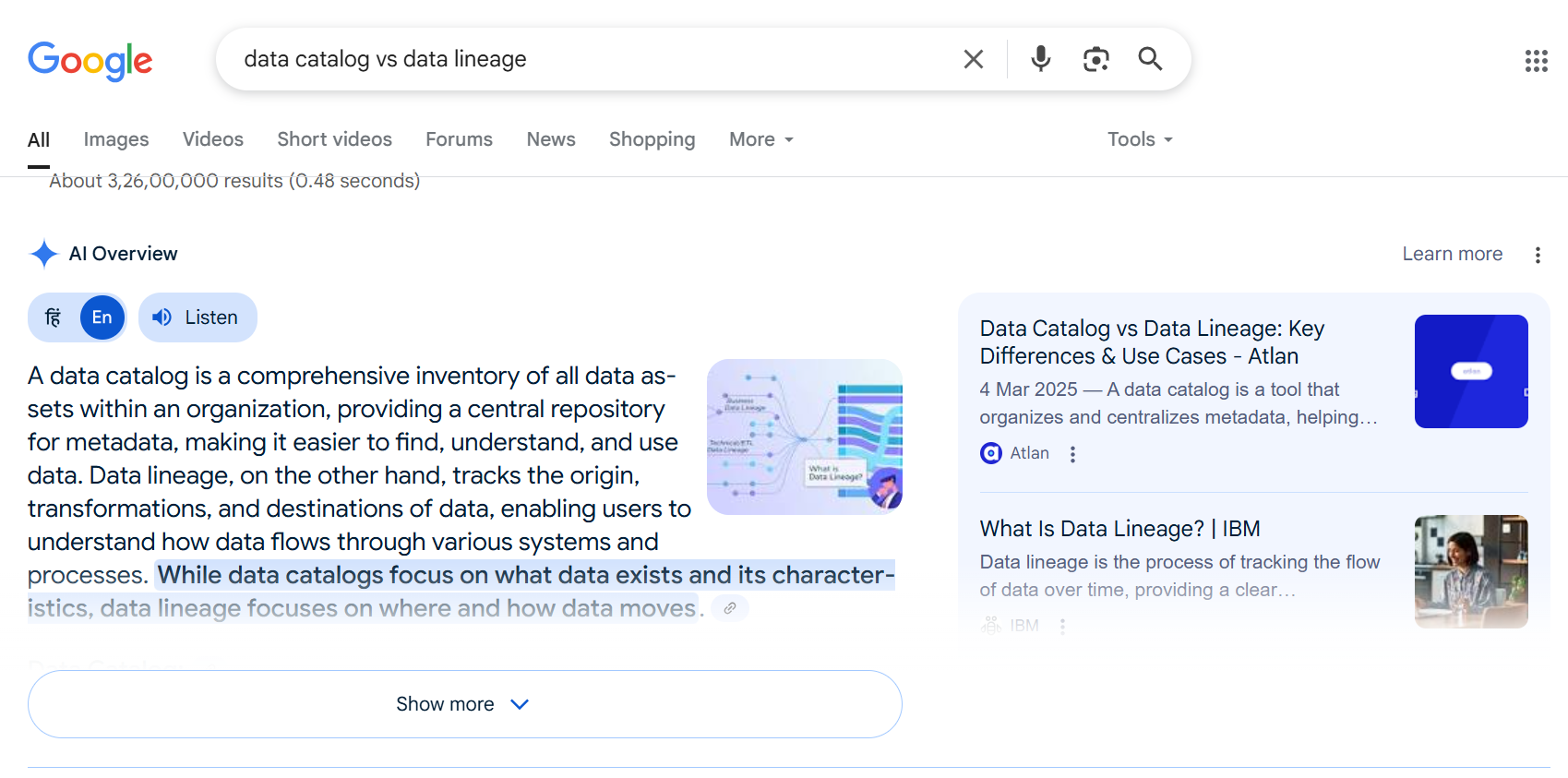
- Zero presence in AI search platforms, i.e., no citations in ChatGPT, Google AI Overviews, AI Mode, or Gemini
- 120 MQLs per month
The larger issue was topical positioning.
To compete in the DataOps and data governance ecosystem, Atlan needed to rank for high-intent, high-volume keywords across:
- Data quality
- Data lineage
- Data catalog
- Data governance
- Metadata management
However, ranking in this niche requires more than publishing blogs. Major enterprise vendors compete aggressively for these terms, making topical authority and semantic depth essential.
The objective was clear:
- Increase top-3 keyword rankings
- Capture featured snippets
- Expand keyword footprint across adjacent categories
- Build sustainable, compounding organic growth
Our Approach
Building a Scalable, AI-Assisted SEO and AEO Content Engine
We engineered a repeatable organic growth system designed for both topical authority and execution velocity and built to perform across both Google Search and AI answer platforms.
1. Pillar-Cluster Architecture for Topical Authority
We structured Atlan’s content ecosystem using a pillar-cluster model, mapping semantically related, high-intent keywords adjacent to core product categories.
For example, “cloud data migration” is not a direct Atlan feature. However, it attracts high-intent searchers within the exact ICP.
Ranking for adjacent commercial-intent and mid-funnel queries expanded Atlan’s semantic footprint, strengthened internal link equity distribution, and passed PageRank and relevance signals into core product and conversion pages.
This built domain-level authority across the broader data ecosystem.
2. Search Intent Mapping
Before producing content, we analyzed the true search intent behind every keyword:
- Informational vs commercial intent
- Comparison vs definition queries
- Buyer-stage alignment
Content structure, depth, and SERP formatting were aligned with what Google was already rewarding.
3. Structured, SERP-Aligned Outlines
We reverse-engineered top-ranking pages and identified:
- Content depth benchmarks
- Schema and formatting patterns
- Featured snippet structures
- Comparison table placement
This removed guesswork and increased ranking probability.
4. AI-Assisted Drafting at Scale
We leveraged ChatGPT, Claude, Perplexity, and Frase for first-draft acceleration, calibrated specifically for:
- Featured snippet capture
- Definition clarity
- Structured lists
- Comparison sections
- SERP-friendly formatting
This enabled production of 130+ long-form, SEO-optimized blogs per month without sacrificing structure.
5. Expert Editorial Optimization
Every piece underwent two layers of human review to ensure:
- Accuracy and domain credibility
- Strong E-E-A-T signals
- Brand alignment
- Contextual authority
- Internal linking precision
AI-enabled velocity. Human editorial ensured ranking durability.
6. Strategic Internal Linking
Each cluster page linked to its pillar page within the first paragraph, strengthening topical hierarchy and improving crawl clarity.
Example:
“Data Catalog vs Data Dictionary” linked directly to the “What is a Data Catalog” pillar, consolidating authority over time.
This reinforced semantic relationships and improved SERP positioning.
7. Technical On-Page Optimization
Every blog was optimized for:
- Meta titles and descriptions
- Keyword placement strategy
- H1–H3 structure
- Schema alignment
- Featured snippet formatting
- Transition optimization
- Crawl depth and internal link mapping
8. Automated Editorial Workflow
The pipeline from keyword brief to CMS publish was automated using Notion and CloudCannon, reducing turnaround time while maintaining content consistency.
9. Answer Engine Optimization (AEO)
Beyond Google, we engineered Atlan's content to appear in AI-generated responses across ChatGPT, Google AI Overviews, AI Mode, and Gemini. This required a seven-layer execution system: AEO discovery to identify queries where AI Overviews already existed, pillar-cluster architecture to build topical authority, and a structured brief process where every page led with a 50–80 word Short Answer Block written specifically for AI extraction.
Content was produced through a hybrid AI and human workflow, with schema markup, llm.txt deployment, and AI crawler access configured on the technical side. Off-page authority was built through contextual backlinks and niche directory placements that LLMs actively reference.
Every citation earned was tracked weekly across platforms and classified by quality level — from indirect reference to named source attribution. The result: Atlan cited across ChatGPT, Perplexity, Google AI Overviews, and DeepSeek within the first two months, with zero paid media spend.
Results
From Blog Presence to Search Dominance
After implementation, Atlan’s organic growth accelerated across every major SEO KPI.


.webp)